

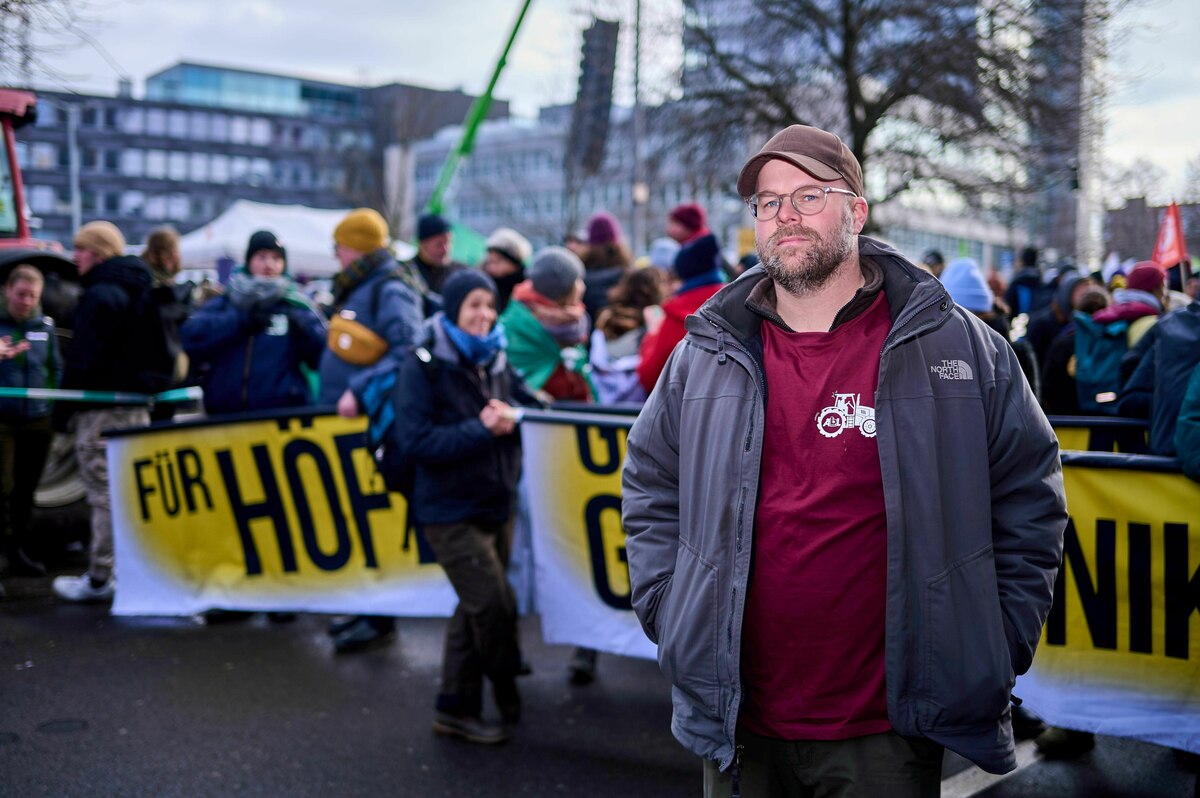
taz: Mr. Gerdes, you run an organic potato farm in Märkisch-Oderland. What do you say about Osterland Agrar GmbH’s campaign with the Berlin morning post and Ecosia, To distribute 4,000 tons of “rescued” potatoes free of charge, mainly in Berlin?
Johann Gerdes: This cannot be surpassed in terms of absurdity. A huge amount of an agricultural raw material that has sadly become worthless is being given away in huge quantities and it is pretended that this is a good campaign to save food. We believe this primarily addresses an audience that would probably otherwise buy regional or organic potatoes. A conventional potato variety, which is normally grown as a processing potato, is now being carted in from far away. And people will now hoard. In the end, there is great disappointment because people themselves become food wasters.
taz: Can you illustrate how much 4,000 tons of potatoes are?
Gerdes: This is roughly the amount that all organic farms in the surrounding area produce for the Berlin natural food market in one year. In total, a year’s worth of work product from a dozen companies is given away. In normal years, one ton of raw materials is worth around 500 euros. That means it has a market value of 2 million euros. This has the potential to influence the overall market.
taz: What do you suspect is the motivation behind the campaign?
Gerdes: At best, it is well-intentioned but poorly executed. The Brandenburg Farmers’ Association has made the assumption that an agricultural company from Saxony is flooding the market here in order to prepare its own market entry. This is just an assumption. Ultimately it is a marketing stunt for them Berlin morning post and Ecosia, and of course also for Osterland Agrar GmbH. In doing so, they are kicking us regional producers in the shin – and people believe that they are doing something good.
taz: The potatoes from Osterland Agrar GmbH have already been paid for. The buyer paid money not to have to accept these potatoes. How can this actually happen?
Gerdes: The conventional market is so full of potatoes this year that the trading partner who originally wanted to buy this quantity finds it cheaper to buy cheap potatoes again in the neighborhood and compensate these potatoes. So the company has received its money, but the goods are still there – and now it is giving them away. Actually, the potatoes are disposed of very cheaply.
taz: What would be a more sensible way to handle the goods?
Gerdes: Potatoes can go on the plate, in the trough as feed, or in the tank as fuel. Osterland Agrar GmbH is currently converting its livestock operations to organic, but the potatoes are still produced conventionally. This means they cannot feed the potatoes. If they cannot be sold as table potatoes, the most sensible solution would be to send them to the biogas plant, where they are used to produce energy. That’s sad, but the reality.
What’s it about? Every year during Green Week, an alliance of farmers as well as environmental and animal protection associations calls for protests for solidarity-based agriculture. Under the motto “Show your attitude!” This year, the promotion of small farms, transparency about farming conditions and genetic engineering, more climate standards, as well as fair prices and development cooperation are called for.
Where and when? It starts on Saturday (January 17th) at 12 p.m. at the Brandenburg Gate. Traditionally takes place the evening before a “Schnippeldisco” took place, with many workshops and inputs on the topics of agricultural transition, nutrition and agriculture. This will take place on Friday (January 16th) at the Center for Art and Urbanism (Siemensstraße 27) at 6 p.m. (tk)
taz: Why is the market so full this year?
Gerdes: In recent years we have always had a reduced harvest due to the weather, allowing supply and demand to balance at an acceptable price. That’s why many new producers came onto the market because the prices were good. This year the harvest exceeded all expectations. Now all of this product has to be taken off the market within twelve months because otherwise it will rot. The result is a scary downward price rally.
Here, a year’s worth of work from a dozen companies is given away
Farmer Johann Gerdes
taz: Can large agricultural holding companies like Osterland hold up better than small farmers in this price rally?
Gerdes: Yes. In all the crises of the past few years, large operating structures have always survived, often through investments from international consortia. Many small farms have stopped producing because they no longer saw any prospects for themselves. The tendency is: the small ones give up and the big ones get bigger.
taz: This weekend is the “We’re fed up” demo, which you also take part in every year. Will that also be an issue there?
Gerdes: Yes, sure. At the demonstration we will talk a lot about the fact that, in terms of food sovereignty and agricultural resilience, a rural agricultural structure is always better than holding companies that change hands every few years with complex investments. Because small farming structures are always at an economic disadvantage, it is important to support them. This is also a criticism: that this action was deliberately placed in the context of the “We are fed up” demo, without being coordinated with the organizers or with local agriculture – and now overshadows the critical debates that we want to have about the agricultural and food industry.