

Pushing a walker in front of her, Tatjana R. enters the meeting room of the “Refugium” shared accommodation. The 70-year-old Ukrainian, who only wants to appear in the newspaper with her first name, is accompanied by the caretaker, who stepped in at short notice to provide language mediation. She has only been living here for three days, she says, but it has already been two years since she fled to Berlin to escape the Russian war of aggression.
For two years, the old lady was housed under catastrophic conditions in the emergency shelter in Tegel, which was closed at the end of the year. Your first impression of your new home? “It’s quiet, clean and I can cook for myself,” she says, adding: “Everything you need is there.”
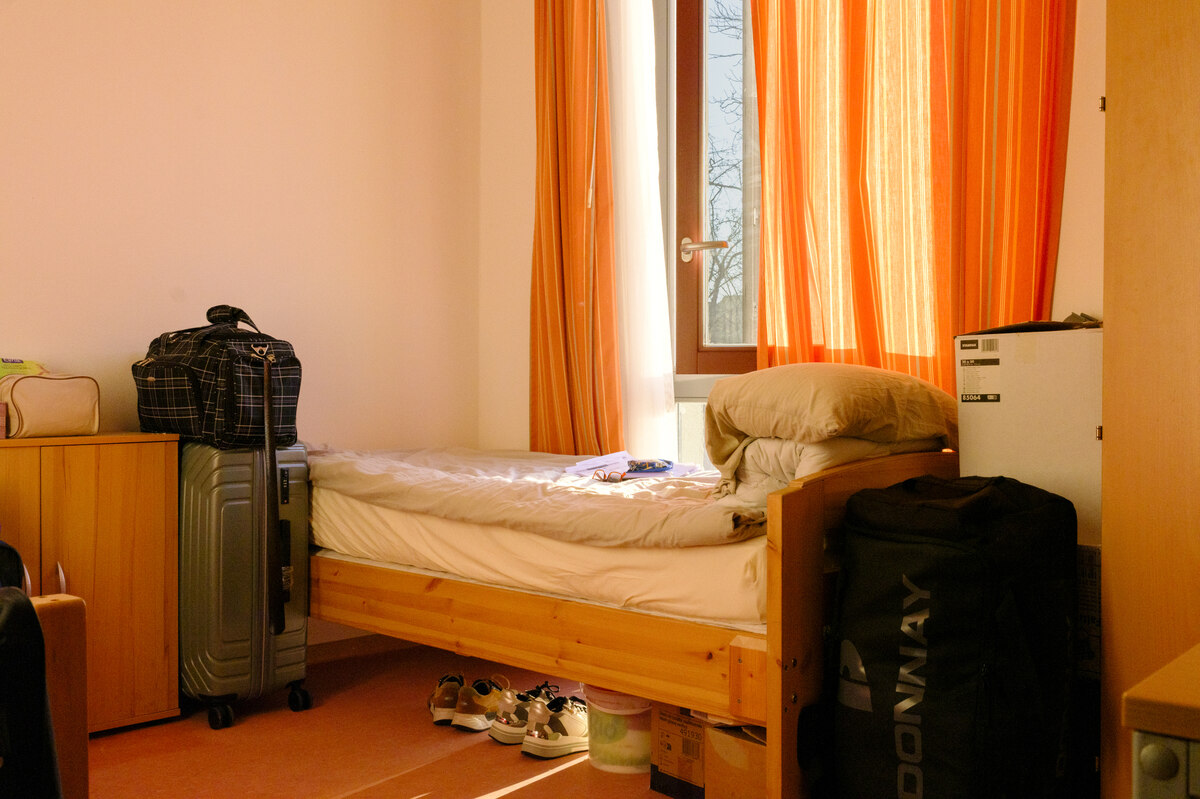
Shortly afterwards she is led into the 16 square meter room that she shares with a friend from Tegel who also fled Ukraine. At the end of the beds there are suitcases and a folded wheelchair. There is also space in the room for a wardrobe, a chest of drawers, a small refrigerator and a table on which the women have placed kitchen utensils. There is also a barrier-free, handicapped-accessible bathroom; There is an opened drying rack in the cubicle-free shower. The senior citizen giggles at the sight: “We use the space as best we can.”
The oldest resident is 89 years old
The refuge in the Berlin district of Wedding is a contract facility run by the State Office for Refugee Affairs (LAF) for refugees in particular need of protection. This group includes, among others, unaccompanied minors, people with disabilities, serious or chronic illnesses, older people, single parents, pregnant women and LGBTI people.
The facility is run by Paul Gerhardt Stift Soziales gGmbH, which also operates a senior center, a district and family center and a daycare center on the same site – and also has a nursing service. Since the refuge can also use this care service, the accommodation is particularly attractive for older, sick people and those in need of care.
The refuge has a capacity of 294 places, of which 280 are currently occupied. The residents include 71 people aged 65 or older, a large proportion of whom are in need of care or have a disability; the oldest resident is 89 years old. About “a third of the residents come from Ukraine,” says Stefanie Tepie Tame, one of the two facility managers. “As Tegel was closed, it was mainly older people from Ukraine who came to us.”

The sponsor is the Paul Gerhardt Stift, which also runs a senior citizen, district and family center and a daycare center there
Photo:
Maria Sturm
Tatjana R. is one of around 4,800 Ukrainian people seeking protection in Berlin who are older than 60 and are entitled to social assistance due to their age, disability or illness. This means: In addition to assistance with living expenses and basic security, they are also entitled to health and care services.
A scarce and contested commodity
While refugees from non-European countries in the age group 60 plus who receive benefits under the Asylum Seekers’ Benefits Act only make up around 3.4 percent of the total number in Berlin, senior citizens from Ukraine represent a significantly larger group. This emerges from a request from Berlin Green Party politician Catrin Elections from August last year to the Senate Department for Social Affairs, which addressed the specific accommodation and care situation of older refugees in Berlin.
In an aging society, care is a commodity that is as in demand as it is scarce and contested and affects people with and without a history of flight or migration equally. They all depend on an adequate and functioning care infrastructure with trained specialist staff. Anyone who needs care also has to fight through a thicket of bureaucracy. A lack of knowledge, language barriers and discrimination represent additional barriers to access to professional care, which primarily affect refugees and people with a migration background.
“Older people with a migration history are the fastest growing population group in Berlin,” says the Senate Department for Science, Health and Care. A specialist office for migration, care and aging (FaMiPA) is currently being set up.
Lack of knowledge, language barriers and discrimination represent additional barriers to access to professional care
The refuge team also experiences that care is a major challenge. It consists of specialists from social, child and youth work, administration and building services and a psychologist. “The increasing need for care comes in addition to social counseling and represents an enormous amount of work,” says Tepie Tame.
The concept of the refuge is based on two pillars: on the one hand, the greatest possible independence and self-determination of the residents, and on the other hand, a fixed offer of advice and support. Like Tatjana R. and her friend, the residents live in separate residential units with their own bathroom. You shop independently and take care of yourself in the communal kitchens.

Enable a normal everyday life
“Some of those who come here from Tegel cry when they see our rooms,” says Tepie Tame. The self-determination and privacy they experience in the refuge are in stark contrast to the previous mass accommodation. Enabling residents to have as normal a daily life as possible is what it’s all about. Due to age or a disability, some people have an increased need for support. But one thing is also certain: “We don’t have the care structures of a nursing home,” explains facility manager Judith Drews. At a certain point, a move to a nursing home must be considered, for example for people with severe dementia.
In social counseling, residents receive support in applying for benefits, in communicating with offices and authorities, and in finding specialized assistance facilities. There is also psychological counseling and educational offerings for children and young people. Each resident is also assigned a caregiver.
At the same time, the refuge team relies on volunteer support, for example for language training or accompaniment to doctor’s and authority appointments. “If no volunteers can be found, we often simply give the residents a cover letter,” says Drews.
When it comes to care, the refuge relies on cooperation, including with the district care bases and the “intercultural bridge builders in care”. This initiative, funded by the state, offers native-language and culturally sensitive advice and support for older people and those in need of care with a migration history and supports, among other things, care assessments.
“It’s not enough yet”
“Something is happening,” says Clémentine Cordier from the Berlin Center for Self-Determined Living for Disabled People, a specialist agency that supports, among other things, particularly vulnerable refugees. Care for older and disabled refugees and migrants is now receiving more political attention. Cordier sees initiatives such as the Intercultural Bridge Builders as a step in the right direction. But for her it is also clear: “It’s not enough yet.”
Loneliness among residents without family is also an issue in the refuge
In addition, the “Lotsen Berlin” project, which helped older refugees to leave communal accommodation by providing advice and arranging supported housing offers for people with disabilities, will be discontinued, criticizes Cordier.
There is also a lack of communal accommodation with a residential group structure in which single older refugees can also find social connections and be cared for by a nursing service. The fact that care is often provided within the family applies to refugees with family connections, but “for older refugees who live alone, this support no longer applies,” says Cordier.
Loneliness among residents without family is also an issue in the refuge. It is therefore important to “create connections,” says Tepie Tame, for example through common rooms or activities such as a residents’ breakfast or a Christmas party. Tatjana R. also lives in Berlin without any family connections. Her son and daughter-in-law have now returned to Ukraine.