

As a reader-funded independent news outlet, we operate free from the influence of governments, advertisers, and corporate backers. This is essential to our mission: to report on what matters most, beholden only to the truth. In that spirit, we made a commitment to ensure that our journalism is free for everyone, not locked behind a paywall. But that means we rely on the voluntary support of our community of readers. Please consider making a tax-deductible donation to support our work today.
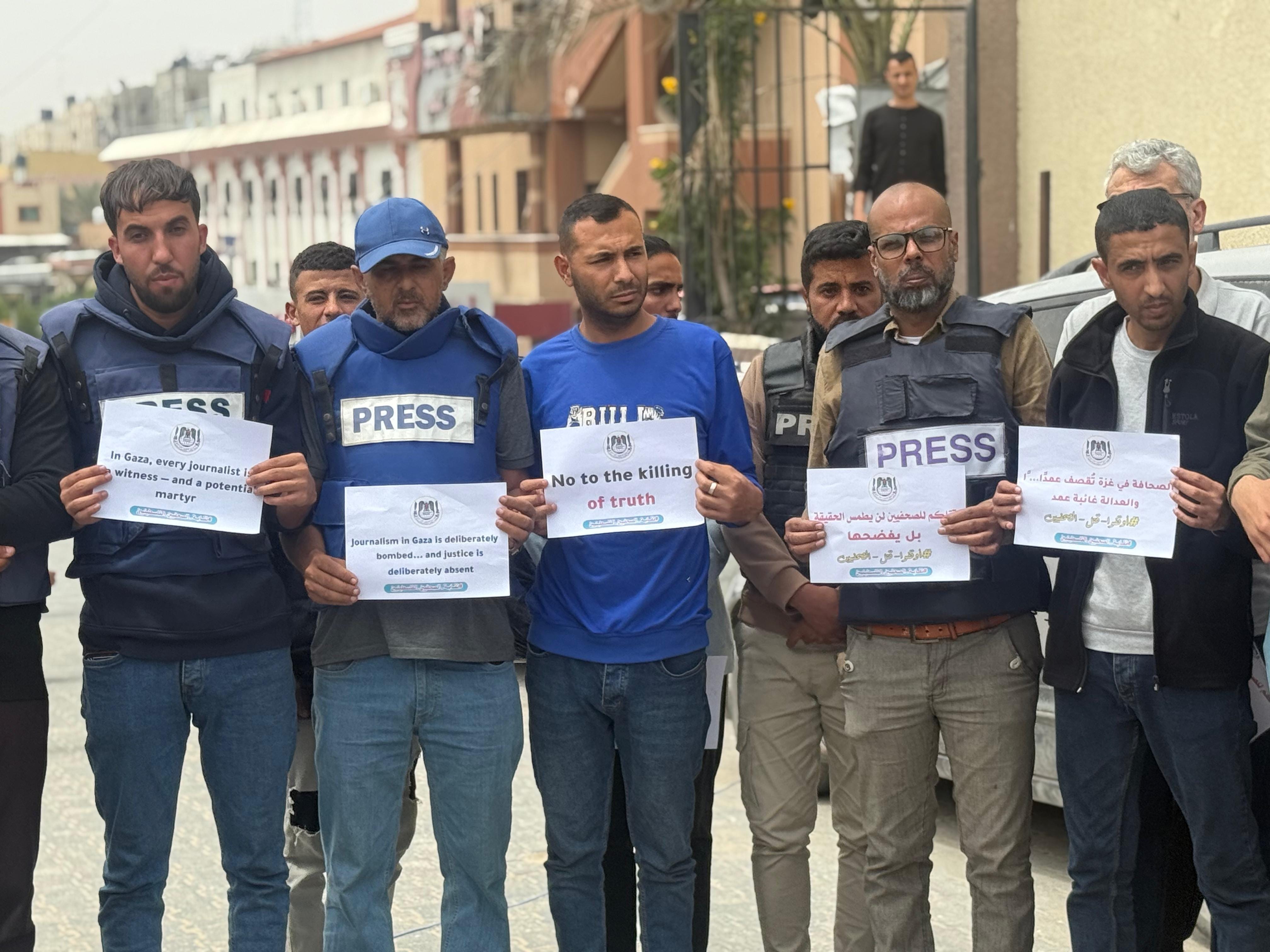
Honest Reporting, a self-described media watchdog and nonprofit with offices in New York, Jerusalem, and Toronto, claims that its mission is exposing “media bias, challenging false narratives, and ensuring that reporting on Israel is rooted in facts, context, and accountability.” In practice, it operates as a pressure group, monitoring international media coverage of Israel, producing reports attacking coverage it deems unfavorable, running access operations that embed international journalists within curated pro-Israel perspectives, and organizing mass campaigns directing its subscribers to contact newsrooms directly until corrections, retractions, and rewordings are secured.
That work has led to the dismissal of journalists at publications around the world. But since October 7, 2023, Honest Reporting’s operations have moved into considerably darker territory, and its activities have contributed to the assassination of at least one journalist, Hassan Eslaiah—a freelance photographer and director of the Gaza-based Alam24 news agency whose images had appeared in the Associated Press and CNN.
The campaign against Eslaiah was not isolated. Honest Reporting has systematically targeted journalists and news organizations—including Drop Site News—across multiple platforms and countries, employing consistent tactics: publishing posts raising questions about individual journalists’ alleged connections to Hamas or other armed groups, characterizing their coverage as propaganda or as “antisemitic,” and mobilizing its subscriber network to contact news organizations directly. The cumulative effect of this approach has been to characterize numerous Palestinian journalists as combatants.
Despite its record as a pressure group that targets and endangers reporters, in 2023 Honest Reporting’s Israeli organization—registered under the name Divuach Ne’eman R’’A—received an “emergency” grant of $100,000 from the Knight Foundation, a widely respected U.S.-based foundation that prominently touts a commitment to freedom of press and the safety of journalists. The grant, listed in Honest Reporting’s Israeli nonprofit filings for 2024, is not reported in the Knight Foundation’s 990 for 2024 or on its website.
The Knight Foundation says that it primarily funds U.S.-based organizations and that international programs and organizations are among the categories it generally prefers not to fund, making grants outside the United States limited and exceptional by the foundation’s own description. Knight’s website states that “most of our grantmaking is tied to strategies with defined goals and outcomes” and that funding “typically emerges through relationships, research and ongoing work,” with most grants initiated by Knight itself rather than through open applications.
When approached for comment, Atena Sherry, Knight Foundation’s director of communications, initially denied that Knight had provided funding to Honest Reporting: “Knight Foundation did not provide any grant to Honest Reporting, and the foundation has not directed any Knight funds to Honest Reporting” through any third party, Sherry told Drop Site. In a follow-up statement, Sherry said, “We reviewed all documentation. Knight Foundation has never provided any funding to Honest Reporting.”
According to Honest Reporting, however, “the grantor, Jewish Federations of North America and United Israel Appeal, notified Divuach Ne’eman R”A and HonestReporting.com, Inc. that a donation of $100,000 was made ‘on the recommendation of the donor, The Knight Foundation.’ Honest Reporting added that “Staff for Divuach Ne’eman R”A and Honest Reporting.com, Inc. were in direct touch with staff at the Knight Foundation throughout the process on the grant and the programs that would benefit from the grant.”
When Drop Site then asked the Knight Foundation about Honest Reporting’s statement, which directly contradicted its own, the Knight Foundation acknowledged that it had provided funds for Media Central, an Honest Reporting program that arranges tours for international journalists. “Knight Foundation did make a one-time, emergency grant of $100,000 in November 2023 to Media Central to support a very specific project: helping international journalists to gain access they wouldn’t otherwise have had to report on the facts from the ground in the West Bank,” said Alejandro de Onis, vice president for communications, in a statement. “Neither the grant agreement nor the grant file contains any reference to Honest Reporting.”
Unlike Gaza, the West Bank has remained accessible to international journalists, raising the question of what access Media Central was providing that journalists could not obtain independently, and whether the access in question was in fact embedded reporting alongside the Israeli military.
Knight declined to answer additional questions about the specific reporting funded by its grant or how it could have been unaware that Media Central was a program operated by Honest Reporting.
Through its Media Central project, Honest Reporting arranges press tours, briefings, and curated access to Israel for international correspondents, presenting itself as a neutral resource while functioning as an operation designed to shape how journalists understand and cover the country. Honest Reporting’s director of press relations, Laura Cornfield, runs the program.
In Honest Reporting’s 2023 first quarter impact report, Cornfield wrote that: “Journalists met with locals to hear how the Lions’ Den terrorist group was using Nablus as its command center. They were then briefed by the IDF to understand the security risks to Israeli civilians,” boasting that “MediaCentral staff enabled exclusive access to these unheard, nearly impossible-to-reach voices. The tour was so sought after it was repeated with three groups, and an additional three one-on-one tours were arranged.”
In that year’s second quarter impact report, Cornfield wrote that the group’s Media Central program “took foreign media outlets on exclusive tours to hotbeds of terror activity, including Nablus and Jenin, to get an up-close look at what Israeli security forces are facing and how they are addressing the threats.” The reports say that journalists from prominent international outlets including the New York Times, the Wall Street Journal, the Economist, the Financial Times, and CNN have participated in its events.
The impact report described a media tour of the Israel-Lebanon border, quoting the Israeli military’s Lt. Gen. Herzi Halevi and Military Intelligence Directorate chief Aharon Haliva on Hezbollah. It also included a section on “crime in the Arab sector” and said that journalists had gone on “a field tour to Umm Al Fahm and Jaffa of Nazareth to address the surging crime rate,” referring to largely Palestinian towns and cities within Israel.
More recently, Media Central press tours have taken international journalists to the Al Aqsa compound and Western Wall Tunnels in occupied East Jerusalem and to northern Israel. Media Central has also hosted exclusive briefings for international journalists with senior Israeli political figures, including a recent lunch in Tel Aviv with former Israeli Ambassador to the United States Michael Oren and an “exclusive dinner” with Brigadier General (Res.) Pinchas (Pini) Yungman. Yungman has held senior command roles in the Israeli Air Force and executive positions at the Israeli defense company Rafael.
None of the briefings or meetings organized by Media Central appear to have been led by Palestinians.
“We don’t claim to be a news organization.”
On November 8, 2023, one month into the genocide in Gaza and the same month as the Knight Foundation grant, Honest Reporting published what it classified as an exposé on its website. The article featured photographs of several Palestinian freelance journalists who had been covering the events near the Gaza border on the morning of October 7, among them Hassan Eslaiah. It asked, in language the organization has since described as just “raising questions,” whether these journalists could have had advance knowledge of the Hamas attack. The article was then updated to feature a photograph from 2020 of Eslaiah next to Hamas leader Yayha Sinwar—clearly suggesting guilt by association through proximity in a photograph.
Within hours, Israel’s official X account had amplified the post to its own audience of 1.8 million. The Associated Press reviewed its relationship with Eslaiah and later severed it, while stating publicly it had found no evidence he had foreknowledge of the attack beyond what was known to journalists routinely working in the border area. When the AP asked Gil Hoffman, then Honest Reporting’s executive director, to substantiate the allegations, his response was notable. “They acted as if we were stating facts instead of asking questions,” Hoffman said. “We don’t claim to be a news organization.”
Jonthan Dagher, head of the Middle East desk of Reporters Without Borders (RSF), described the November 2023 Honest Reporting article as being “full of conjecture” and “based on circumstantial evidence,” noting that it “provoked a chain of reactions from Israeli authorities and politicians who started accusing Gazan journalists of belonging to Hamas.”
RSF named Honest Reporting in its 2025 list of Press Freedom Predators that it says “smear media and promote mistrust of journalists.”
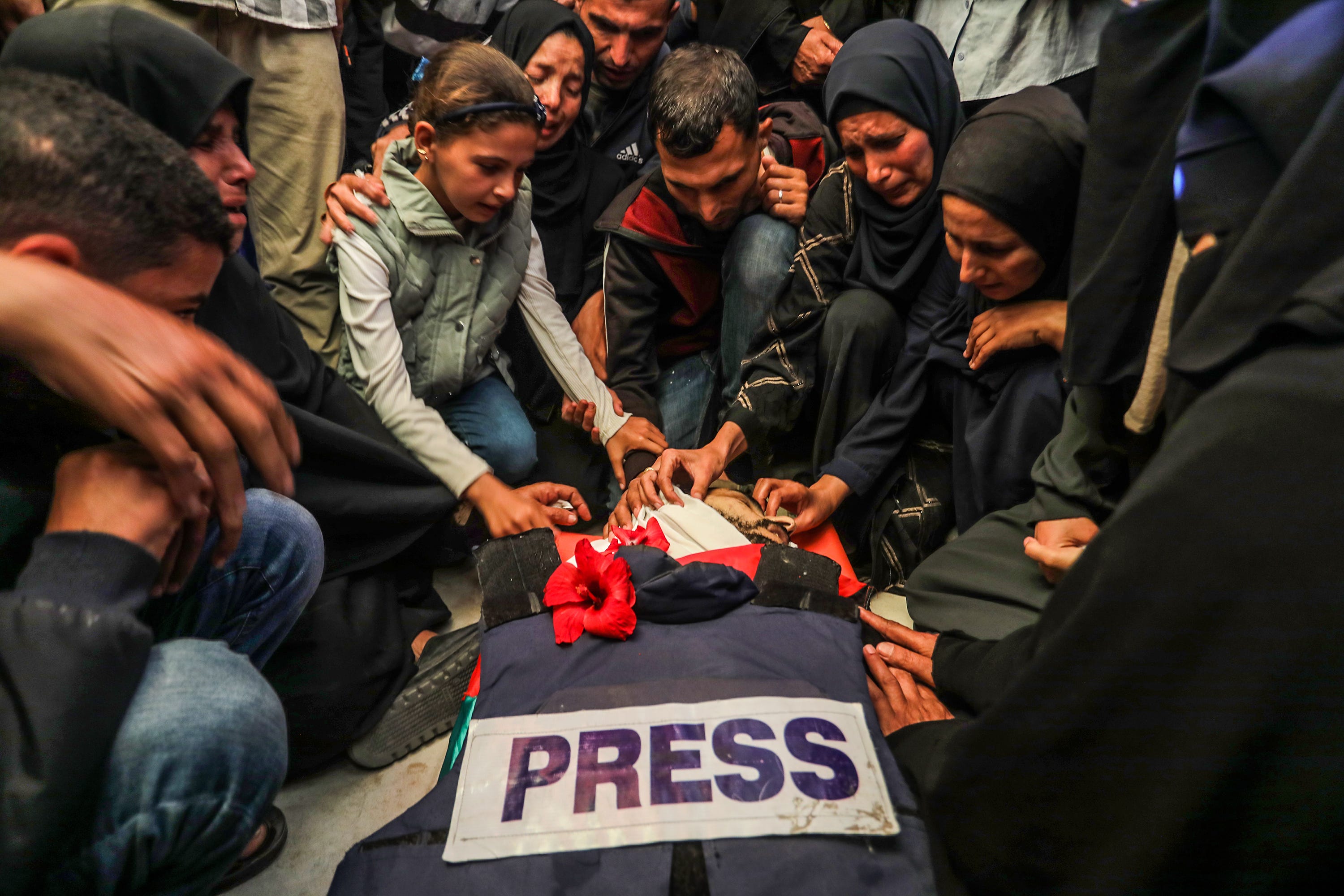
Eighteen months later, in April 2025, an Israeli airstrike struck a media tent outside Nasser Hospital in Khan Younis, killing two journalists and wounding eight others, Eslaiah was among them. The Israeli military publicly announced it had deliberately targeted Eslaiah, claiming he was a member of the Khan Younis Brigade and had participated in the attacks of October 7th. Eslaiah survived the strike but his skull was fractured, his body was burned, and he lost two of his fingers. He was admitted to Nasser Hospital’s burns unit to recover. On May 13, 2025, while he lay in the burn unit, an Israeli drone bombed the hospital and murdered him. Hours later, the Israeli military admitted to assassinating Eslaiah, calling him “Aslih” and posting a screenshot of Eslaiah on Oct. 7, 2023 from a video also posted by Honest Reporting in its “exposé” and saying: “Don’t let Aslih’s press vest fool you…Journalist? More like terrorist.”
Targeting Palestinian Journalists
Since the start of the genocide in Gaza, one of Honest Reporting’s central goals has been to challenge the records kept by press freedom organizations documenting Palestinian journalists killed in Gaza. The organization has led a sustained pressure campaign against the Committee to Protect Journalists (CPJ), which maintains the most widely cited casualty list of media workers killed in Gaza. It has also sought to attack and pressure other press freedom bodies such as Reporters Without Borders and the International Federation of Journalists.
On June 25, CPJ announced that it would be “conducting a full review of its database of journalists killed during the Israel-Gaza War.” Honest Reporting was quick to claim victory, stating that the review had happened because Honest Reporting had “helped put them in an untenable position.”
In a statement, CPJ denied that Honest Reporting’s pressure campaign was responsible for its database review.
“The Committee to Protect Journalists (CPJ) is an independent organization. We independently research, source and report information related to attacks on journalists and media workers. When new information becomes available, we update our reporting. Our review of the Israel-Gaza war casualties list was spurred by new information published by Hamas and Palestinian Islamic Jihad that identified as combatants individuals previously listed by CPJ as journalists. Honest Reporting’s campaign had absolutely no bearing on the review process or on the decision to remove names from the list.”
CPJ, which receives major funding from the Knight Foundation, did not respond to questions about the foundation’s grant to Honest Reporting.
“We condemn any misrepresentation of that process to serve political agendas or to try to obscure the fact Israel has killed more journalists than any other country in the world and been the leading killer of journalists for the past three years,” CPJ said in its statement.
In response to questions about the direct conflict of interest entailed by funding both a press freedom organization that maintains a database of journalists killed by Israel and a pressure group that targets Palestinian journalists, the Knight Foundation said, “The funding directed to Media Central was specifically and only earmarked to facilitate journalists’ access to report on the war in hard to reach areas and there is no ongoing relationship. Nothing in Knight Foundation’s grant records reflects any reference to a campaign concerning CPJ, and Knight Foundation has never funded advocacy directed at CPJ.”
On the same day that CPJ announced its Gaza database review, Jacob Weisberg, chair of CPJ’s board of directors, emailed fellow board members to say that he was establishing a “special task force to reexamine the question of ‘Who is a journalist?’”
According to reporting in the Columbia Journal Review, Weisberg’s initiative was separate from the database review and grew out of a board discussion of an article in the right-wing Washington Free Beacon that largely repackaged Honest Reporting’s attacks on CPJ and news organizations that report critically on Israel, including Drop Site.
Nika Soon-Shiong, publisher of Drop Site News and a member of the CPJ board, was alarmed by Weisberg’s email and requested a vote on the proposal by the full board, according to a letter she posted publicly. She was then informed by Weisberg that her term on the board had expired. On July 1, the board held an emergency meeting and voted to affirm its “existing definition of who is a journalist.”
Broader Influence Network
Honest Reporting’s sustained attempts to establish connections between journalists and armed groups, such as Hamas, is particularly striking given the organization’s direct ties to AIPAC, the Israeli government, and the Israeli military, which continues to carry out a genocide in the Gaza Strip.
Prior to co-founding Honest Reporting, Lenny Ben-David spent 25 years at AIPAC, including 15 years directing its Jerusalem office, before serving three years as deputy chief of mission at the Israeli embassy in Washington. He has recounted with evident pride how an early Honest Reporting campaign crashed CNN’s internet servers. The organization he helped build is now led by Jacki Alexander, who spent approximately 15 years at AIPAC before being hired with a mandate to expand Honest Reporting’s reach in the United States.
National Development Director Rebecca Shimonovitc spent more than eight years as an AIPAC regional director before moving into Honest Reporting’s fundraising operation. Justin Pozmanter worked in AIPAC’s political department for over ten years before relocating to Israel, where he served as a senior foreign policy advisor to Israeli government minister Tzachi Hanegbi, and then joined Honest Reporting. David Barish, treasurer of Honest Reporting’s U.S. organization, has held positions on the boards of AIPAC’s Houston Council, Friends of the IDF, the Jewish Federation, Anti-Defamation League, and the United Israel Appeal. He is also listed as a director of the Foundation for the Defense of Democracies, a pro-Israel think tank. Laura Cornfield, the group’s director of press relations, also runs the Media Central program. She attends high-level events within Israeli political circles posing and smiling with U.S ambassador to Israel Mike Huckabee and Sara Netanyahu.
The connections to the Israeli military are equally direct. Multiple staff members served in the Israeli military, a fact Honest Reporting says “should not be a surprise” given Israel’s mandatory service requirement. Gil Hoffman, former executive director and current board member, for example, served in an Israeli army artillery unit and later as an Israeli military reserve spokesperson following his emigration to Israel, before his journalism career at the Jerusalem Post. Editorial Director Simon Plosker has also served in the Israeli military’s press office. Rachel Safdie, who now appears as a reporter in Honest Reporting’s social media output, spent more than two years in the Israeli military press office, where she served as head of its Iranian-language social media desk.
In a statement, Honest Reporting denied that it has a formal relationship with the Israeli military. “There is no formal affiliation or partnership between the IDF and Divuach Ne’eman R”A or HonestReporting.com, Inc.”
Honest Reporting was launched in 2000 in association with the Jerusalem Fund of Aish HaTorah, an Orthodox Jewish outreach movement whose stated mission is encouraging secular Jews to embrace religious observance, but which also operates one of the most extensive pro-Israel advocacy networks in the world. The organization’s first executive director was Irwin Katsof, who simultaneously served as president of the Jerusalem Fund. In 2001, the Jerusalem Fund lent the newly established Middle East Media Watch (Honest Reporting’s registered name at the time) $158,724. The following year, Aish HaTorah’s Jerusalem operation provided a further $48,100 grant.
Honest Reporting’s 2006 tax return lists Ephraim Shore, who heads Aish’s operations in Israel, as president. Shore is also one of the founders of the Hasbara Fellowships program—the Israeli Foreign Ministry’s campus advocacy initiative that Aish HaTorah was asked to develop and run. His twin brother, Raphael Shore, produced “Obsession: Radical Islam’s War Against the West,” a controversial 2005 film that Honest Reporting initially promoted as its own project on its website and listed as an affiliate in 2006, before later denying any involvement in its production.
When the Israeli Foreign Ministry sought to counter what it characterized as anti-Israel sentiment on university campuses internationally, it turned to Aish HaTorah to design and run the program, which flies hundreds of student leaders to Israel for intensive advocacy training. Multiple current Honest Reporting staff members worked as Hasbara Fellowship lecturers.
The financial relationship between Aish HaTorah and Honest Reporting has not been confined to the founding period. Canadian tax filings show that Honest Reporting Canada made a donation of $15,000 to Aish HaTorah as recently as 2023, demonstrating that the institutional relationship between the two organizations remains active more than two decades after Honest Reporting’s founding.
The network around Honest Reporting extends to some of the most controversial pro-Israel blacklisting operations on the internet, including Canary Mission, the pro-Israel doxxing site that publishes dossiers on students, academics, and activists it accused of anti-Semitism or support for Palestinian rights. At least one former employee of Honest Reporting, Zahava Raymond has worked at Megamot Shalom, the Israeli nonprofit organization funding Canary Mission.
A Widening Operation
According to Honest Reporting’s filings with Israel’s Corporations Authority, 96.6% of the total 2024 budget of 6,040,198 NIS [$1,632,044] comes from foreign donations. In addition to the $100,000 grant from the Knight Foundation, 4,903,640 NIS [$1,324,950] came directly from Honest Reporting’s U.S. organization. The Israeli operation is almost entirely dependent on American dollars.
Honest Reporting’s recent communications demonstrate the group’s growing ambitions. An update to supporters describes the launch of “Honest Reporting AI Labs,” a proprietary system trained to identify “anti-Israel bias” and intercept narratives “before they reach mainstream credibility.” The system monitors social media in real time, traces what the organization characterizes as “coordinated narrative pipelines,” and feeds findings to what it calls “strategic communications partners,” among them the Foundation for Defense of Democracies.
In May, for example, Rachel O’Donoghue, an employee of Honest Reporting, was invited to publish a column in the Wall Street Journal challenging Nicolas Kristoff’s article in the New York Times about Israel’s use of sexual violence against Palestinian detainees. The organization’s research has also been cited in articles published by the Washington Free Beacon and National Review.
The reach of Honest Reporting and its affiliates extends into the legislative institutions of its English-speaking donor base. In 2018, Honest Reporting submitted evidence to the UK Parliament’s inquiry into fake news, falsely claiming that “Honest Reporting is not aligned with any government or political party or movement.“ The submission was initially absent from the inquiry’s published record and was only made available following the intervention of UK Lawyers for Israel.
The Canadian operation has demonstrated similar objectives. In July 2023, Honest Reporting Canada’s executive director Mike Fegelman said it wanted to “create a digital army for Israel.” A written briefing to the House of Commons’ Standing Committee on Canadian Heritage referred to Palestinian journalists killed by Israel as “so-called journalists” with “connections to Palestinian terrorist groups” and claimed media coverage of Gaza “directly contributes to a spike in anti-Jewish hate crimes.”
Another significant donor identified in Honest Reporting’s 2024 Israeli filings is a vaguely named organization called Canadian Charity Partners, which contributed 507,176 NIS [$137,000]. In January 2026, the Canada Revenue Agency revoked Canadian Charity Partners’ charitable status, citing multiple areas of non-compliance including conducting non-charitable activities and failing to maintain adequate books and records.
Honest Reporting Canada has run its own pressure campaigns against journalists and outlets it deems biased against Israel, claiming to have contributed to the dismissal of two Palestinian journalists in October 2023, one of whom was on maternity leave at the time. In November 2024, Robert Walker, the group’s assistant director, was arrested and faced 17 criminal charges in connection with a string of anti-Palestinian graffiti in Toronto, including the phrase “Fuck Gaza.” The charges were withdrawn in March 2025 after a payment to charity. Walker remains employed by the organization.