

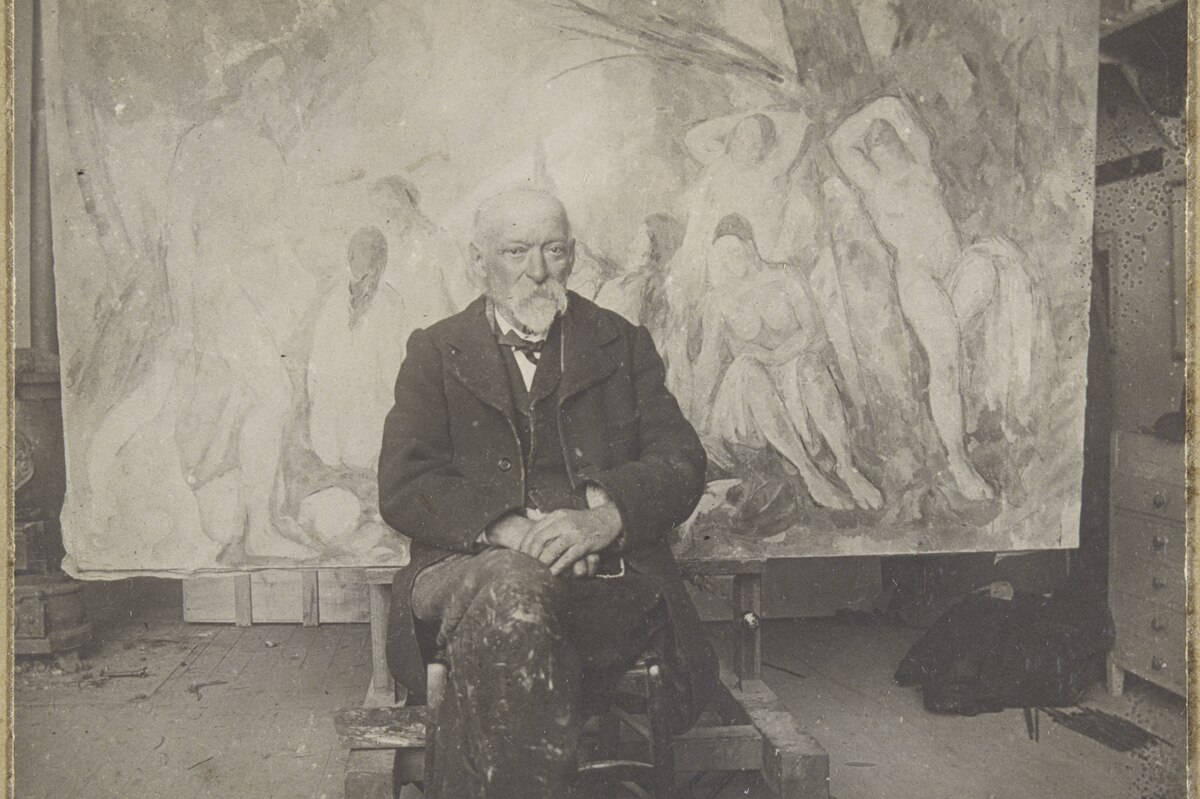
There are good reasons to focus on sensory perception in exhibitions. Especially when it comes to painting, which is communicated through the colors, the application of paint and the composition. Paul Cezanne painted unusual pictures for his time and had to accept for a long time that he was not understood. Whether things are different today cannot be answered so easily.
The 80 portraits, landscapes and still lifes currently in the Beyeler Foundation exhibited undoubtedly radiate intensity and energy. But what is the basis of their world fame, and is it enough to quote Picasso that Cezanne was the father of modernism?
The conditions for such an exhibition are ideal in the museum built by Renzo Piano in Riehen in the canton of Basel. Bright rooms, some with daylight, modern ambience, embedded in a park. Information about individual pictures can be found in the handy visitor booklet; everything is done to ensure that the painting has an optimal appearance.
Unencumbered by too much input, the eye wanders over landscapes made of patches of color, over the rocks of L’Estaque near Marseille or the Montagne Sainte-Victoire near Aix-en-Provence with the sandstone quarry Bibémus. Places that regularly served as motifs for Cezanne. The eye registers a wealth of finely orchestrated color gradations that tell not only about the light, but also about the smell and the temperature of a particular day.
In contrast to his friends, the impressionistsCezanne’s pictures radiate a deep calm, which is due to the static nature of his motifs and the formal balance of the picture elements.
Salon painting disgusted him
Body and environment blur into one another in Paul Cezanne’s “Baigneuses”, around 1895, oil on canvas
Photo:
Anders Sune Berg, Ordrupgaard, Copenhagen
It was not for nothing that Cezanne copied the Old Masters in the Louvre for years. However, the smooth lifelessness of salon painting of his time, the second half of the 19th century, disgusted him. He had been training his own grip since the late 1870s to painting, which can be seen in the motif of the “Bathers”.
The pictures show people by the river, naked, uninhibited, relaxed. Cezanne varies the poses, the image details, the format, the way the paint is applied – until the contours of the bodies merge with the trunks and branches of the bank. Roughly summarized: He returned people to their original state and thus also painting, freeing them from the need for central perspective and anatomically correct representation.
One of his most famous motifs is the Montagne Sainte-Victoire, the local mountain of Aix-en-Provence, where the painter was born and where he lived intermittently. The mountain served as his motif more than thirty times. These also include “unfinished” landscape paintings and watercolors in which he integrated the white of the image support.
Programmatic for his genre-subverting painting: Paul Cezanne, Self-Portrait with Palette, around 1890
Photo:
Emil Bührle Collection/Kunsthaus Zurich
The principle of non-finito, the unfinished, is a kind of revenant in art history. The work as a fragment, such as Michelangelo’s “Slaves,” symbolized the possibility of becoming. Cezanne, on the other hand, created an immediate impact: “I don’t think the term ‘unfinished’ is correct for these pictures,” says curator Ulf Küster. “They are open images, open to the imagination of the viewer.”
The disgruntled-looking Provençal
However, there is a lot of art history in the pictures of the Provencal, who usually looks disgruntled in his self-portraits, who, by the way, always wrote his last name without the accent aigu has. His self-portrait from 1890 must be seen as programmatic.
In it, the painter depicts his rectangular palette folded down so that it appears like a picture within a picture. You can see the much-quoted splashes of color with which he builds his pictures in a lengthy process.
In Cezanne’s still lifes, the fruit and tablecloths are piled up in mountains, and the background in the self-portraits is also ambiguous
It is no coincidence that the background of this portrait is enigmatic: turquoise-pink color fields emerge, reminiscent of a landscape in the haze of dawn. But it could also be about an interior, about plays of light on a whitewashed wall.
Once such ambiguities have been discovered, doubts arise as to whether the arrangement of the images according to genre and motif, which promises an overview, is not a hindrance to the reception of the enormous work: which was founded by the Cezanne expert John Rewald and is accessible online directory lists over 3,000 works. In 2017, the Staatliche Kunsthalle Karlsruhe presented evidence in the exhibition “Cézanne: Metamorphoses” that the painter systematically undermined the division of painting into genres.
The exhibition
CezanneFondation Beyeler, Riehen (Switzerland). Until May 25th. Catalog (Hatje Cantz): 58 euros
In his still lifes, the fruit and tablecloths are piled up in mountains. As in the aforementioned self-portrait, the background is ambiguous. In the portraits of the gardener Vallier, of which there are very beautiful versions on display in Riehen, the figure and the garden merge.
The cliché of the modern genius
The show ends with a short film about Cezanne Contemporary artist Albert Oehlen. It is peppered with passages that tend toward the spiritual and celebrate the painter’s oneness with nature and painting. The quotes go back to a book by Joachim Gasquet. Cezanne had met him personally.
There is debate about the extent to which they are authentic. To make the celebration of the cliché of the modern genius perfect, the personified color itself gets involved, embodied by the US actress Nicole Galicia. She walks through a field below the Montagne Sainte-Victoire, digs with her hands in the red ocher of a rock and wades through a stream: a male projection that, at best, triggers the desire for a cool thought.