

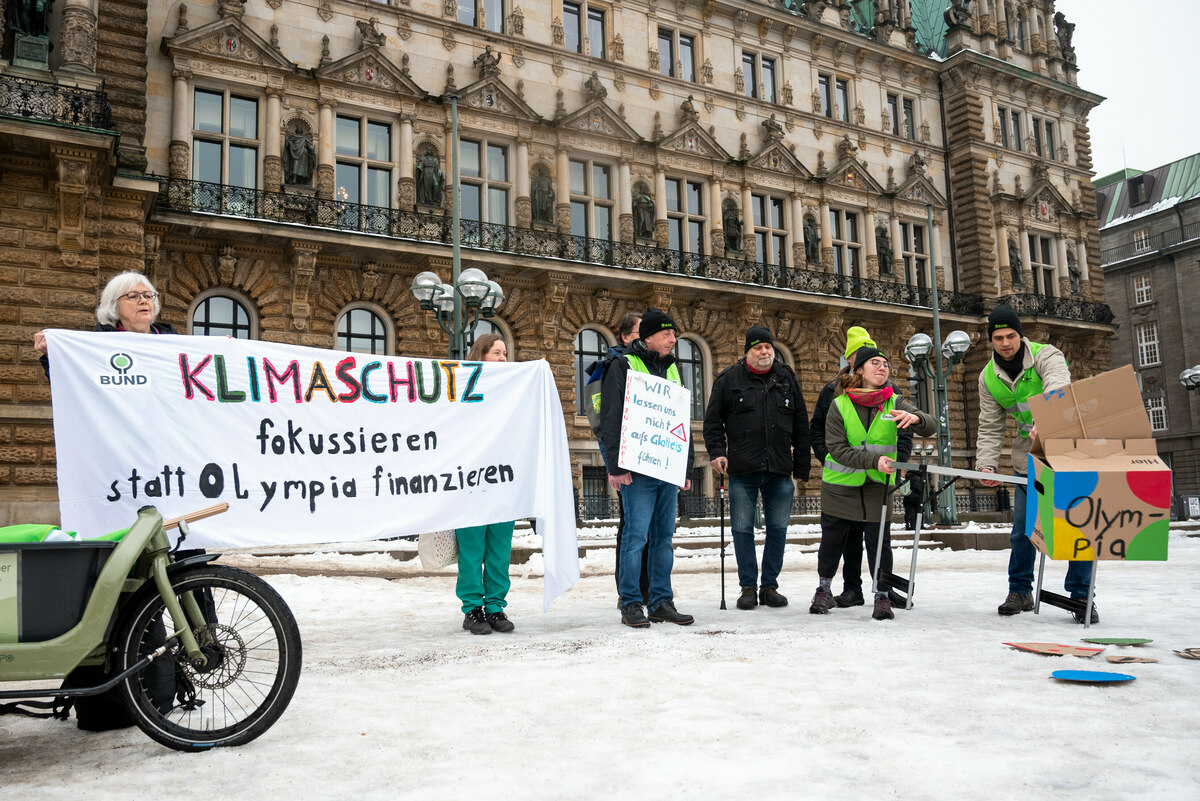
The Olympic Games could help Hamburg achieve its stricter climate goals – this is what the Senate says in response to a parliamentary question from the Left. This seems contradictory, because SPD representatives in the red-green Senate had warned against a referendum with the aim of bringing forward climate neutrality from 2045 to 2040.
The initiators of the so-called future decision prevailed last October. It is the law that the city must be climate neutral by 2040. The Left is now surprised that Mayor Peter Tschentscher (SPD) expressed strong doubts about its feasibility when making the future decision, while suddenly everything is supposed to be possible in connection with the Olympic Games.
In its response to the Left, the Senate justified this by saying that “hosting the Olympic and Paralympic Games will accelerate many developments and processes.” Left-wing MP Stephan Jersch sharply criticizes this: “Making necessary action for the climate dependent on the decision for the Olympics in the style of blackmail is subterranean.”
Along with Berlin, Munich and Rhine-Ruhr, Hamburg has expressed interest in hosting the Summer Games in 2036, 2040 or 2044. In Munich’s population voted in a referendum 66 percent said they were in favor of applying for the games.
The IOC is trying
The Hamburg Senate will have a referendum on an application voted on in May. A recent representative survey commissioned by Radio Hamburg achieved 50 percent approval. 41 percent rejected an application.
Recent studies show that sport is an economic giant.
Michael Thomas Fröhlich, UV North
In its response to the Left, the Senate reminds that the International Olympic Committee (IOC) has carried out extensive reforms since 2014. In its “Olympic Agenda 2020”, the IOC committed itself to the United Nations (UN) sustainability goals. The further development of this also includes “the obligation to organize ‘climate-positive games'” from 2030.
This entails extensive reporting obligations for applicants, such as creating a climate action plan and annual sustainability reports. The reports would have to be audited by “external, accredited testing bodies”. International standards and the IOC’s methodology for calculating CO are decisive for this2footprint.
Sport as an economic factor
That sounds like a lot of effort, as the economy usually criticizes and as it also criticizes in the specifications of the future decision. However, representatives of the Chamber of Commerce and the Chamber of Crafts point out that the Climate Protection Act with its rules on how to make the city climate-neutral by 2040 and the requirement to organize climate-positive games are two different things.
The Chamber of Commerce sees the games primarily as an opportunity to make Hamburg known worldwide as a location and as an infrastructure booster. If the people of Hamburg decided against applying, it would be “a fatal signal,” says Peter Feder, spokesman for the Chamber of Commerce. Then the north would not have to complain in the future about Bavaria taking the lion’s share of federal funds for investments.
The Chamber of Commerce has commissioned a cost-benefit analysis for the games, which will be published before the referendum. Michael Thomas Fröhlich from the Association of Business Associations Hamburg and Schleswig-Holstein (UV Nord) recalls a recently published study by the Hamburg World Economic Institute (HWWI) on the importance of sport as an economic factor for Hamburg.
“Recent studies show that sport is an economic giant,” says Fröhlich. According to the HWWI, every euro earned in sport leads to 2.40 additional added value in the city; Each job in sport secures an average of 2.3 more.
The Olympic Alliance warns of enormous CO2 emissions
When it comes to climate protection, the Alliance represents Nolympia Hamburg a completely different position than the Senate. “Hamburg needs investments in a transformation towards a climate-neutral economy as well as fossil-free energy production and no additional burdens caused by a mega-event,” says Sabine Sommer, state chairwoman of BUND, which is a member of the alliance. The foreseeable pressure on traffic and the environment may not pass the reality check.
The Senate points to role models such as the 2024 European Football Championship in Germany and the Olympic and Paralympic Games in Paris in the same year. There are “compared to previous games CO2Emissions have been reduced by an unprecedented 54.6 percent,” reports the IOC.
95 of the sports facilities already existed or were only built temporarily, and only three facilities were newly built. 98 percent of the energy used came from renewable sources, and 87 percent of the audience used public transport or bicycles. Almost all of the equipment was recycled. The Hamburg Senate wants to go further than this in part by avoiding, reducing or compensating for emissions.
From the perspective of Olympics that doesn’t count. The Games caused huge emissions from construction, traffic and air travel. There are still around 2.1 million tonnes of CO in Paris2equivalents have been emitted – the IOC speaks of 1.6 million tonnes. “Offsets do not change the fact that the actual CO2footprint remains huge,” criticizes the alliance.