

taz: Mr. Eblenkamp, the New Start Treaty limits the number of nuclear warheads in Russia and the USA to 1,550 each. That’s enough to bomb the world into Armageddon a few times. What difference does it make if the agreement expires on Thursday and new warheads could be added?
Florian Eblenkamp: Of course, the nuclear arsenals are already so destructive that one more warhead doesn’t make much of a difference. However, the fact that the treaty is expiring shows that all restraint is being lost when it comes to nuclear weapons. Trust between the USA and Russia has completely eroded. Both sides cannot agree on the continuation of an agreement for which they would not even have to change anything about their current policies, but could simply let existing practices continue.
taz: Since its full invasion of Ukraine, Russia has no longer fulfilled an important part of the treaty: the agreement actually stipulates that Moscow and Washington will inspect each other’s nuclear weapons stocks. What value did the agreement have anyway?
Eblenkamp: Although the contract may have already been dead in practice, legally it still achieved something. Both sides most likely stuck to the number of permitted nuclear warheads so that in case of doubt they could accuse the other of breaching the treaty. With the expiry of the agreement There is no limit to arming with strategic nuclear weapons. In fact, all nuclear weapons states are currently massively modernizing their arsenals. In a certain sense, New Start was a farce.

taz: Putin has suggested that the US and Russia extend what’s left of the treaty by one year. So that both sides – without mutual inspections – are sticking to the number of 1,550 warheads. What does that mean?
Eblenkamp: I think that wouldn’t be so bad at first. At the beginning of his administration, Trump also spoke of denuclearization as one of his priorities. Unfortunately there isn’t much left of it. In practice, Putin’s wish certainly comes from the fact that Russia simply does not have the money to invest in nuclear weapons at the moment. The war in Ukraine ties up too many resources. Nuclear weapons and their delivery systems are incredibly expensive and at the same time not what is currently helping Russia militarily.
taz: Putin hasn’t wanted to negotiate a new anti-nuclear weapons agreement in recent years because he said we’d only do it when the US cut back on its aid to Ukraine.
Eblenkamp: Yes, he exposed his bluff that we can only talk about these things once the war in Ukraine is over. That was a negotiating tactic, but that’s what Putin is known for. Perhaps this is also evidence that Russia realizes that it will have to make compromises in the nuclear field if it wants to continue this war in Ukraine. Military resources are limited and nuclear weapons do not provide Ukraine with an advantage on the battlefield. They are far too complicated to use, both normatively and legally.
Trust
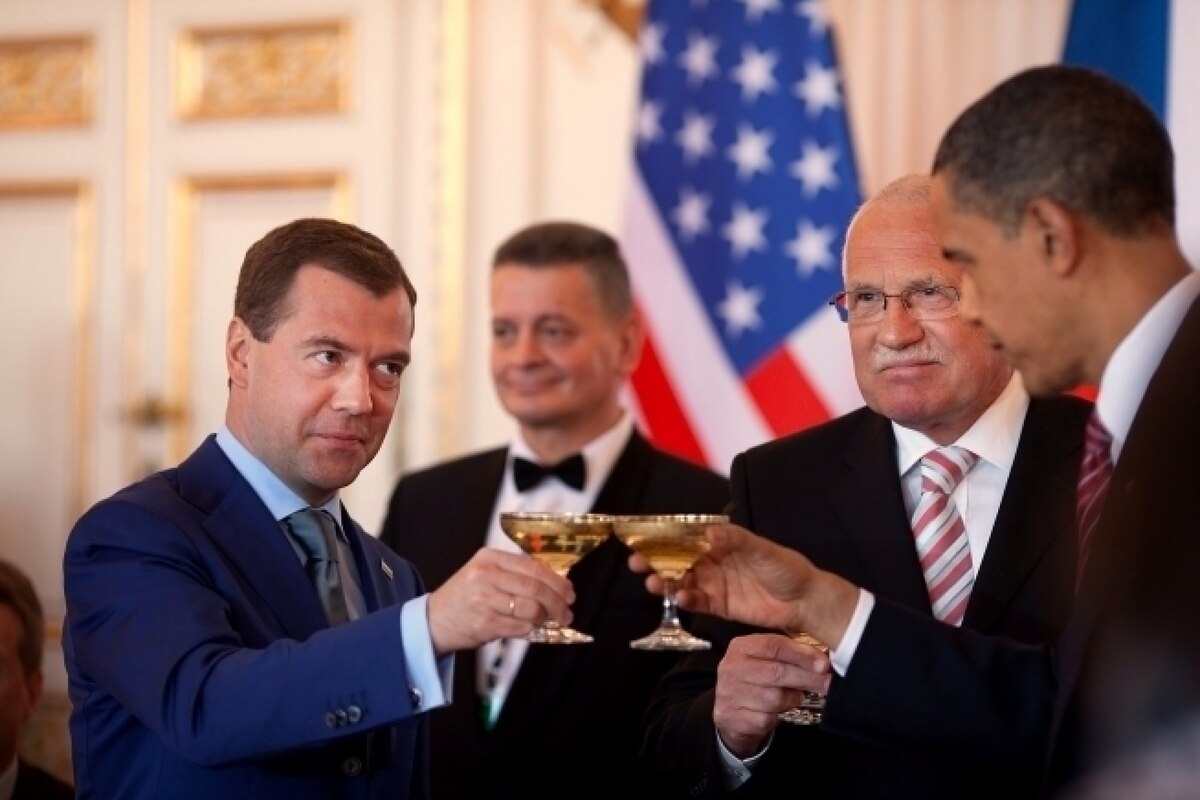
US President Barack Obama and his Russian counterpart Dmitri Medvedev agreed on New Start in 2010 as a follow-up to the Strategic Arms Reduction Treaty. Both countries thus committed to reducing their operational strategic nuclear warheads to 1,550. In addition, both states were “only” allowed to have 700 operational carriers such as ballistic missiles and 800 launch systems such as submarines and bombers. “We hope that we can continue discussions with Russia about further reductions in our strategic and tactical weapons,” Obama said at the time after the signing in Prague Castle.
control
This gave rise to the hope that new treaties could limit the countries’ entire nuclear weapons arsenal. In total, both states each have around 6,000 nuclear warheads. The strategic weapons at issue in New Start are only a small part of the inventory. In order to strengthen mutual trust, both sides agreed on on-site inspections. To this end, both countries also wanted to exchange comprehensive data, including automatically recorded sensor data from their weapons arsenals.
Hollowing out and temporary end
Since the start of the Ukraine war, Russia has no longer adhered to this part of the agreement. The fact that the contract is now expiring has to do with the fact that it was initially limited to ten years, with the option of being extended by five years. This deadline has already been exhausted. (taz)
taz: The Russian leadership has but repeatedly threatened with precisely such an operation.
Eblenkamp: Putin tried to use this to create psychological pressure. But despite these oft-repeated threats, arms are still being delivered to Ukraine. There are also Ukrainian attacks in Russia, in self-defense. Moscow’s nuclear deterrent was actually supposed to prevent all of this. Perhaps we will see that in reality nuclear deterrence does not achieve as much as some strategists think.
taz: Donald Trump once said he was in favor of a nuclear weapons treaty with Russia and China. Isn’t that a good idea?
Eblenkamp: Yes, that would be great. But that would make everything much more complicated. There is huge mistrust between the Chinese and American negotiators and there is no movement. Furthermore, China is not integrated into the structures that have existed between Russia and the USA since the Cold War. You have to be realistic: China now has around 600 nuclear warheads, which is only a fraction of the stocks in the USA and Russia.
The discussion about nuclear armament is a combination of a lack of ideas in order to solve a complex problem in a seemingly simple way, and heavy-handedness.
taz: Still, that’s not a small amount.
Eblenkamp: Yes, every warhead is one too many. But the great responsibility for nuclear disarmament lies with the USA and Russia. Otherwise Great Britain and France, with their few 100 warheads, would also have to be included in such a treaty. Or Israel. Or North Korea. Or India and Pakistan.
taz: There are also calls for nuclear armament in Germany – if not for the Bundeswehr, then at least for the EU, it is said again and again. Wouldn’t that be a logical step if you say that you want to become more independent from the USA?
Eblenkamp: It would be consistent, but consistently stupid. There are many reasons against it. First of all, at the EU level: There is no common defense policy at all. A deal between member states at a bilateral level would also be illusory. The fact that Austria, Ireland and Malta also speak against this Treaty on the Prohibition of Nuclear Weapons have joined and have obligations under international law not to take part in something like this. This shows the positive impact of this contract.
taz: And nuclear weapons for Germany?
Eblenkamp: Here the debate completely misses reality. This would have terminated the two-plus-four contract. Russia would have been given every argument to expand its war. Germany would also have to terminate the Non-Proliferation Treaty, which is already badly damaged. Then it would only be a matter of time before Iran, Saudi Arabia or South Korea also had nuclear weapons.
taz: Why does this topic keep coming up?
Eblenkamp: This is a combination of a lack of ideas to solve a complex problem in a seemingly simple way, and a lack of effort. I want to see the politician who wants nuclear warheads in his constituency. These weapons would have to be tested somewhere. Which European country would give up territory for this? In addition, people often act as if they had to get nuclear weapons and then they would have a deterrent effect. But military capability is not enough.
taz: Oh?
Eblenkamp: You also have to show credibly that you would use the weapons. You have to beat your chest every now and then and say: “We are somehow a little evil.” And you would have to do it in such a way that someone like Putin would be impressed by it. But when in doubt, someone like Putin, who doesn’t care about human dignity, is always more credible when he threatens to use these weapons. It is therefore a very bad defense strategy to get involved in nuclear weapons – beyond all the tactical considerations and international legal problems that this entails.
taz: Do you see a path to nuclear disarmament?
Eblenkamp: 2026 offers a few opportunities to do this: there will be review conferences of the Non-Proliferation Treaty in April and May and the Treaty on the Prohibition of Nuclear Weapons in November. The countries that meet there must point the finger at the states that accept nuclear weapons. You can get out of this whirlpool by clicking on the scientifically widely researched risks and is not aimed at the assumed benefits of the nuclear deterrence theory. In this question, Germany also has a role that it has not yet fulfilled. Germany has no influence on the arms policy of Russia or the USA, but bears the majority of the risks. A war between the two countries would most likely take place in Europe. Germany could help ensure that there is more talk about the risks instead of deterrence.