




As someone who spends a ridiculous amount of time studying the financials of professional sports teams, people are usually surprised to hear that I rarely invest in the industry’s publicly traded assets.
Of course, there are a few good publicly traded stocks — the parent company of the UFC and WWE (TKO) is up 75% over the last two years. But then you have a team like the Atlanta Braves, which currently trades at a market cap of $3.6 billion. Given that Sportico values the MLB team at $4.1 billion by itself, that means shareholders of the publicly traded company essentially get the team’s real estate for free, an asset that has been privately valued at more than $1.3 billion.
This is exactly why most sports teams stay private. Some leagues don’t even allow teams to go public, but most avoid it anyway because the private-to-public process brings on a bunch of headaches. Beyond dilution and potential loss of control, forcing an asset that relies on long-term investments to drive valuations higher into a protocol that rewards short-term financials is a recipe for disaster.
Just look at the numbers. Despite a massive jump in valuations across every major sports league over the last five years, the Atlanta Braves’ publicly traded stock (+30%) has massively underperformed the S&P 500 (+75%) over the same period.
This context matters because it proves the New York Knicks are an outlier.
One of my favorite stats right now is that while everyone chases the AI trade, investing in everything from memory and power to semiconductors and compute, the stock price for Madison Square Garden Sports Corp has doubled over the last year. That makes the holding company for the New York Knicks and Rangers one of the stock market’s best-performing assets, handily beating the S&P 500 (+20%) and even the ProShares UltraPro QQQ ETF (+66%). For those unaware, TQQQ is a three-times-leveraged ETF (!!) that tracks the performance of the Nasdaq 100.
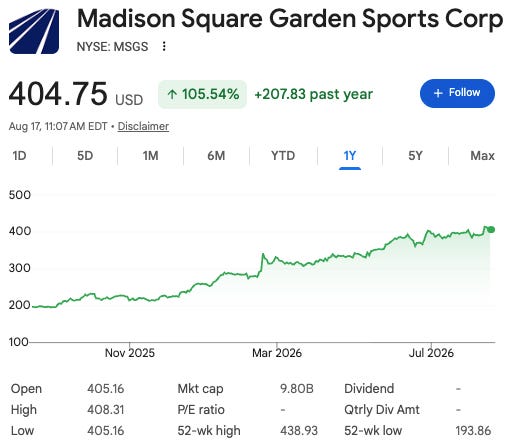
The logical response to this is…duh! The Knicks just won their first NBA title in 53 years. Sports valuations have gone through the roof as professional investors look to hedge their AI exposure with in-person experiences, and Madison Square Garden Sports Corp just posted record earnings, announcing $182 million in playoff-related revenue last season. That’s just over $20 million per home game.
But that’s not why the stock is up 100% over the last 12 months (and the real reason proves why it’s so challenging for teams to go public in the first place).
Read more