


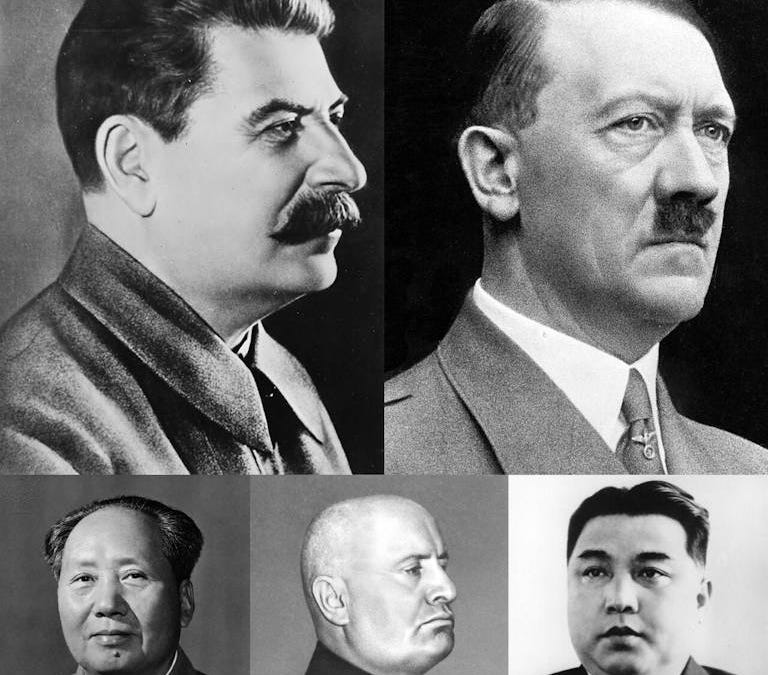
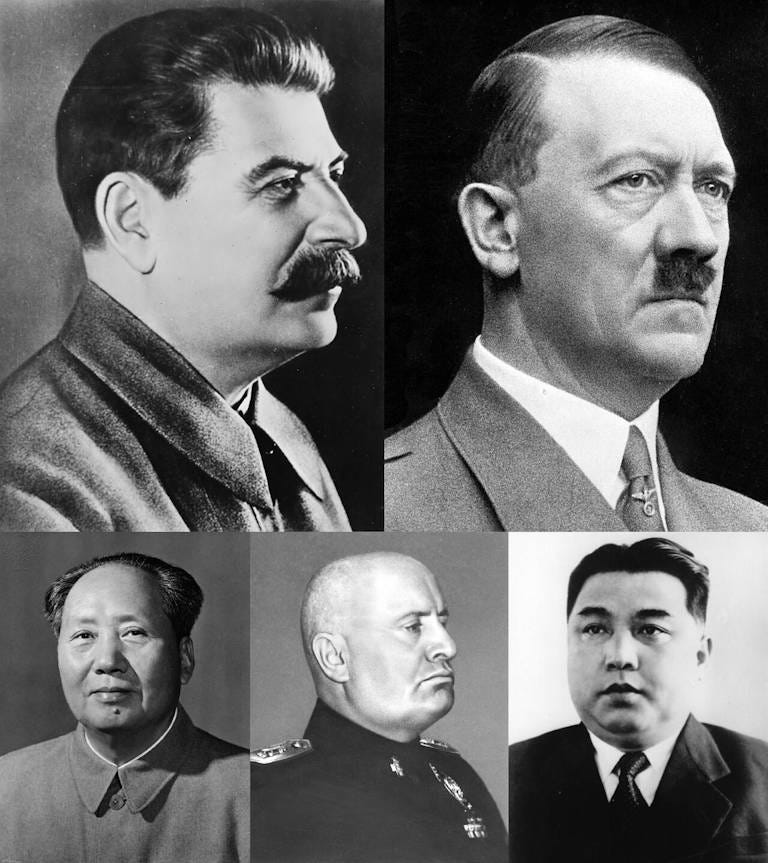
Let’s take a break from discussing the insanity of American politics, the tragedy of British economic mismanagement, and other weighty topics, and talk about something fun and light. Who was the greatest monster of the 20th century?
Well, ok, that’s not really fun and light. The 20th century featured hundreds of millions of people slaughtered in wars, genocides, political persecutions, and preventable famines. Many of my own extended family members were killed in the Holocaust, and I have plenty of friends whose relatives died in World War 2, the Great Leap Forward, the Cultural Revolution, the Cambodian Genocide, and other such calamities. Those deaths are even more tragic because of all the good things that were happening in that century — the fabulous economic growth and technological progress. Everything could have just been a smooth upward glide to luxury and comfort, and yet people were still being machine-gunned into mass graves.
With time, the emotional power of those events fades — Genghis Khan killed tens of millions in his campaigns of conquest eight hundred years ago, but today he’s more likely to be invoked as a joke, or an object of reverence, than as a monster. It can happen surprisingly fast. By the early 2000s, hipsters in my dorm were already hanging ironic Chairman Mao posters in their rooms. Today, you can see leftist pundits like Hasan Piker praising Mao without a trace of irony:
Plenty of other leftists joined in the Mao lovefest.
Piker is wrong, of course; if you read the authoritative biography of Mao by Jung Chang and Jon Halliday, you’ll see that the dictator repeatedly aggrandized himself at China’s expense, willfully derailing multiple periods of reform and recovery by launching the country into destructive episodes of chaos like the Great Leap Forward and the Cultural Revolution. Nor was he much help against the Japanese invaders in World War 2, preferring to let them fight and weaken his Chinese rivals (again, at the expense of many Chinese lives). It was Deng Xiaoping, not Mao, who made modern China great.
But the people who say that Mao was history’s greatest tyrant, with an unsurpassed body count of 40-50 million people, are also probably overreaching a bit. Yes, about 36-40 million people did die in Mao’s Great Famine, caused by his various foolhardy agricultural policies and the inefficiencies of China’s communist economic system. Nor was this merely an accident; even after Mao learned that his policies were failing, he kept them in place to avoid losing face in front of CCP rivals. But killing tens of millions of his own people was never Mao’s plan.
Intent is an important factor to consider when ranking history’s greatest monsters. The reason has to do with why we should care about the question. The point of ranking evil regimes isn’t to have fun marveling at the scale of human brutality — it’s not like trying to figure out what the biggest dinosaur was, or whether Michael Jordan was better than LeBron. Sometimes real life forces you to choose between monsters.
In World War 2, America had to decide whether allying with Stalin against Hitler was worth it, or whether we should simply sit it out and be neutral as the two villains slugged it out. Our decision probably tipped the course of the war. Later, we formed a quasi-alliance with Mao’s China against the Soviet Union, helping to hasten the latter’s downfall.
Many populations, of course, have an even grimmer choice — they have to choose which ruthless, cruel regime to support in a civil war. If you lived in Syria in 2016, did you support Bashar al-Assad, ISIS, or offshoots of al Qaeda? If you lived in Russia in 1919, did you support the Reds or the Whites? And so on.
So when we ask “Who was worse”, the question is actually pretty relevant. Obviously it’s a matter of opinion, but I think some factors we should consider when assessing the horribleness of a regime are:
-
Overall death toll during the regime’s time in power
-
How much of the death toll was intentional
-
How much of the death toll was willful versus accidental
-
How harmful the regime was relative to the size of the population it controlled
-
What other bad things the regime planned to do but was unable to accomplish
-
What life was like for the people who lived under the regime and didn’t die
So with that in mind, here’s my ranking for last century:
The worst regimes of the 20th century
#1: Adolf Hitler and the Nazis
For me, Hitler easily takes the top spot, and it isn’t really a question. The reason isn’t that the Jewish Holocaust — Hitler’s most-discussed atrocity — was uniquely horrible compared to other acts of genocide. It’s that the Jewish Holocaust was only the beginning of Hitler’s wave of destruction.
The slaughter of 5-6 million Jews was deliberate, but it was only one part of Hitler’s plans for genocide in Europe and Asia. Generalplan Ost, the Nazis’ plan for East Europe, involved the deliberate slaughter or enslavement of tens of millions of people in Russia and other countries to Germany’s east. Here’s a chart from Wikipedia:
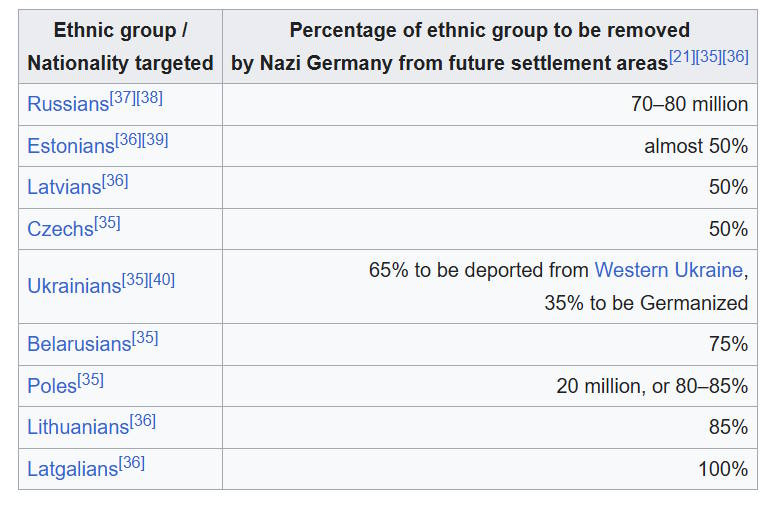
“Removed” here means “killed”, since the Nazis intended to take all of the land.
Hitler’s invasion of the USSR — Operation Barbarossa — was meant to carry out this unprecedented genocide. The main tool was starvation — Nazi Germany’s “Hunger Plan” called for intentional mass famines to wipe out most of the people living in the USSR and East Europe.
The Nazis actually implemented this plan to a significant degree. Out of the 27 million Soviet citizens killed by the Nazis during World War 2, 19 million were civilians, and most of these probably died from hunger and disease, caused in large part by the Nazis’ deliberate policy of mass starvation during the war. The Nazis also mass-executed or starved millions of Soviet POWs. Had the U.S. not stepped in to help, the death toll in the USSR might have been twice as large, or more. Those that weren’t killed were to be enslaved, but given the experience of the “workers” at Auschwitz — and considering that Nazi ideology stated that superior races lived and inferior ones died off — it’s an open question how long those slave populations would have been allowed to survive.
And why would Hitler have stopped there? Having overcome the Soviets, would the Nazis really have allowed the Chinese, or the Arabs, to live their lives and hold their lands unmolested? Not a chance. Hitler’s regime was purpose-built for conquest and genocide — it could only keep killing or die. In this sense, the Holocaust, as horrifying as it was, was only the tip of the iceberg.
It’s not clear whether there has ever been another regime quite like Hitler’s, even when we look back to the barbarity of premodern times. Genghis Khan, Timur (Tamerlane), and other conquerors killed millions, but only in order to subdue and rule, not to annihilate. Other regimes have attempted annihilation of subject peoples, but have generally done this within their own borders rather than trying to do it to the rest of the world.
Hitler and the Nazis should thus stand as the undisputed all-time champion of evil. With an intentional body count of over 30 million, and plans to do even more, they were less like other historical tyrants and more like some kind of alien armada. In my mind, the decision to ally with Stalin in order to defeat that unique menace was unquestionably the right one.
#2: Fascist Japan
The Japanese Empire in the 1930s and 1940s was very different than the empire that came before. The military usurped civilian rule, put an end to the democracy that Japanese people had enjoyed in the 1920s, and made their society increasingly totalitarian. Japan had conquered and colonized before — Taiwan and Korea — but in the 1930s and 40s, they became increasingly brutal.
By the time they went after all of China in 1937 and Southeast Asia in 1941, genocide had become their standard tool of conquest. Like the Mongols 700 years earlier, the Japanese conquerors were very aware of China’s greater population, and intentionally used genocide in order to make China easier to rule. They killed 14 million Chinese people in their invasion (some say only 6 million, some say 20 million), mostly by deliberately starving them or slaughtering whole towns — similar to what the Nazis did in the USSR, but without the camps. They used biological weapons to try to kill even more. And of course they famously killed over 10,000 people by experimenting on them. This is in addition to a long list of massacres and atrocities carried out in the rest of Asia.
We tend to leave Japan off of the list of “history’s worst monsters”, because these crimes were committed in a very distributed way. They were not a result of official state ideology, like the Nazis’ ideology of race war. Individual figures like Tojo Hideki sometimes did encourage policies of mass starvation, mass shootings, and biological warfare, but the Imperial Japanese Army was remarkably decentralized, and lots of local commanders did atrocities all on their own. The Emperor probably knew about at least some of the atrocities being committed in his name, but didn’t try to intervene.
Still, collectively, Imperial Japan was the closest thing to the Nazis that existed in the 20th century, and like the Nazis they would have gotten far worse if they hadn’t been forcibly stopped.
#3: Pol Pot and the Khmer Rouge
Pol Pot and the Khmer Rouge had a total body count that was much lower than the other regimes on this list — 1.5 to 3 million instead of tens of millions — and they didn’t try to conquer the surrounding lands (though they sometimes attacked their neighbors). But the reason they only killed a few million people was that Cambodia only contained a few million people. The Khmer Rouge slaughtered a fifth to a quarter of their populace, higher than anyone else on the list — or maybe in recorded history. And had they had the power to conquer any of their larger neighbors, they probably would have conquered and killed even more. As it was, their reign of terror was only stopped by a Vietnamese invasion.
In terms of the cold, systematic nature of the mass murder, the Khmer Rouge are second only to the Nazis. The Killing Fields are legendary. You can go see the “magic tree” where Pol Pot’s soldiers would dash babies’ brains out, or gaze upon nice neat rows of human skulls. It really doesn’t get more psychotic than these guys.
#4: The USSR under Stalin
Stalin is generally held responsible for somewhere between 10 and 20 million deaths, of which maybe 6-10 million starved to death because of communist agricultural policies. Like Mao, Stalin learned of these deaths but turned a blind eye rather than admit a mistake. But there may have been more to it in Stalin’s case — he probably wanted a famine in Ukraine in order to intentionally reduce the Ukrainian population and make the “republic” easier to rule.
Stalin’s deliberate murders were fewer than Hitler’s but that’s a relative statement; he did slaughter maybe 3 million political opponents by murdering them or sending them to gulags to die of neglect. He committed small local genocides, killing over a hundred thousand Poles in WW2, mass-expelling a bunch of minority populations (like the Crimean Tatars) and killing many in the process, and so on.
His armies were also very brutal in Germany during World War 2, mass-raping literally millions of German women, expelling and enslaving large numbers of Germans in East and Central Europe, and so on. On top of all that, Stalin’s USSR was famously nightmarish, with people living in a constant state of fear and encouraged to rat out their neighbors.
What Stalin mostly didn’t do was conquer and expand the USSR’s territory. With a few exceptions, he just sat on his existing empire, dominated surrounding states with proxy arrangements, and focused on internal ideological and economic reorganization and maintaining his personal power. This lack of world-conquering ambition made him palatable as an ally against Hitler. Ultimately, he mostly just sat there and brutalized the people already under his own control.
#5: China under Mao
The vast majority of Mao’s deaths come from the famine. He also killed maybe 2-4 million people deliberately, through political purges, executions and forced labor during the Great Leap Forward, and the insanity of the Cultural Revolution. But the basic story of Mao is that he implemented insane policies in an attempt to gain and hold onto power, and often viewed Chinese deaths as collateral damage in his power struggles.
Mao, like Stalin, was also a villain that other countries learned to live with. He conquered Tibet and invaded South Korea (before being repulsed), but overall he wasn’t much interested in conquest. Like Stalin, he sat on his giant empire and brutally attempted to bend it to his (often insane) will. The society he created was desperately poor, paranoid, and totalitarian, but also often chaotic and even anarchic in places.
Honorable mentions
In my mind, those five regimes stand head and shoulders above the rest, but there are certainly no shortage of other bad ones. Seven honorable mentions:
-
The Young Turks: Turkey’s junta carried out the Armenian Genocide during World War I, killing around a million people.
-
North Korea: One of the world’s most nightmarish totalitarian regimes, North Korea tried to conquer South Korea, and also caused at least one mass famine with its policies of deliberate isolation.
-
Rwanda’s Hutu government: The Hutu government in the 1990s committed the famous Rwandan genocide, and helped foment and prosecute the Second Congo War that killed millions of people in central Africa. An ideology of ethnic supremacy was a big part of the reason why.
-
The Derg: Ethiopia’s communist regime in the 1970s and 1980s doesn’t get talked about much, but they killed maybe 500,000 people in political executions and ended up starving hundreds of thousands of Ethiopians to death.
-
Yahya Khan: Under Yahya Khan in 1971, Pakistan tried to terrorize Bangladesh into remaining under Pakistan’s control. The army killed anywhere between 300,000 and 3 million Bangladeshis, and raped hundreds of thousands more.
-
Suharto: Although Indonesia saw robust economic growth under Suharto, he killed over half a million people for political and ethnic reasons.
-
King Leopold II: The Belgian king’s extractive regime in the Congo killed anywhere from 1.2 to 10 million people there. The bulk of the atrocities in the 19th century, however; Leopold’s rule over Congo ended in 1908.
I realize that this list is subject to differences of opinion, depending on A) which estimates you believe, and B) which factors you weight more heavily in the calculation of regime evilness. But I think it’s a pretty defensible list, and it demonstrates at least two important lessons.
First of all, the very worst atrocities come during times of war — especially wars of conquest, where foreign peoples are dehumanized and armies are given carte blanche. The fascist regimes of WW2 come off as the worst because they were engaged in massive wars of conquest. And wars often increase a regime’s appetite for further conquest and destruction. So basically, regimes that invade other countries tend to be worse.
Second, communist regimes tended to starve a lot of their people to death. Insane agricultural policies were a hallmark of communist economics — probably because successful communist revolutions usually began as revolts by agrarian peasantry rather than proletarian workers as Marx had envisioned. In trying to transform agriculture, communists ended up just starving their people to death.
So while communism probably caused more aggregate human misery than fascism in the 20th century, that was only because fascism didn’t have time; it was so incredibly malignant that it was stopped very quickly by external coalitions. Communism was more like a chronic debilitating disease, while fascism war more like ebola.
The worst regimes of the 21st century so far
That leaves us one more interesting question: By these criteria, who have been the worst regimes of the current century, so far? So far, the 21st century has been somewhat less destructive than the 20th — by 1926 we had already seen World War I, the Armenian Genocide, Lenin’s political purges, the Russian Civil War, and so on. The years 2000-2026 have, thankfully, been somewhat less brutal and chaotic so far. But we still have plenty of tyrannical villains. Here would be a tentative top five:
1. The RSF, Omar al-Bashir, and the Janjaweed: There has basically been a rolling series of genocides in Sudan this whole century — the first Darfur genocide, the second Darfur genocide, the Masalit genocide, and so on. Some of this was done at the behest of former president Omar al-Bashir, who encouraged murderous militias known as the Janjaweed, who later morphed into the RSF.
2. ISIS: This is the closest thing we’ve had to the Khmer Rouge in recent decades. ISIS’ extremist ideology led them to create a nightmarish totalitarian state in the areas of Iraq and Syria under their control, genocide the Yazidis, and throw much of the Arabian Peninsula into chaos. Their total death toll wasn’t as high as some of the others, but this was because they were stopped quickly; they were so horrible that everyone immediately united to fight and destroy them.
3. Vladimir Putin: Putin is one of the most aggressive leaders of modern times. He started wars in Georgia and Ukraine, and got heavily involved in the war in Syria. Over half a million people have died in Ukraine so far, and Putin bears some responsibility for the hundreds of thousands more who perished in Syria. It seems clear at this point that he’s not going to stop prosecuting wars of aggression until he dies or is defeated.
4. Bashar al-Assad: In his desperation to hang onto power, Assad laid waste to his country, killing hundreds of thousands and even using chemical weapons on rebels before ultimately fleeing.
5. The Tatmadaw: Myanmar’s military has been locked in a brutal civil war against ethnic minorities for decades, but in 2021 things really kicked into high gear after the army staged a coup against the country’s democratically elected government and put down protests with extreme brutality. The country is now an anarchic wasteland with war crimes galore.
These tyrants and murderers are somewhat less impressive, numbers-wise, than their 20th century counterparts. They also don’t clearly fit into the “fascism vs. communism” dichotomy that dominated much of the previous century; they’re more likely to be motivated either by Islamism, local ethnic chauvinism, or simple personal lust for power. But looking back at the 20th century, we should remember how bad dictators and totalitarian regimes can get, especially when they go to war — and how important it is to stop the worst of them in their tracks, before they can get even worse.