

It was actually a scandal: that normal Chinese women were sitting in the park of an imperial palace, perhaps even in the Forbidden City. It had been taboo for centuries, until the end of the last Qing dynasty in 1911.
But in the 1920s there was a turning point. After two lost opium wars and the brutally suppressed “Boxer Rebellion”, China had the British, French, Russians, later Germans also had a number of ports have to open and allow virtually unlimited import of opium, among other things. There was also severe flooding. China’s population and economy were starving.
In such times, imperial palaces also became public spaces. And so on the advertising poster for the Hamburg exhibition “Fresh from the Twenties: Insights into China’s Modernity,” two women in modern, body-hugging dresses sit between weeping willows and cherry blossoms and chat. The ambience cites classic Chinese landscape paintings from a time when women still had to look after the house.
Old viewing habits with new content
You can see that you are walking between tradition and a modern era in which women became visible, had access to education and sometimes even to offices. The original, slightly modified poster is an advertisement for textile paints by IG Farben. So the colonial aspect is inherent to it.

In 1925, when the original was made, the national revolutionary, hard-ruling Guomindang Party (GMD) was in power and was – still – able to push back the Communist Party. It was also the GMD that “unified” the crumbling empire in the bloody northern campaign of 1926. Geographical unification was to be followed by mental unification, so the northern campaign was sought to be staged as the founding myth of the new China that would create its identity.
The objects were selected by Chinese scientists. Not, as usual, by foreign colonial powers
The timing was good, as China had just adapted lithography and offset printing from the colonial powers, so nothing stood in the way of mass propaganda. Newspapers and leaflets could be produced in large quantities, for example in printing centers in Shanghai.
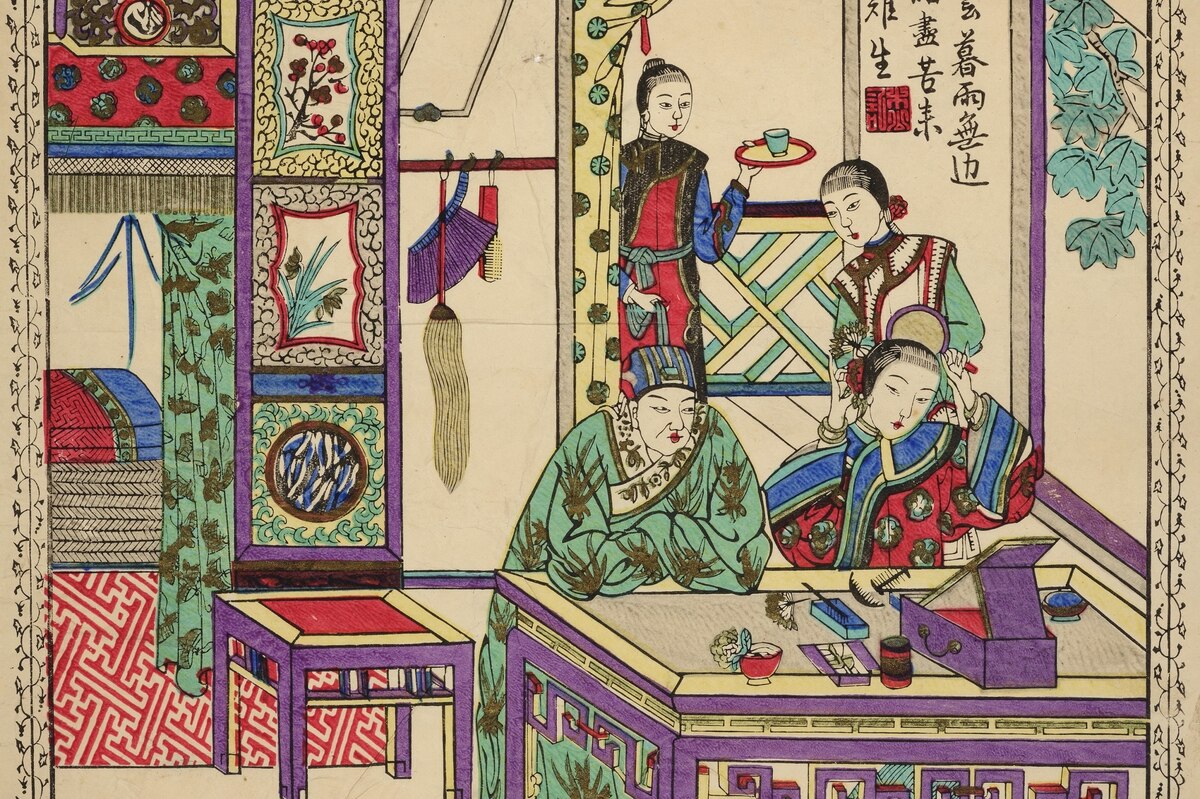
One of these posters can be found in the exhibition in Hamburg’s ethnological museum (Markk). It resembles the comic-like traditional Chinese picture sheets with fairy tales and moralizing stories. The Northern Campaign picture cleverly combined old viewing habits with new content. A proven attack on the unconscious in propaganda and advertising.
The specificity of such sheets – and in general of the 1,300 popular prints in Hamburg on which the show is based: It contains a number of traditional woodblock prints with gods and traditional stories that were considered “only typical” for centuries because they were invented there in the 7th century (and only known in Europe since the 15th century).
There are also 360 modern offset prints, also with a number of traditional depictions. This combination of modern technology and traditional Chinese motifs is considered unique in the world.
In addition to a collection in St. Petersburg, Hamburg’s Markk owns the only collection of popular Chinese prints in Europe. However, modern lithographs and offset prints were neither noticed nor researched for a long time because they do not correspond to the China cliché. Sinologist and co-exhibition curator Bernd Spyra has only now opened up the collection and made it accessible as part of a research project.
With this show, the museum is presenting a more differentiated image of China from this period of upheaval for the first time. In addition – this is also rare – the objects were selected by Chinese scientists and given voluntarily and not, as is usually the case, stolen or stolen by foreign colonial powers.
This collection was created on the initiative of the Chinese ethnologist Cai Yuanpei (1868–1940), a key reformer of education and science. He had studied in Berlin and Leipzig, was briefly China’s Minister of Education and in 1928 was entrusted with founding an academy of sciences, the Academia Sinica. In the course of this “nation building”, their ethnological department should collect cultural evidence that creates identity, both from the peoples of the periphery and in the centers.
German-Chinese exchange
In order to equip the international department, Cai asked his ex-Leipzig classmate Theodor Wilhelm Danzel (1886–1954), now head of the Africa department of what was then the Hamburg “Museum for Ethnology,” for help.
Cai suggested an exchange of objects, and so Hamburg delegations brought exhibits from the Oceania, America and Africa departments, as well as display boards that depicted the people in “Breed types” divided. Everyday objects, paintings as well as old wood and modern lithographic and offset prints came from China. A conglomerate emerged that virtually reflected the transformation of Chinese society live.
In 1933, the year Hitler came to power, Sino-German cooperation ended. The “Chinese Folklore” exhibition was considered a conclusion and classified China as a “cultured people” on a par with the Europeans, whose elites differentiated themselves from the “primitive” peoples of the periphery. Despite contact with the intellectual Cai, ex-fellow student Danzel stuck to the image of an “eternal China”. “based primarily on a mythical way of thinking,” as he wrote at the time.
Sharp internal debates in China
That China long before Europe – from 1,600 BC. BC – division of labor mass production invented with varying modules for export bronzes has been hidden. What was forgotten was that Europe had admired China as a cultural nation before colonial attacks were justified by China’s alleged backwardness.
In the 1920s, there were heated debates within China about the continued need for progress. Intellectuals ask whether the picture stories of “filial piety” that are now being mass-produced and calibrated to total submission are still contemporary.
And a character game in the exhibition testifies to a literacy campaign. At the same time, people were considering whether Chinese should be replaced by English in order to appear as an emancipated nation. The emancipatory content of the body-hugging women’s clothing that hangs in the show next to concubine picture stories and powder compacts needs to be discussed.
On the other hand, an ink painting of the “Eight Broken Ones” from 1884, with scraps of paper and money arranged like a collage, looks surprisingly modern. In between there are traces of paper damage. Elsewhere, the paper damage is simply painted on in a trompe l’oeil style. A fine, humorous symbol of transience.