

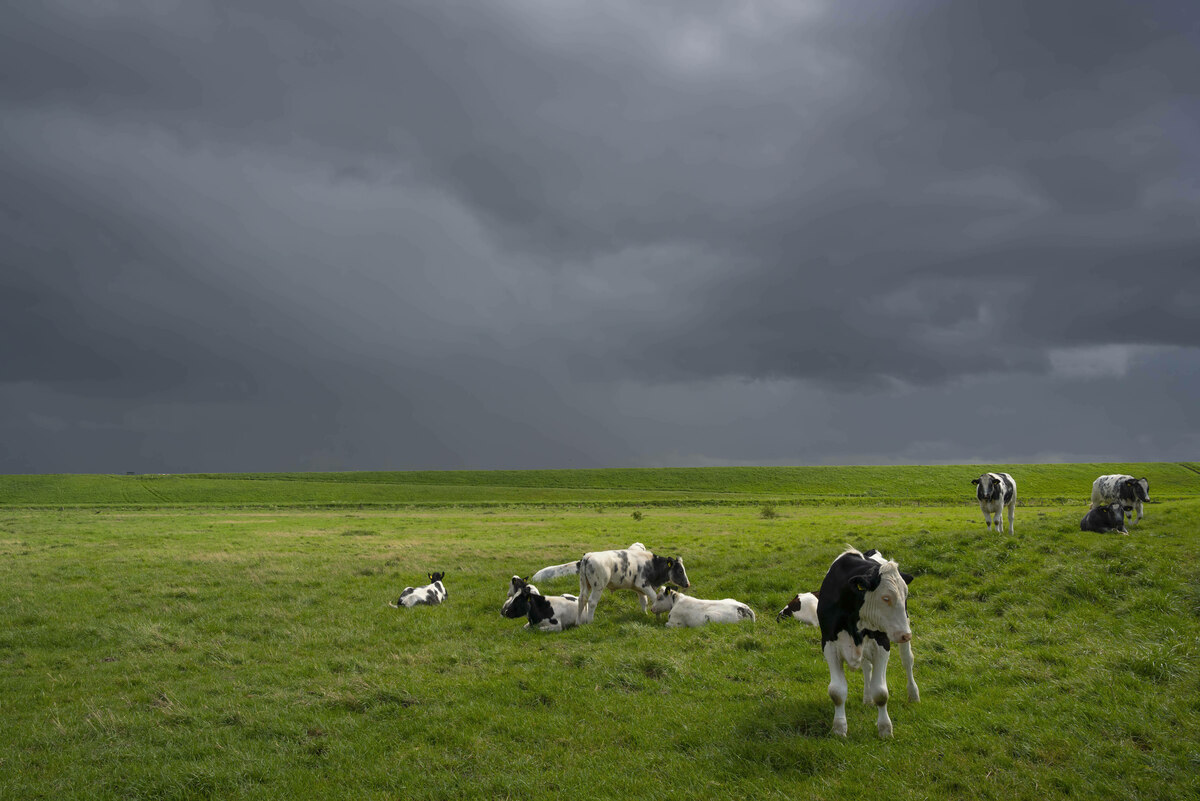
They are a pillar of global food security – and are dramatically threatened by climate change: half of the world’s pasture areas could disappear, so eine Studie aus dem Fachjournal Proceeding of the National Academy of Science of the United States of America (PNAS). The livelihood and nutrition of hundreds of millions of people depended on the grassland. But pasture areas reacted sensitively to climatic changes, according to the study authors.
For their study, in which the Potsdam Institute for Climate Impact Research (PIK) played a leading role, the authors examined how climatic changes affect pastures. To do this, they have defined a so-called safe climate area under which suitable grassland can continue to exist. They measured the temperature, rainfall, humidity and wind strength.
The result: man-made global warming is changing conditions so drastically that that suitable grasslands could shrink on a continental scale by the year 2100. “We can predict the decline across the entire continent for Africa, Oceania, South America and other regions,” said lead author Chaohui Li to taz.
The team predicts that between a third and half of the world’s pastureland could be lost due to the climate crisis. With dramatic effects: well over a hundred million people who secure their existence as shepherds would be affected. The scale of the livestock population is much higher: between 1.4 and 1.5 billion animals, cattle, sheep and goats, are losing the pastures on which they feed.
A pillar of global food security
“Grazing areas and associated animal production are a strategic pillar of global food security and play a central role,” says Daniel Müller, who researches land use at the Leibniz Institute for Agricultural Development in Transition Economies (IAMO). Pasture areas enable food production in locations that are unsuitable for agriculture. The researcher says the study is innovative and carefully prepared. However, predictions, especially up to 2100, are subject to great uncertainty.
The authors emphasize that people whose diet is already unsafe are particularly affected. According to the study, the African continent is losing a particularly large amount of pastureland. The findings showed how the climate crisis is exacerbating existing inequalities by destabilizing the world’s largest food production, on which the existence of many local communities depends.
Containing the climate crisis is crucial
“The results call into question whether local livestock farmers will continue to be able to respond to environmental change in traditional ways,” says Chaohui Li. Even local measures such as climate-friendly grassland restoration, drought-resistant animal feed and other sources of income would not be able to stem the continent-scale loss.
What will be crucial is how consistently the global community will fight the climate crisis. In the best scenario, productive pastureland in Africa could decline by 16 percent. If the global community continues to emit increasing amounts of greenhouse gases, the African continent could lose up to 65 percent of its grassland for livestock farming. According to the study, there are already temperatures in many regions that are pushing pasture farming to its climatic limits.