



It’s hardly news that Americans are not happy with the state of their nation. Confidence in the country’s direction crashed hard during the Bush years and never recovered. But what’s notable about more recent years is Americans’ increasing dissatisfaction with their personal lives:1
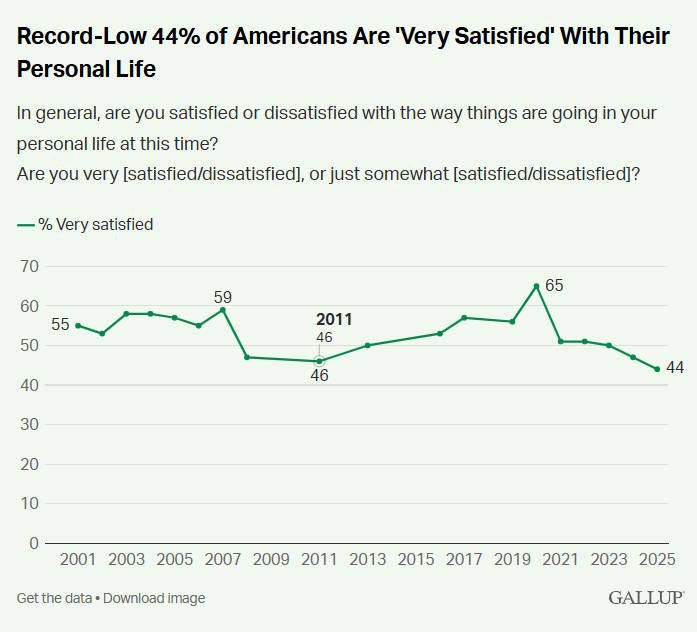
This decline looks pretty mild, but other numbers tell an even starker story. For example, happiness surveys show an increasingly despondent populace:
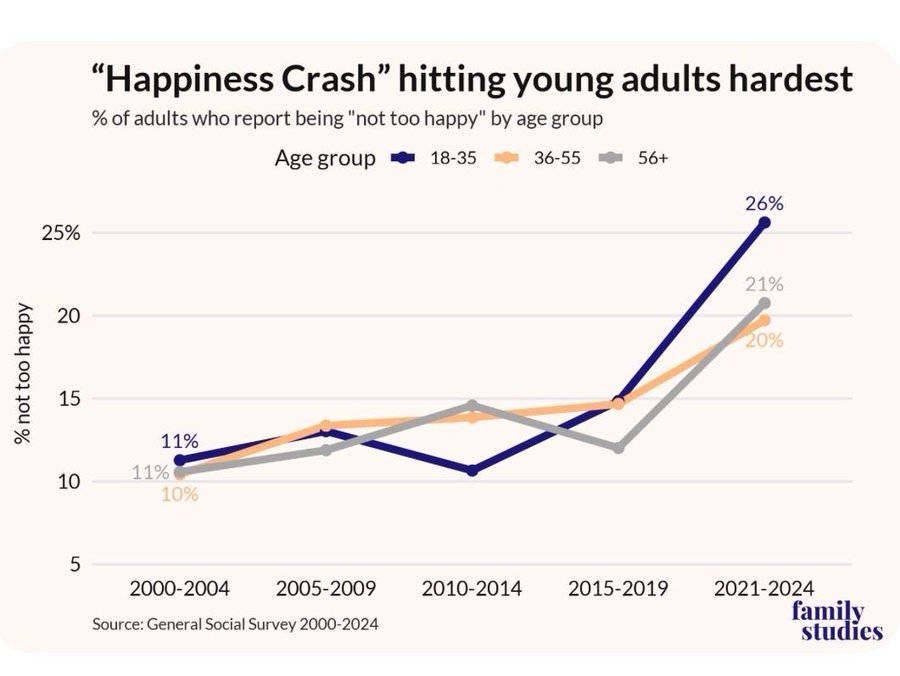
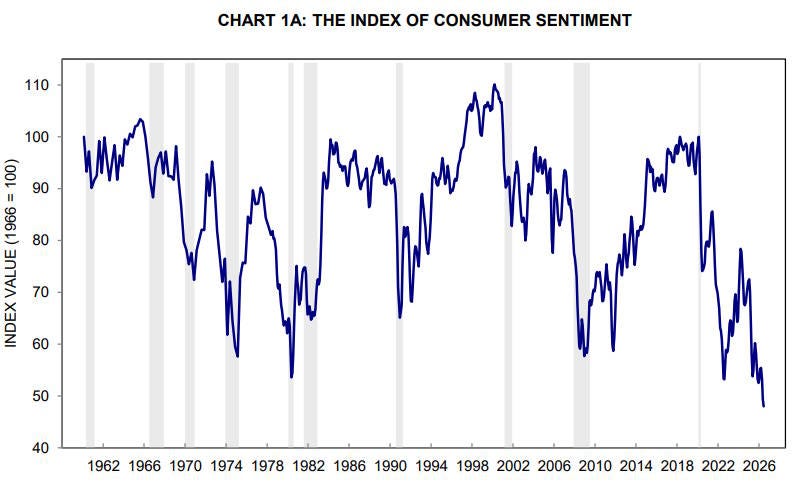
Suicide has been slowly rising as well. And then there’s consumer sentiment:
For intellectuals and commentators such as myself, for many policy wonks and academics, and even for many politicians, the question is how to make the American people happier. And the answers we come up with are usually economic ones — ideas for policies that will improve the material well-being of either the whole populace, or some segment of it.
This is common on both sides of the aisle. On the left, centrists have embraced the Abundance movement, whose main idea is to give Americans more stuff — more housing, electricity, health care, and so on. For progressives and leftists, meanwhile, Medicare for All is probably the centerpiece idea. On the right, Trump’s trade agenda has usually been justified with claims that it will return good manufacturing jobs to the American working class. Even immigration restriction is usually couched in economic terms — the MAGA people claim that mass deportations will open up jobs for Americans, lower the price of housing, and so on.
The roots of the country’s malaise, too, are often described in economic terms. Many people claim that the First China Shock — and the loss of good blue-collar jobs to offshoring more generally — left a disappointed, angry working class in its wake. Progressives decry corporate landlords that they claim raise the cost of housing, and blame grocery stores’ greed for the rising cost of food. Practically everyone agrees that inflation was the biggest reason Trump won the 2024 election.
I’ve spent a lot of time arguing against a lot of these ideas (and in favor of a few of them). But I almost always accept the basic frame that A) many of America’s problems are due to economic malaise, and B) we ought to focus on finding ways to make Americans richer. Partly, this is because I was trained as an economist; I recognize that things like culture wars are also important to Americans, but I don’t have much special expertise in that area. But partly, I think I just subscribe to the general tendency of American intellectuals to focus on the material.
I was thinking of this as I read Jay Caspian Kang’s essay, “Subaru Socialists and the Great Disappointed.” Kang argues that the young, educated, angry voters who currently form the Democrats’ base can be separated into two basic groups: Millennials who are mad about the raw economic deal they received during and after the Great Recession, and Zoomers who are mad about Covid and Palestine. Here he describes the first of these groups:
This new voting bloc has two similar but distinct components. There are what I call the Subaru Socialists: college-educated millennials in their thirties and early forties who earn a somewhat steady income but not what they expected. These voters arrived at their politics via the Great Recession, Occupy Wall Street, and the continual escalation of housing prices in urban areas—all of which heightened the contrast between what they were promised when they took on student debt and their current circumstances.
For a long time, I basically bought the narrative that at least some of the unrest of the 2010s was due to angry Millennials who had gotten screwed by the Great Recession. It makes intuitive sense that a generation who were on the losing end of such a vivid demonstration of economic risk would turn toward policies that decrease economic risk — like government health insurance and rent control. It also makes sense that they’d want student debt forgiveness.
But as time has gone on and I’ve seen Millennials do better and better economically, I’ve begun to doubt this narrative. Corinth and Larrimore (2026) write:
We find that Millennials had a real median household income that was 20% higher than that of the previous generation, a slowdown from the growth rate of the Silent Generation (36%) and Baby Boomers (26%), but similar to that of Generation X (16%). The slowdown for younger generations largely resulted from stalled growth in work hours among women…Additionally, lifetime income gains for younger generations far outweigh their higher educational costs.
And here’s a chart:
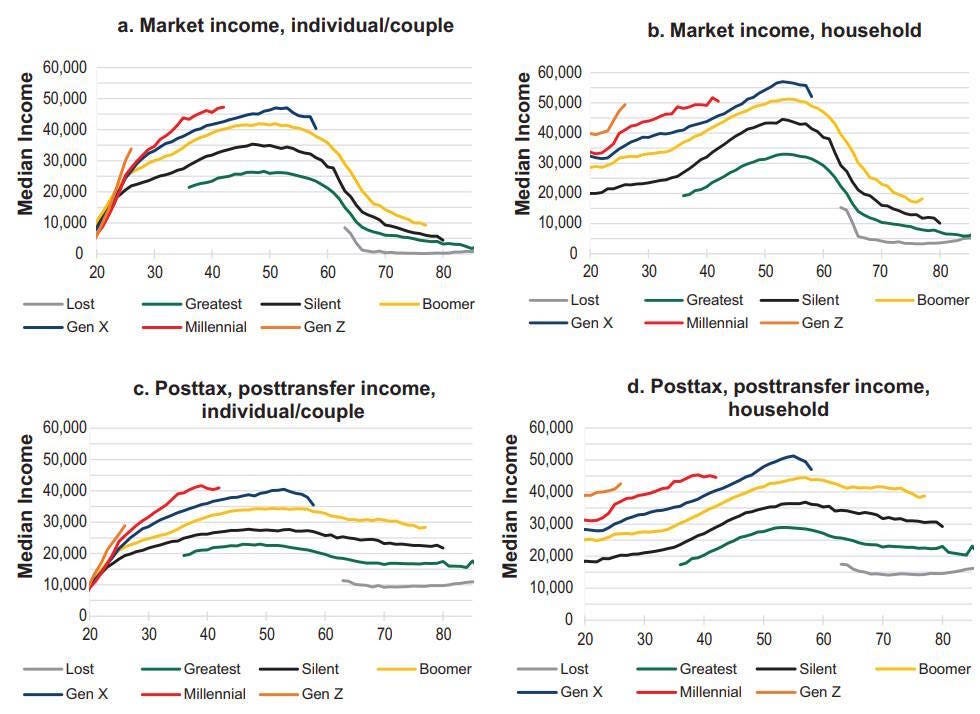
It’s not just government redistribution giving Millennials a boost. By the time they hit their mid 30s, their market income was well ahead of Gen X or the Boomers (and yes, this is adjusted for the cost of living). They had caught up in wealth, too:
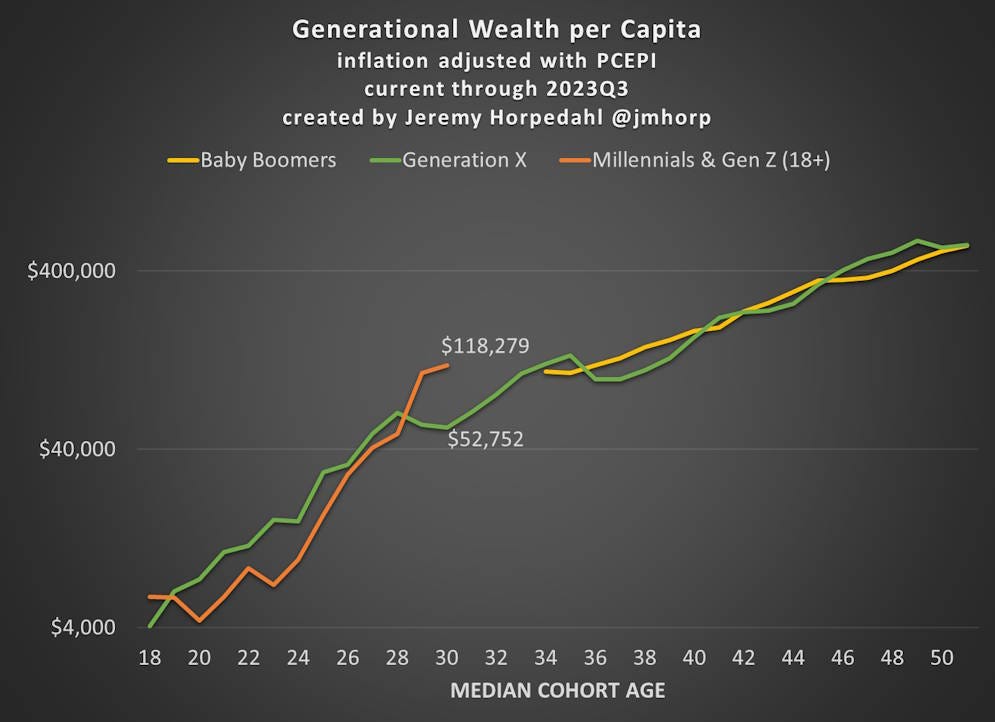
Now, is it possible that even though Millennials eventually did OK, the disruptions of their 20s created a scarring experience that they’ve never forgotten? Yes, it is absolutely possible. But it’s also notable that the kind of economic policies lefty Millennials demand — especially universal health insurance — don’t really address the main kinds of risks they experienced in their youth (unemployment and wage declines).
On the right, it’s notable that the economic policies Trump has unleashed have not helped the people they were supposedly designed to help. Manufacturing employment has fallen since Trump took office and started putting tariffs on anyone and everyone:
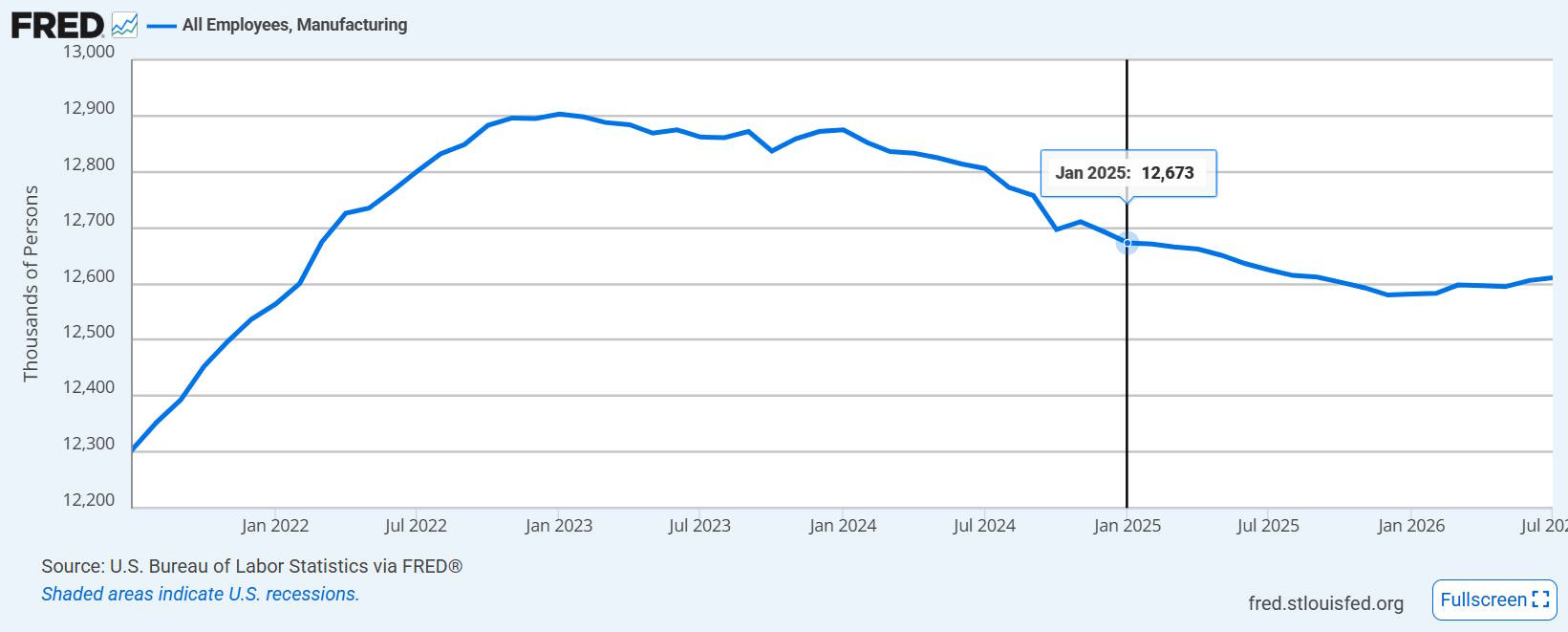
So much for those blue-collar jobs coming back. Meanwhile, mass deportations and a near-cessation of net immigration to the U.S. have spectacularly failed to raise employment rates for native-born Americans:
It’s possible, of course, that Trump’s supporters think his policies will take a long time to work, or perhaps they simply aren’t very aware of what’s going on in the economy. I kind of doubt this, though. Americans as a whole have noticed, which is why Trump’s approval rating is in the gutter and inflation — the most important economic issue at the moment — is the issue on which voters are most angry at Trump:
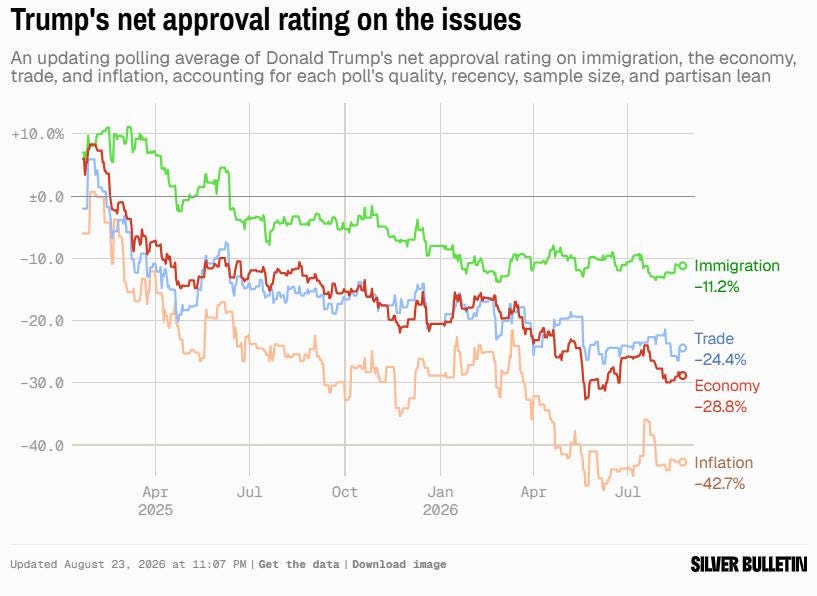
So it’s possible that Trump’s voters were just tricked into thinking he was better on economics than he was. On the margin, that’s probably true. But the fact that Trump’s base has stuck with him strongly implies that economics was not their primary concern.
In fact, there was a whole huge debate among political scientists and economists about whether Trump’s victory in 2016 was due to “economic anxiety” or to sociocultural issues. In the end, the “economic anxiety” hypothesis generally lost out. Here’s Margalit (2019):
Empirical findings indicate that the share of populist support explained by economic insecurity is modest. Second, recent evidence indicates that voters’ concern with immigration—a key issue for many populist parties—is only marginally shaped by its real or perceived repercussions on their economic standing.
On the left, I think there’s pretty good evidence that economic issues are not foremost in the minds of the progressives who dominate the Democratic Party. The political analyst David Shor has found that the issues Democratic donors and activists care about are just different from the bread-and-butter economic concerns that motivate swing voters:
In reality, Shor says, young party staffers are far to the left of the median Democratic voters on relatively uncontroversial, bread-and-butter Democratic priorities like combatting income inequality or addressing climate change. In their 2015 paper, for instance, Enos and Hirsch found that 23 percent of Obama staffers cited income inequality as the single most important issue facing the country, whereas polls from that election cycle found that fewer than one percent of all voters listed “the gap between rich and poor” as the most important issue. Enos and Hirsch also found that campaign workers were more likely to cite health care and inequality as an important issue to voters — even though most voters did not list those as high-priority issues and said they were more concerned about things like war and inflation.
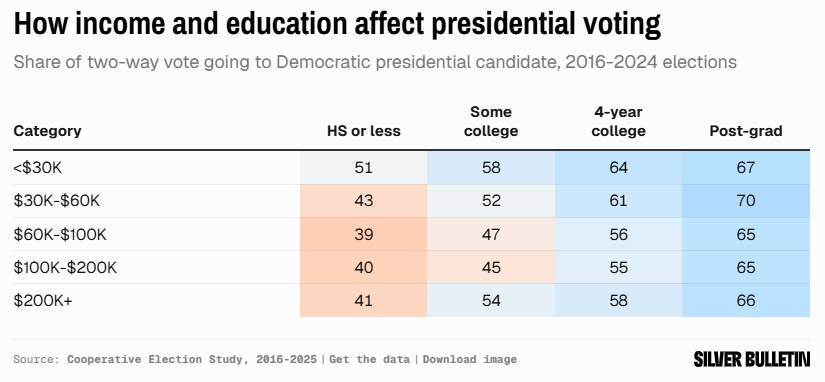
And although much has been made of the fact that low-income highly-educated voters tend to break strongly for the Democrats, it turns out that high-income highly-educated folks also vote blue:
In fact, in his essay, Kang describes Gen Z voters as caring less about the economy than about Palestine:
Then there are the Great Disappointed, a younger set. They don’t have strong memories of the 2008 financial crash, as their millennial elders do, but they came of age during the pandemic and saw that seemingly invincible institutions could, in fact, sputter and fail when placed under duress. Like the Subaru Socialists, these twenty-two-to-thirty-year-olds aren’t exactly happy with the return on their educational investment. But their political views have seemingly coalesced less around the economy than around the war in Gaza, which serves as a character test for any politician who asks for their vote…A majority of young Democrats believe that their tax dollars are funding a genocide; candidates like Melat Kiros, who defeated the longtime Colorado Congresswoman Diana DeGette in a primary, are running to the left of progressive incumbents not so much on economic issues as in their condemnation of Israel and of America’s continued military aid to the country.
The name Kang assigns to these voters — the “Great Disappointed” — seems at first to imply some kind of economic disappointment. But it turns out he just means they’re angry about foreign policy stuff that they see in the news.
In fact, a lot of committed DSA types are actually post-economic. The Gen Z political strategists who recruited Graham Platner to run for Senate, Morris Katz and Daniel Moraff, were found to be scions of very wealthy families. Similar stories keep popping up:
If people like this are “disappointed”, their disappointments have little to do with their material standard of living.
In other words, over the past decade I’ve increasingly come to doubt that economic policies and programs can address the true concerns of the people driving American politics. Yes, economics still matters, of course — for humanitarian reasons, if nothing else. And yes, there are still a lot of voters who care about inflation, jobs, and other economic issues. But these are not necessarily the people setting the agenda in American politics or causing unrest in American society.
Even where “normie” voters are concerned, though, it’s proving maddeningly hard to craft economic policies that give them what they want. Even though inflation fell from 9% in the summer of 2022 to just 3% in the summer of 2023, voters still seemed to punish Democrats at the polls in 2024.
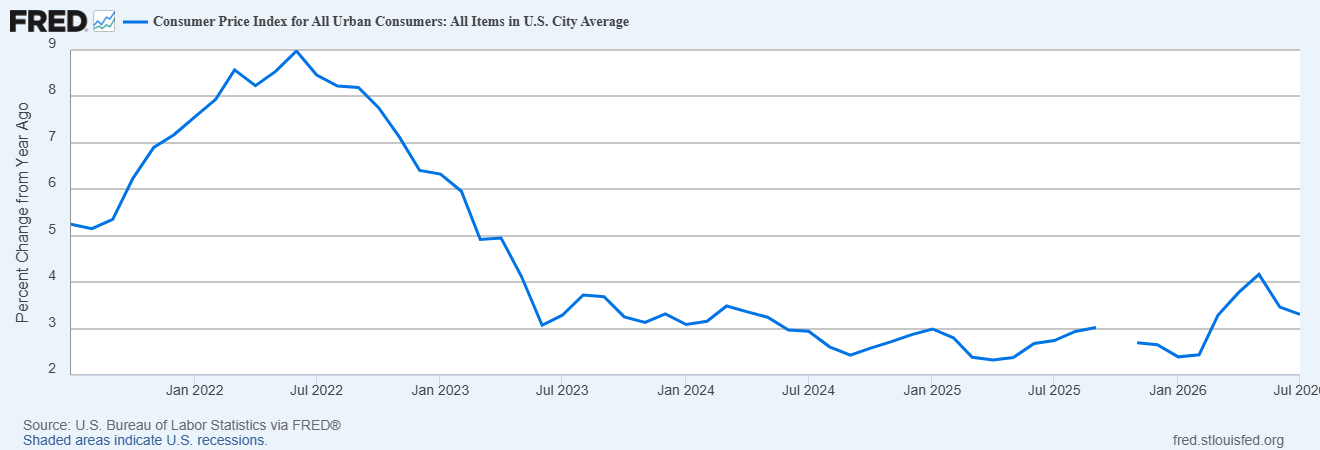
And although inflation during Trump’s current term has never approached anything resembling 2022, voters still say they’re incredibly mad at Trump over inflation.
With a robust job market, low-ish inflation, and decent economic growth, analysts have struggled to figure out why consumer sentiment — at least, as measured by UMich — is at all-time lows. At a loss, commentators have been reduced to talking about “vibes” — basically a label for our ignorance.
Every time a policy wonk thinks about some measure that would increase GDP by 0.4%, or create 200,000 jobs, or lower inflation by 40 basis points, they need to think about the unpleasant reality that Americans may simply not care very much. That doesn’t mean it’s bad to help people economically, but it means that economics may ultimately not be the lever we need to pull if we’re going to make the people of this country happy and satisfied again.
We should therefore think about whether our primary social problems are actually about material scarcity. The vast majority of Americans now possess not only the basic necessities of life, but a degree of economic security unimaginable to their forebears a century ago. It seems plausible to think that a great many Americans have climbed to the higher rungs of Maslow’s Hierarchy of Needs — that instead of where to get their next meal or how to save for retirement, they’re thinking about how to feel like they belong in their society, or how to get more status and respect.
A large contingent of Americans may now simply care less about adding to their bank accounts than about questions like “Who are the real Americans?”, or “Does one race deserve special treatment in the eyes of the law?”, or “Why do some of the people I went to college with have 10,000 times as much wealth as I do?”. As long as those questions remain unanswered, boosting Americans’ economic fortunes could have little effect on their happiness.
Neither the discipline of economics nor our typical policy discourse is set up to deal with issues like belonging, social status, or respect. There’s no market for these things; people with wealth might be more respected, but you can’t buy respect on Amazon. And some of these psychological needs are positional goods — for the status of one person or group to be higher, someone else’s status often has to be diminished.
Not only is modern economics poorly set up to deal with those kinds of things, it often bothers us to even talk about them. A world dominated by positional goods — where one person having more requires that someone else have less — is a dark, zero-sum world. We would much prefer to work toward a world where everyone wins.
And yet like it or not, this may now be the world in which we find ourselves. Just as the great challenge of the 20th century was to provide broad-based material plenty, the great challenge of the 21st century may be to make everyone feel high-status at the same time — or at least to create a world where status differences don’t lead to mass resentment.
2026 saw a further slight decline in this number.