

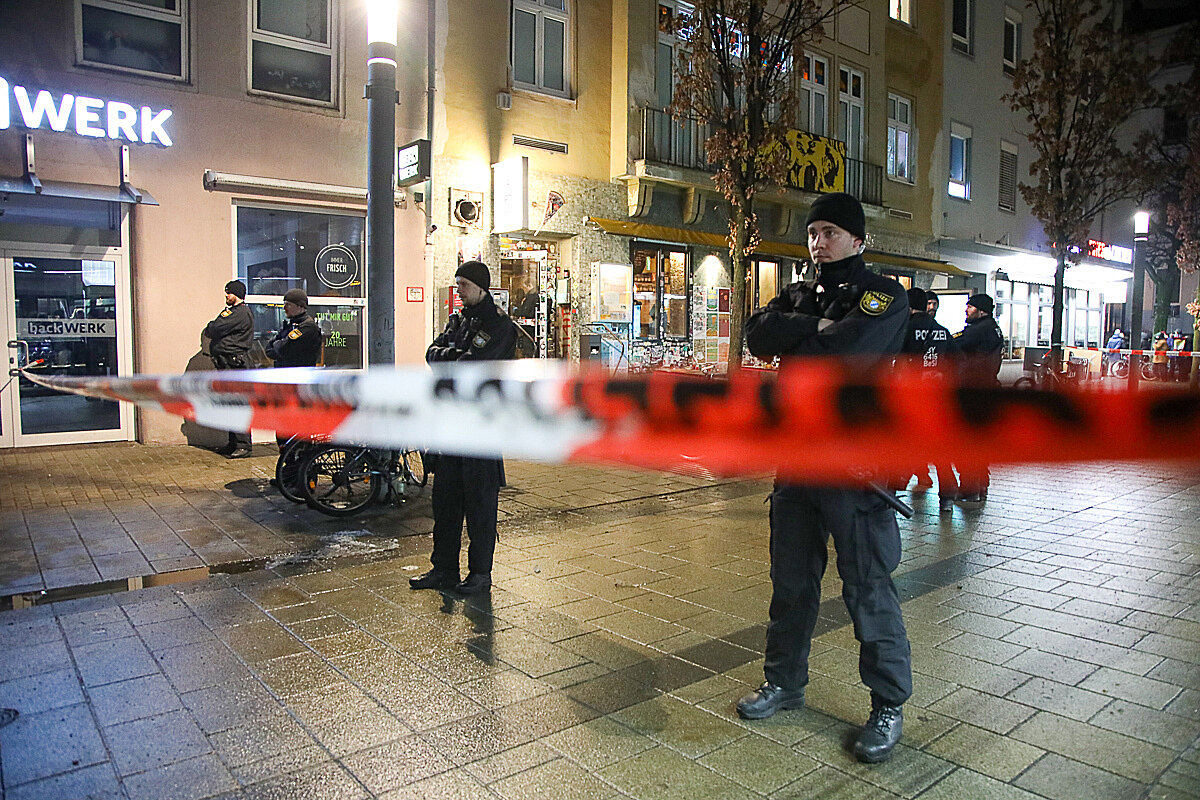
On a Saturday evening around 9 p.m., smokers usually gather in front of the City Club in the center of Augsburg in anticipation of the night ahead. On the last weekend in January, a completely different picture can be seen: During a techno party that was already underway, around 200 police officers stormed the club, which is considered an important cultural meeting point for the alternative scene in Bavaria’s third largest city.
When the police gained access to the premises, there were around 150 guests in the club. You are immediately asked to put your hands up. “There was an emergency worker on site for each person,” says a City Club employee. When she asks for a search warrant, it is not initially presented to her.
Meanwhile, the officers act brutally: they break open doors with battering rams, breaking windows in the process. Many of the officers are masked and equipped with body cameras when on duty. Remarkable: They are also accompanied by a television team from the program “Galileo” (Pro Sieben). All people present are held on site for several hours.
Body searches around freezing point
Sometimes they have to endure outdoor temperatures at temperatures around freezing point. The officers gradually carry out body searches. Memory protocols available to the taz show that some people had to completely undress. They were asked to “pull their underpants forward and down” or “lift their genitals.”
At the end of the operation, which lasted several hours, Sebastian Demmer, managing director of Blausky GmbH, to which the City Club belongs, received the search warrant. The police press release only states that the raid was ordered in consultation with the Augsburg public prosecutor’s office because investigations had confirmed the suspicion that “open consumption and trafficking of narcotics” was taking place in the club.
From the perspective of the City Club’s lawyer, Martina Sulzberger, the underlying investigation results are unlikely to be sufficient. She announced that she would take legal action against the search warrant. Demmer is of the opinion that that “in places of culture and nightlife – as everywhere in society – drugs are consumed“It is a reality, but one that is countered with strict controls.
Diverse cultural place
In any case, a horror image of the City Club as a hotbed of nocturnal drug excesses is incomplete. Rather, Konrad-Adenauer-Allee 9 is a diverse cultural location that has won several awards, among other things. Readings, theater performances and concerts regularly take place in a café on the ground floor and the club rooms above. The Awareness Collective Augsburg e. V. is based here.
The conclusion of the operation: A total of 263 people were checked and various narcotics – including cocaine and amphetamine – in the low three-digit gram range were seized. 17 people were temporarily arrested, 16 of whom were released after the measures were completed. Demmer emphasizes that none of the narcotics found could be attributed to him or Blausky GmbH.
Grab “as much bycatch as possible”.
Although the search warrant was directed against managing director Sebastian Demmer, the operation was carried out during ongoing operations. However, everyone present was included. Konstantin Grubwinkler, a specialist lawyer for criminal law, classifies the situation to Bayerischer Rundfunk: It is “absolutely not usual” for action to be taken with this “severity and massiveness” against people who are only privately on site and are not accused in the proceedings. He assumes that the police wanted to grab “as much bycatch as possible” here.
Eva Weber (CDU), Mayor of the City of Augsburg, is convinced that state actors are called upon to critically examine their actions “also with regard to proportionality”. Also the Green Party politician Claudia Rothwho posted a video in front of the City Club on her Instagram channel, was irritated by the effort, which “seems anything but proportionate.” The SPD and the Greens announced a parliamentary review in the Bavarian state parliament.
According to the Augsburg Club and Cultural Commission, the number of emergency services is “many times (approx. tenfold)” higher than usual compared to similar measures. A request from the taz to the Bavarian police about comparable operations at major events, such as folk festivals, where excessive drinking and drug use are to be expected, remained unanswered by the time of going to press.
Such police measures are particularly well known in subcultural institutions. Most recently in the techno club Rote Sonne in Munich (2025) and in the rocket in Nuremberg (2023). The three clubs also have another thing in common: they have all already been awarded the (pop)award Bayern. It seems as if a pattern is emerging in the operational strategy of the Bavarian police.