

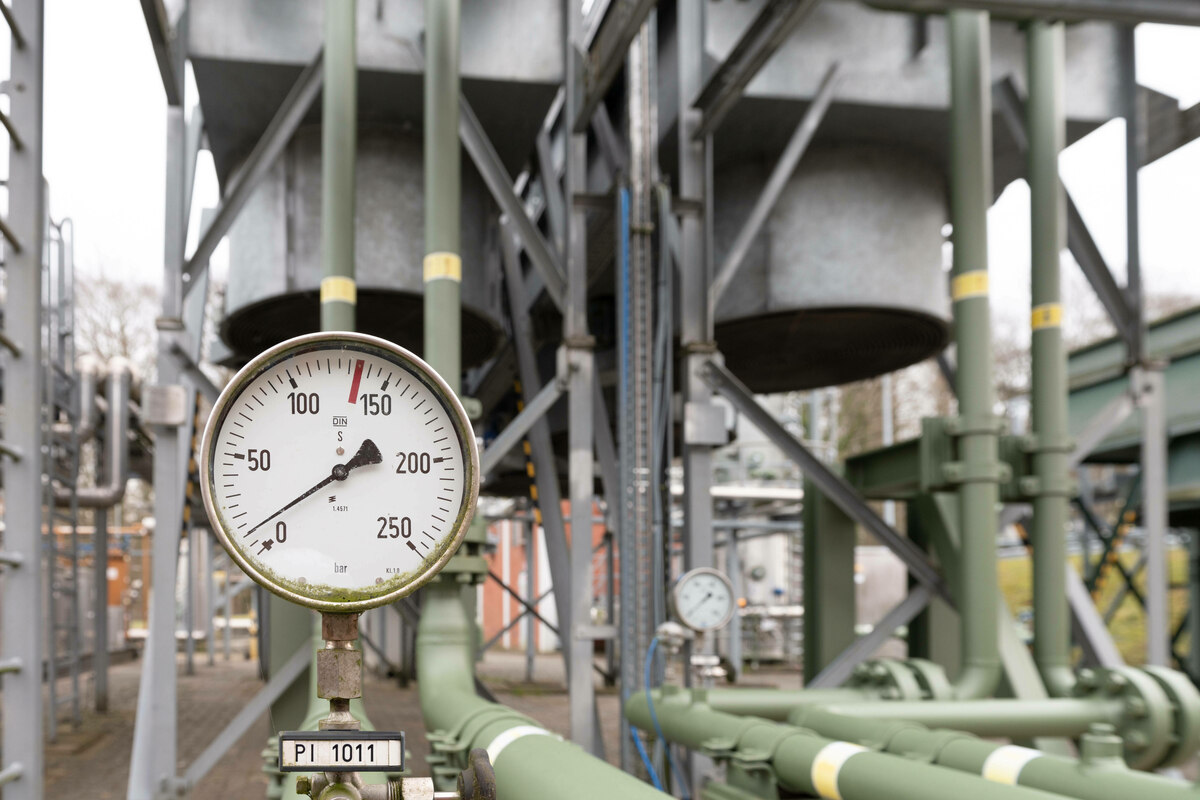
The decreasing cold in Germany is providing some relief when looking at the status of gas stocks – even if it is still too early to give the all-clear. At the same time, there is growing concern as to whether there will be enough energy for heating in the coming winter. The pressure on Economics Minister Katherina Reiche (CDU), quickly a national gas reserve to build increases.
Managers from the energy industry and the public have been looking nervously at the German gas storage facilities for weeks. At the beginning of the heating season, the warehouses were much less full than in previous years. The cold wave in large parts of Germany has significantly reduced supplies. In Bavaria, the deposits are only 18.8 percent full. The national average was 26.6 percent on Tuesdaywhich corresponds to 66.8 terawatt hours.
The Federal Ministry of Economics and the Federal Network Agency, which is responsible for energy security, repeatedly assure that there is no reason to worry. “The now well-developed LNG infrastructure in Germany and Europe enables the necessary imports to Germany in addition to the existing and secure main supply of Norwegian pipeline gas,” said a spokeswoman for the Federal Ministry of Economics. The Bavarian Ministry of Economic Affairs also sees no reason to worry. It refers to the Austrian gas storage facilities Haidach and 7Fields, which are connected to the Bavarian network and are more than 35 percent full.
Despite these assurances, those responsible in the energy industry are relieved that the cold wave has subsided in large parts of Germany. “In the past few weeks, gas has been withdrawn at a pace that we did not expect,” says Peter Schmidt, Managing Director of EWE Gasspeicher. The subsidiary of the predominantly municipal energy supplier EWE operates three gas storage sites in Lower Saxony that are filled above average.
The situation is currently not worrying
Winter is not over yet. If temperatures drop significantly again, relief could turn into worry. As of now, the situation is not worrying this winter despite the low levels. What is certain, however, is that the storage tanks are going into the next season as empty as never before. It is already becoming apparent that refilling will not be as smooth as before. The storage season runs from April to October. Typically, gas retailers reserve storage space well in advance. “But there is still a lot of unmarketed capacity this year,” reports Schmidt.
The background: The price of gas used to fall after the heating season. Traders used this to build up supplies in the spring and summer for the fall and winter because they could sell the gas for more money than they had to pay themselves. After Russia’s attack on Ukraine and the ensuing energy price crisis, the market changed. Also due to the legal regulations on storage filling that have been in effect since the energy crisis, prices no longer fall as much in summer. Dealers are no longer willing to store a lot of gas because it incurs costs. “Dealers are now buying gas for the period in which they need it,” explains Schmidt. “Stocking up isn’t worth it for them at the moment.” If the storage tanks remain comparatively empty, this could lead to sharp increases in prices next winter when temperatures are low.
To avoid shortages, the state could create a national gas reserve based on the model of the national oil reserve. This is what the Federal Association of the Energy and Water Industry (BDEW) and the President of the Federal Network Agency Klaus Müller are calling for, among others. “That should happen very soon,” says Schmidt. Because storing large quantities takes time. “The gas would have to be procured in slices so that prices are not driven up,” he explains. Politicians and the energy industry would have to agree on how much gas should be kept in reserve. Because the demand is heavily dependent on the weather.
The costs would be manageable. A reserve of 100 terawatt hours would last for around 50 days in winter with a consumption of 2 terawatt hours per day. At a price of 30 euros per megawatt hour, that would cost 3 billion euros plus storage fees of 300 to 400 million euros – a fraction of what the state paid for the “gas price brake” to dampen the energy price crisis in 2022 and 2023. And the state could sell the gas one day when the reserve becomes unnecessary.
The opposition criticizes the fact that an uncertain gas supply situation has arisen in the first place. “We are shivering through the winter,” says former Green Party Secretary of State for Economic Affairs Michael Kellner. The Greens are of the opinion that for the current Minister Reiche is also responsible for the uncertainty. Because it didn’t ensure that more gas was stored in the fall, although there were indications from the energy industry of possible bottlenecks. Because the next regular meeting of the Bundestag Committee for Economic Affairs and Energy is not until the end of February, they are calling for a special meeting. Reiche should explain the measures she wants to take to ensure security of supply. “We are currently checking whether participation is possible in terms of time,” said the spokeswoman for the Ministry of Economic Affairs.
Kellner also sees a need for rapid action with a view to next winter. “The government must respond to the changing market conditions,” he demands. He also advocates the development of a national gas reserve. If this supply is to be available for the coming winter, the Federal Ministry of Economics must act now and create the legal requirements, warns Kellner. “Time is of the essence; it takes several months until a gas storage facility is filled.” It is therefore important to quickly create clarity for market participants.
The taz’s query as to whether the Federal Ministry of Economics is in favor of a national gas reserve remained unanswered.