

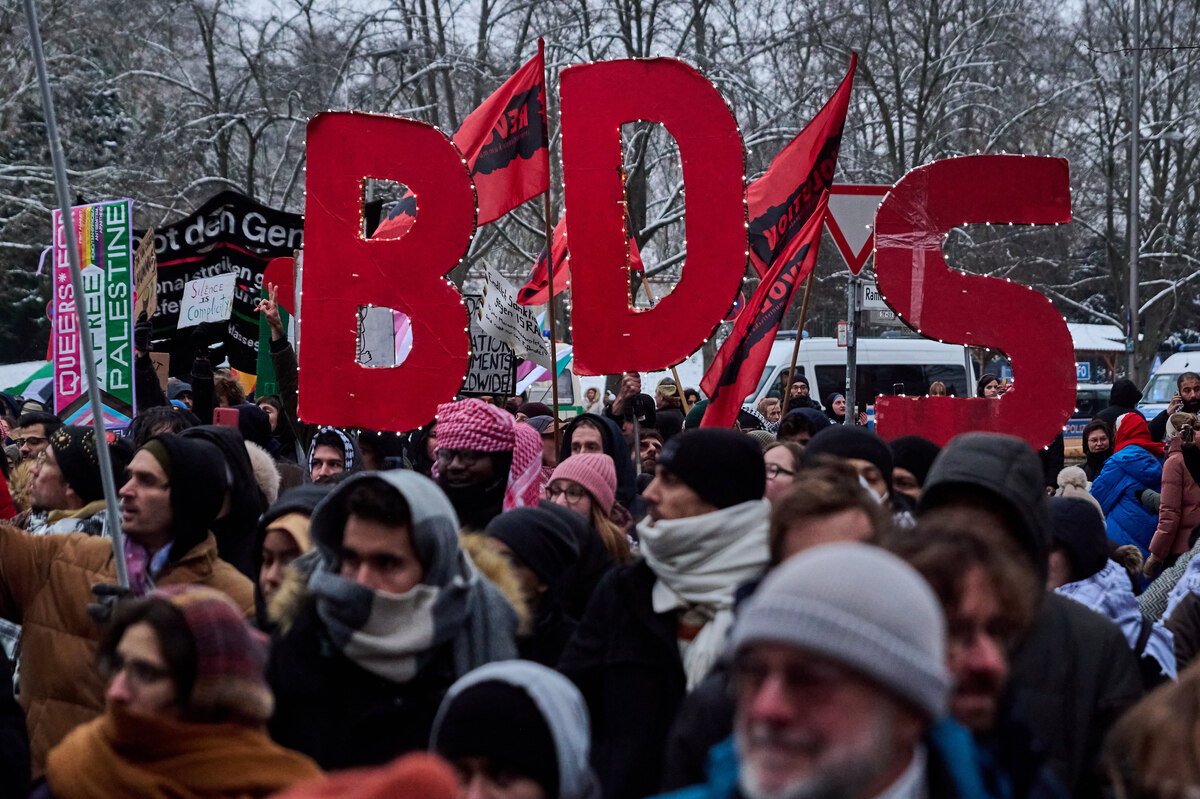
Is a boycott the right way to… war crimes and Human rights violations To stop Israel’s attacks on the Palestinians? For the organizers the Academic Boycott Conferencewhich is taking place this weekend in Berlin, this question has long been answered with a resounding yes. The content of the three-day congress is logically about how to build a nationwide campaign for the boycott of Israeli universities.
The congress is organized by the Internationalist Alliance, an association of Palestinian solidarity groups in Berlin. Those involved include the Socialist German Student Association (SDS), the Jewish Voice, various small communist groups, but also the district associations of the Left in Neukölln and Wedding.
“The need for a boycott arises from the analysis of what functions Israeli universities play in the illegal occupation “Take over Palestine,” explains Leon Bijan, press spokesman for the conference. The Israeli institutions are integrated holistically into the military-industrial complex.
Computer technologies are being developed at the Technion University in Haifa with algorithmic target detection the Israeli army are relevant, explains Bijan. There are also courses of study specifically for soldiers. “Universities are not neutral authorities, but are significantly involved in the occupation,” criticizes Bijan. Technion in particular is centrally integrated into the weapons industry. The university cooperates with Israeli weapons manufacturers such as Rafael and Elbit.
Ecosystem of war
Technion is not the only university seeking proximity to the defense industry. Tel Aviv University only held the event at the beginning of December Defense Tech Weeka two-day conference that showcased the defense industry’s latest developments: attack drones, algorithmic surveillance technologies and AI-based propaganda tools.
Therefore, institutional cooperation with these universities amounts to aiding and abetting violations of mandatory international law.
Uppsala Declaration
In recent years, fueled by the Gaza war, an alliance has formed between Israeli universities, the military and defense companies, which is referred to in the start-up world as an “ecosystem”. Graduates found start-ups that were bought by major defense companies. Due to the war in Gaza and the occupation in the West Bank, the need for high-tech military products remains high.
The campaign, which will begin at the conference this weekend, aims to get German universities to stop collaborating with Israeli institutions. “The boycott is intended to exert political pressure,” says Bijan. This is not only symbolic, but also material. For example, hundreds of millions of euros flow into the Israeli scientific community every year through the European Horizon funding program.
In Germany there are many connections with the Israeli scientific landscape. On the website Academiccomplicity.eu The activists list over 300 direct and indirect connections between German universities. “The TU Berlin in particular has close connections with the Technion Institute,” criticizes Bijan.
BDS in new clothes
The call for an academic boycott has existed since 2005, the year the university was founded „Boycott Divest Sanction“-Kampagne (BDS). The campaign advocates not only an academic, but also a complete, economic and cultural boycott of Israel. A Bundestag resolution passed in 2019 condemned the BDS movement as “anti-Semitic” and called on municipalities not to provide spaces for campaign activists. The Berlin branch of the BDS is also involved in the conference alliance.
But the call for a boycott is now being heard far beyond the Palestine solidarity movement. In the adopted in July last year Uppsala Declaration 438 scientists working at German universities are calling for an academic boycott.
“In Germany, the discussion about an academic boycott is almost impossible to hold due to the legally controversial BDS resolution of the Bundestag,” criticizes co-signatory Robin Celikates, professor of philosophy at the FU. Boycotts are a classic form of peaceful resistance that is internationally recognized as legitimate and effective. It is important to him: “The boycott is not directed against collaboration with Israeli scientists, but against institutions.” It is not about punishing individuals who teach at Israeli universities.
The Uppsala Declaration primarily cites legal concerns for an academic boycott. Israeli universities are closely committed to illegal occupation and support of the “apartheid system” and the “ongoing genocide,” said the statement, which was adopted before the ceasefire in Gaza. “Therefore, institutional cooperation with these universities amounts to aiding and abetting violations of mandatory international law.”
Boycott works
Internationally, academic boycotts are trending. The Israel Today portal reports a rapid increase in boycott activities at European universities. The boycott is increasingly shifting to an institutional level, the report said. In Ireland, Spain and Belgium More and more universities are ceasing their collaborations with Israeli partners.
The Berlin universities have so far firmly refused to stop working together. “A general boycott of Israeli science weakens democratic forces and would particularly affect those Israeli scientists who are committed to combating the polarization and radicalization of society,” says HU President Julia von Blumenthal.
The Berlin Left is also divided over the boycott demand. Tobias Schulze, science policy spokesman, rejects a complete boycott: “We think it is important to maintain academic exchange,” says Schulze, adding that this was also the case with Russia’s military aggression. After the war of aggression in 2022, many universities stopped their cooperation with Russia. Questionable military cooperation could also be prevented in another way. “I’m a big fan of the civil clause,” says Schulze – in other words: a voluntary commitment by universities to forego military research.
Jorinde Schulz, spokeswoman for the left-wing district association, which is also represented in the organizing alliance, at least welcomes the fact that the conference is taking place: “It is important that we can discuss academic boycotts.”