

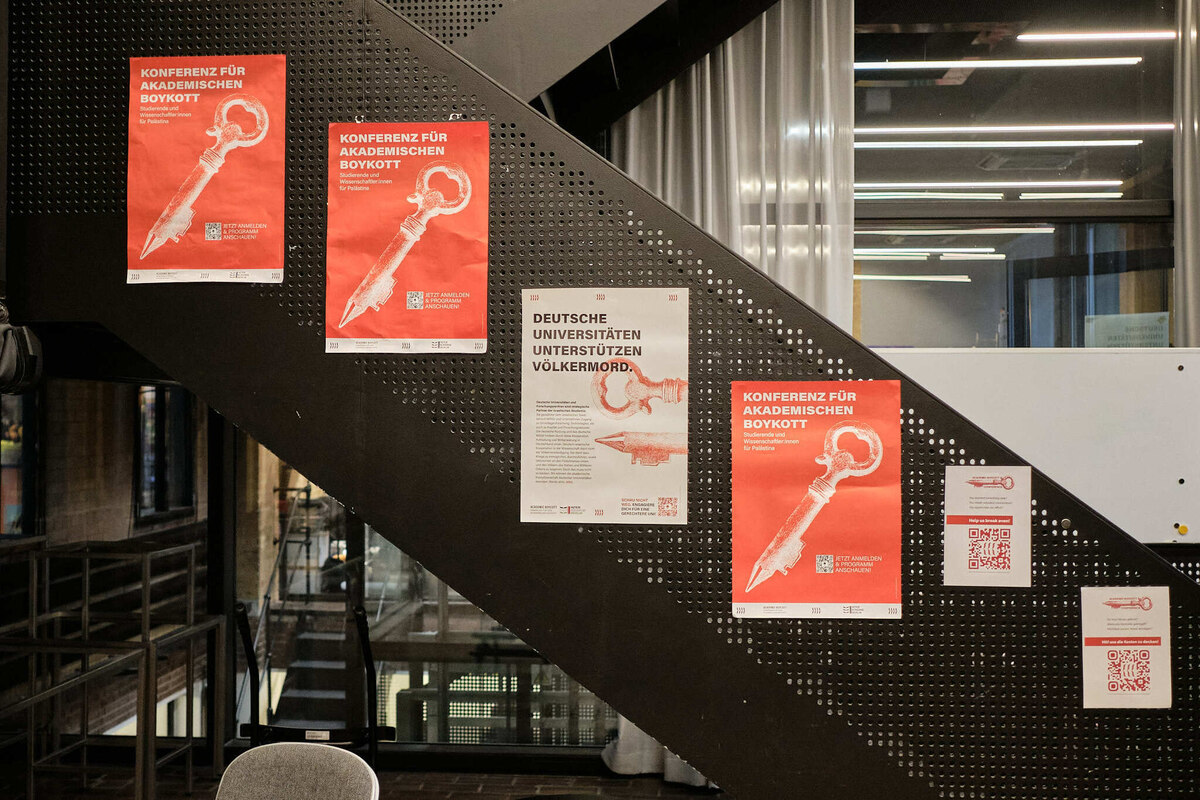
Young people with Pali scarves are nothing unusual on the hip Paul-Lincke-Ufer in Berlin-Kreuzberg. On this Saturday afternoon, many of them went to number 21. Conveniently, police officers from the 21st Hundred were standing in front of the door, so you couldn’t miss the “bUm – space for solidarity together”.
This weekend the Internationalist Alliance Berlin, a coalition of left-wing pro-Palestinian groups, is having a three-day event here „Academic Boycott Conference“ organized. The 150 or so participants wanted to shed light on the role of Israeli science in “colonial and military structures” and develop strategies for a nationwide academic boycott campaign.
Participation was only possible after prior registration; press representatives were only admitted to certain panels on Saturday. In fact, the event had something of a university seminar; the atmosphere was calm and focused.
At the three information tables there were Palestine-related jewelry, keffiyehs in different colors and Che Guevara shirts, and a stand from the “Communist Organization” offered Marxist analyzes of a wide variety of crises. An online survey asked: “What do you find most difficult to boycott?”
No statements that could be criminally relevant
“German universities support genocide,” read one poster, but otherwise there were no banners, no slogans, no statements that could be criminally relevant. The legal scholar Nahed Samour later put it this way: There is no need for activist rhetoric, because all the answers are in international jurisprudence.
Tair, the speaker at the conference, did not give her last name: “It’s about putting further pressure on our institutions and forcing them to comply with international law and to stop their cooperation with Israeli institutions and universities, which are central to the maintenance of the occupation, genocide and settler colonialism.”
The title of the panel “The Need for Boycott-Divestment Sanctions Today” left no questions unanswered. The legal scholar Nahed Samour spoke about the importance of international law for the BDS campaign.
A boycott is consistent with international law
Nahed Samour, legal scholar
Her frontal Powerpoint presentation was peppered with keywords for the intended nationwide academic boycott campaign. Her thesis: “A boycott is in accordance with international law.” Universities have an educational mission, said Samour, and in the face of suspected genocide, public institutions cannot simply carry on as before. German universities also “must avoid cooperation that could constitute aiding or acknowledging illegal situations.” Anything else is not neutral, but carries the risk of breaking international law, said Samour.
Side swipe at the current discussion
South African activist Barbara Schreiner gave an overview of the long struggle against apartheid, in which boycotts played a major role. Many South African universities would have rejected an academic boycott because it would strengthen conservative structures, she said, taking a swipe at the current discussion. The opposite was ultimately the case: the universities could no longer present themselves as neutral, “because neutrality actually supports the status quo”.
The Brazilian activist Lucas Febraro relied on the fact that international jurisprudence and a majority of public opinion were behind him (this was certainly the case here in the room). A lot has already been achieved and we have to proceed strategically, said Febraro: Apartheid is a crime and BDS is an anti-racist movement.
After the input there was hardly any time left for questions. “Why are we here?” someone asked. “We are here because we see a terrible injustice happening,” replied Febraro somewhat cloudily. The question of what would happen after a possibly successful boycott campaign could no longer be clearly answered.
Does Tair believe that German universities are really stopping their cooperation with Israel? “We have to believe in it because there is no other option,” she replied.