

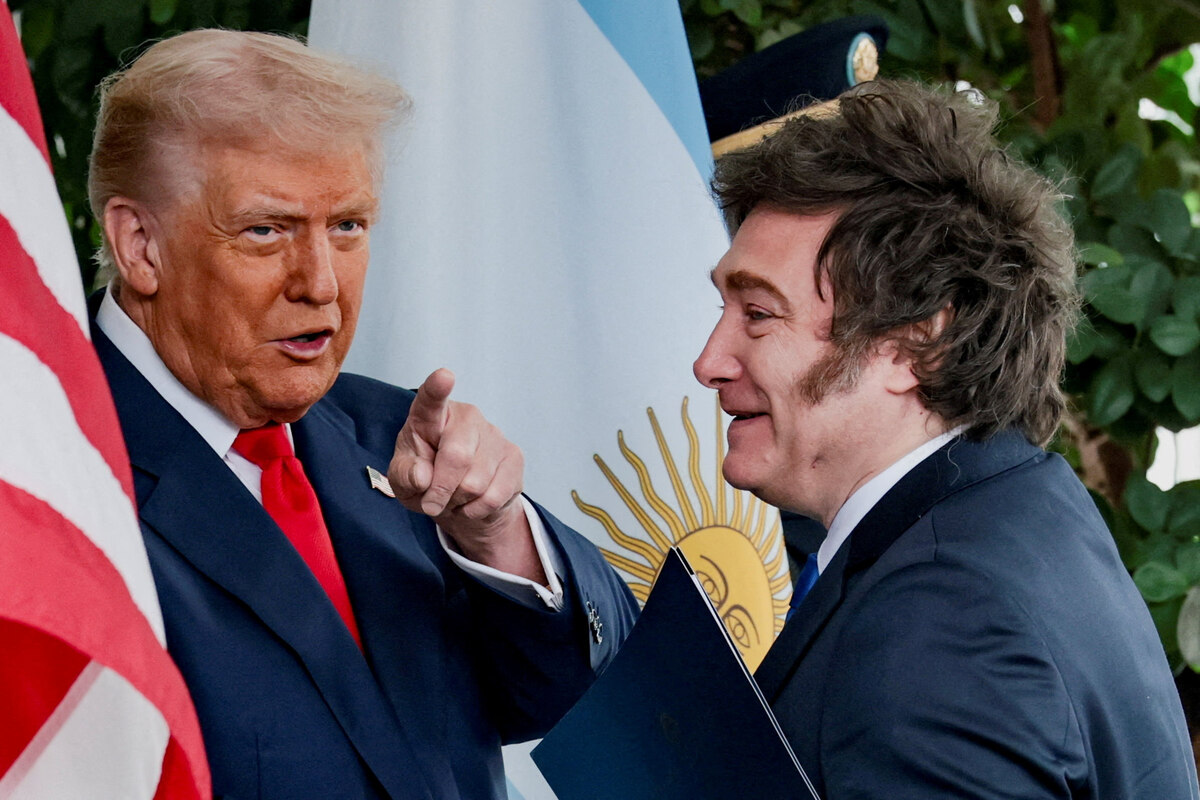
The right-wing governments in Washington and Buenos Aires are also entering into a closer economic partnership. “Argentina is the first South American country to sign an agreement of this magnitude, joining a select group of economies with preferential access to the US market, the world’s largest importer,” the White House said last Thursday. Previously it was “Agreement on Reciprocal Trade and Investments between Argentina and the United States”.
This is a reason for Argentina’s Economy Minister Luis Caputo to be happy. A few days earlier, Caputo announced that he would never buy his clothes in Argentina. It is far too expensive there for the quality offered, says Caputo. Whether he no longer has to fly to Miami to shop in the future is part of a heated dispute he has sparked with the local industry.
For the libertarian President Javier Milei, the agreement is an important lever with which he wants to open the internal market. For market liberals Argentina a country that is sealed off from the world market by customs barriers. However, others see this as a necessary protective measure against cheaper imported goods.
Under the agreement, Argentina must now reduce or eliminate import tariffs on more than 200 U.S. goods, including machinery, transportation equipment, chemical products, auto parts and entire vehicles. The government points to the abolition of counter-tariffs on 1,675 Argentine products as a success and the fact that no more than 10 percent duty may be levied on the rest.
Argentina’s car manufacturer worried
There is criticism of the agreement from the Argentinean economy. Argentine carmakers are concerned because US competitors are granted an annual import quota of up to 10,000 vehicles, while the agreement does not provide better treatment for Argentine cars. The country’s car industry already has to contend with competition from Asian imports.
There is still no agreement on how to deal with patents and intellectual property rights. This should take place in the next 30 days. Argentina’s pharmaceutical and biotech industries are fiercely defending themselves against possible demands for patents on medicines or seeds from US companies. In addition, the US pharmaceutical industry wants to be able to sell drugs that are approved by the US Food and Drug Administration in Argentina without further approval.
Already in the coming days President Milei implement part of the customs agreements by decree. In addition, a number of legislative changes must be made that must be approved by Congress. There is already criticism that the text of the treaty often contains the sentence “Argentina is committed to…”, but only in a few places does it say “The USA is committed to…”. An “agreement on economic and trade subordination” is what Argentine trade relations expert Julieta Zelicovich calls it, summing up: “Argentina’s commitments = 113 (there are more, since there are lists). US commitments = 10 (8 of them are reciprocal with Argentina… so actually 2).”