

In May 1997, one hundred Chinese artists were invited to take part in an exhibition of Chinese art parallel to the upcoming documenta X. The letter, under official documenta letterhead, was signed by a curator named Ielnay Oahgnoh. Please who? Some saw through the joke, others didn’t – and reacted angrily when the hoax was discovered.
Yan Lei and Hong Hao, both in their early thirties, came up with the invitation and addressed it to their fellow artists. In doing so, they exposed how great the need was to take part in the documenta as a supposed hub of world art events. That wasn’t a given in 1997. The documenta served as a symbol of breaking out of national and provincial narrowness.
Fifteen years later, Yan Lei was actually invited to take part in documenta; a nice irony of history. It is noted in the catalog of the exhibition “The China Moment. Contextualizing Individualism in Chinese Contemporary Art”, with which the documenta Institute in the Fridericianum is going public for the first time. The exhibition and accompanying catalog created by the curators Mi You, Su Wei and Anna-Lisa Scherfose have chosen a very difficult topic, because: What do we already know about Chinese art?
„The China Moment“. Kasseler Kunstverein, until March 22nd. Catalog (Hatje Cantz): 34 euros.
The question actually goes much deeper; because what do we know about recent Chinese history? It is the story of the breathtaking transformation of the economy and society while maintaining the political system, that is, the undiminished dominance of the communist party and its all-powerful leader.
The change initiated by Deng Xiaoping
China’s path to the present is fundamentally different from the paths of other countries, as institute director Heinz Bude points out in the catalog. Also in the field of art: There was no such thing as “contemporary art” in the land of centuries-old academies. It only came into being with the The change initiated by Deng Xiaoping in 1979. From then on, interest grew in the West. But now the “China moment” seems to be over again, as co-curator and Kassel professor Mi You, author of the monograph “Art in a Multipolar World”, notes.
The exhibition, which sees itself as a research project, presents different forms of individualism for discussion. “Individualism as a reaction” is the title of the first chapter, and it begins with the tragic fate of Daton Dazhang. “I saw Death” from 1998 is a photographic self-portrait with a piercing gaze. The repeated preoccupation with death ultimately led to suicide at the beginning of 2000, described in the catalog as a “turning point” for the art scene.

Addresses the environmental destruction caused by the Three Gorges Dam: Zhuang Hui, “Longitude 109.88, Latitude 31.09,” 1995-2008
Photo:
Courtesy of the artist
A little later, Lu Jie and Qiu Zhjie undertook a kind of re-enactment of Chairman Mao’s legendary “Long March”, reenacting his route with artists and local residents – and the plastic baby figure that is always carried and captured in Jhiang Jie’s photographs; a journey through place, time and change. More provocative is Wang Guangyi, who deals with the specific forms of military propaganda of the Mao era in the 2007 series “Cold War Aesthetics”.
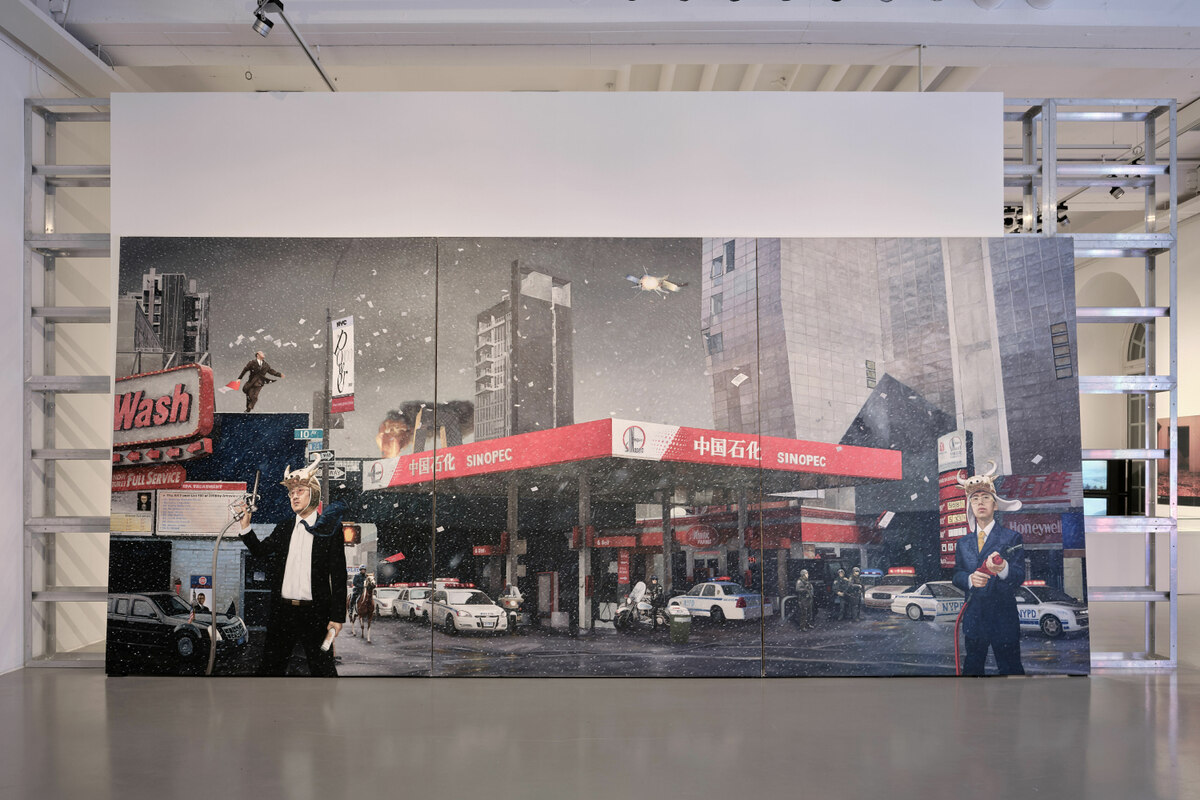
It is striking how much the artists shown in Kassel do field research and document the reality they find. Photography and video are the available means. Only in the second chapter, “Individualism as Participation”, is painting found, by Hang Hao & Yan Lei – the originators of the documenta fraud invitation! – in the form of a monumental painting as a painted collage, set around a gas station of the oil company “Sinopec” in the drifting snow (“Snow Bull”, 2009).
In one corner of the Kassel exhibition, a green patinated bronze sculpture surprises: a seated figure that rests on one of the wicker baskets in which the rent is to be delivered in kind. “The Rent Collector’s Court” is the name of the scene comprising 114 life-size clay figures, which, created and presented in 1965 shortly before the Cultural Revolution, was declared a model of socialist realism by Mao’s wife Jiang Qing and demonstrated all over the country.
Harald Szeemann wanted to present the ensemble of figures at his legendary documenta 5 in 1972, but that didn’t work; It wasn’t until 1999 that at least one replica was shown in Venice (and promptly received the Golden Lion).
Last but not least, it is the bronze figurine that came to Kassel as a guest gift that shows the distance between post-communist art. And the distance to the K couldn’t be greaterbe collectivism that the nameless man in Wang Bing’s In the hour and a half video “Man with no Name” from 2009, a man alone in a placeless country, concerned with pure survival, without contact with any third parties – “individualism in the form of silent resistance,” as the catalog notes.
25 positions are shown, from individual artists to collectives. What the viewer can see in them is the distance to the Western globalized art scene. China, once again we realize, is its own continent.