

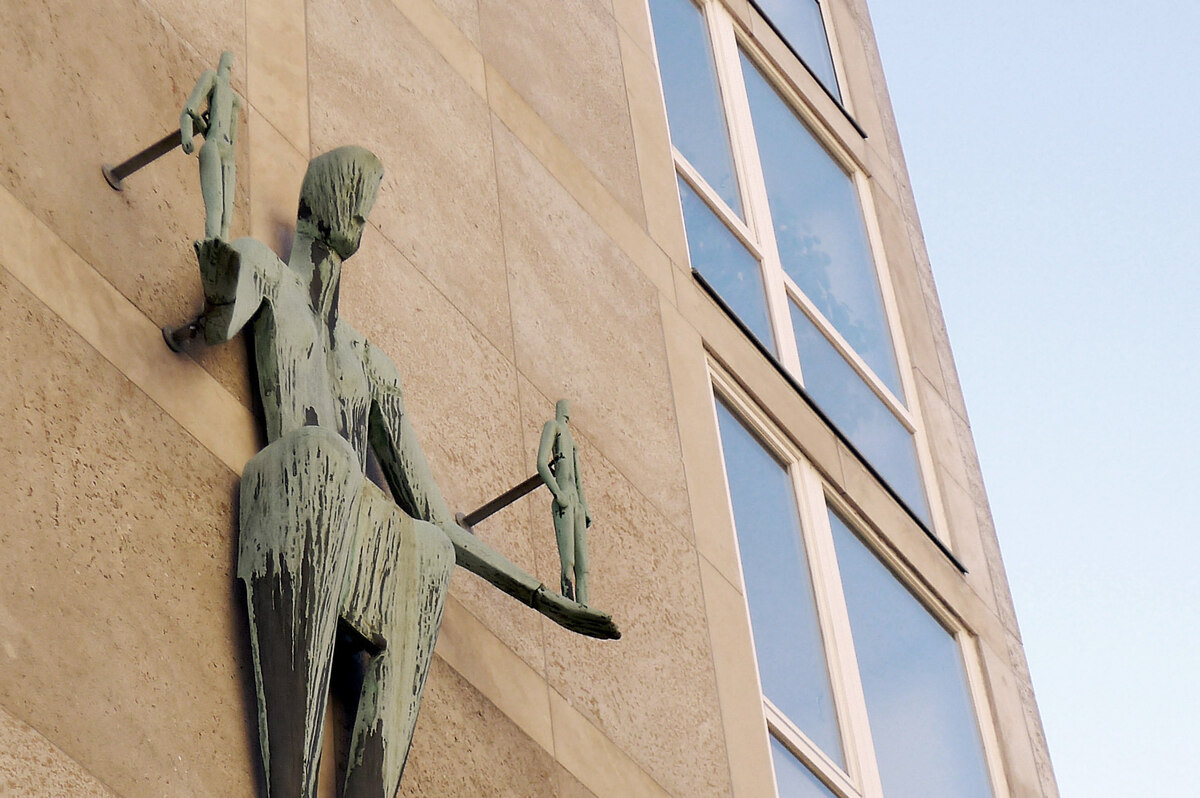
Art in architecture – this form of public art seems to be undervalued at the moment. It has a long tradition in this country, with a peak phase in reconstruction after the Second World War. At that time, it not only took on aesthetically comforting tasks as “architectural decoration,” it could also become an experimental field for social and political self-assurance. An example: that modern “Justitia“, which the artist Bodo Kampmann created in 1956 for the new building of the public prosecutor’s office in Braunschweig.
The initiative for this patron saint of justice, who no longer needed the traditional aids of a blindfold, scales and judge’s sword, is working the lawyer Fritz Bauer back. When the Basic Law of the Federal Republic of Germany came into force in 1949, he returned from exile in Scandinavia and took over the post of regional court director in Braunschweig.
Bauer placed great hope in a humanistic legal order in the young democracy, whose primary duty would be the defense of human rights. Appointed Attorney General in 1950, trials observed nationwide ensured the rehabilitation of the resistance fighters of July 20, 1944. In his plea, Bauer coined the term “unjust state” for the Nazi regime.
Bodo Kampmann: “Sculptor and goldsmith”. Braunschweig Municipal Museum, until February 28th. Publication “Bodo Kampmann – an artist’s life in Braunschweig” (Bärbel Mäkeler): 22 euros.
Bodo Kampmann, born in 1913 into a Rhineland artist family and raised in Berlin, was a trained goldsmith. As a wounded Wehrmacht soldier, he remained in Tyrol for a long time, and in 1954 he accepted a call to the then Braunschweig Werkkunstschule for the metal specialist class, which he led until shortly before his death in 1978. Bauer found in him the congenial artist for his radically democratic Justicewhich embodies law and justice as superhuman categories in itself. Clearly, heavy, monolithic bronze casting was not an option.
In the ascetic reduction typical of the time
Kampmann took light, thin copper sheet and made the figuration out of it: the three-meter-high central personification of the judiciary and a man and a woman in her measuring hands. Designed in the ascetic reduction typical of the time and left recognizable in its fragile arrangement, it can be seen as a symbol of an unreinforced democracy that protects and justifies itself solely from itself, carefully weighed up.
It’s a shame that in 2023 this Lady Justice did not move with the General Prosecutor’s Office like the Fritz-Bauer-Platz address installed in 2012, but remained in its old location.
This major work of Kampmann and the contemporary historical context seem to have been forgotten. It is all the more commendable that the author Bärbel Mäkeler has now compiled her many years of research into his life and work in a publication. Kampmann’s other well-known and unknown architectural sculptures are documented there, in the cityscape and in representative interiors, not only in Braunschweig. Kampmann also created jewelry, everyday objectsstage designs, often in his reduced, abstract forms.
A cabinet exhibition in the Municipal Museum is currently honoring a cross-section of Kampmann’s small sculptures and award-winning product designs. It is embedded in a collection of exemplary consumer goods that his contemporary Walter Dexel put together.