

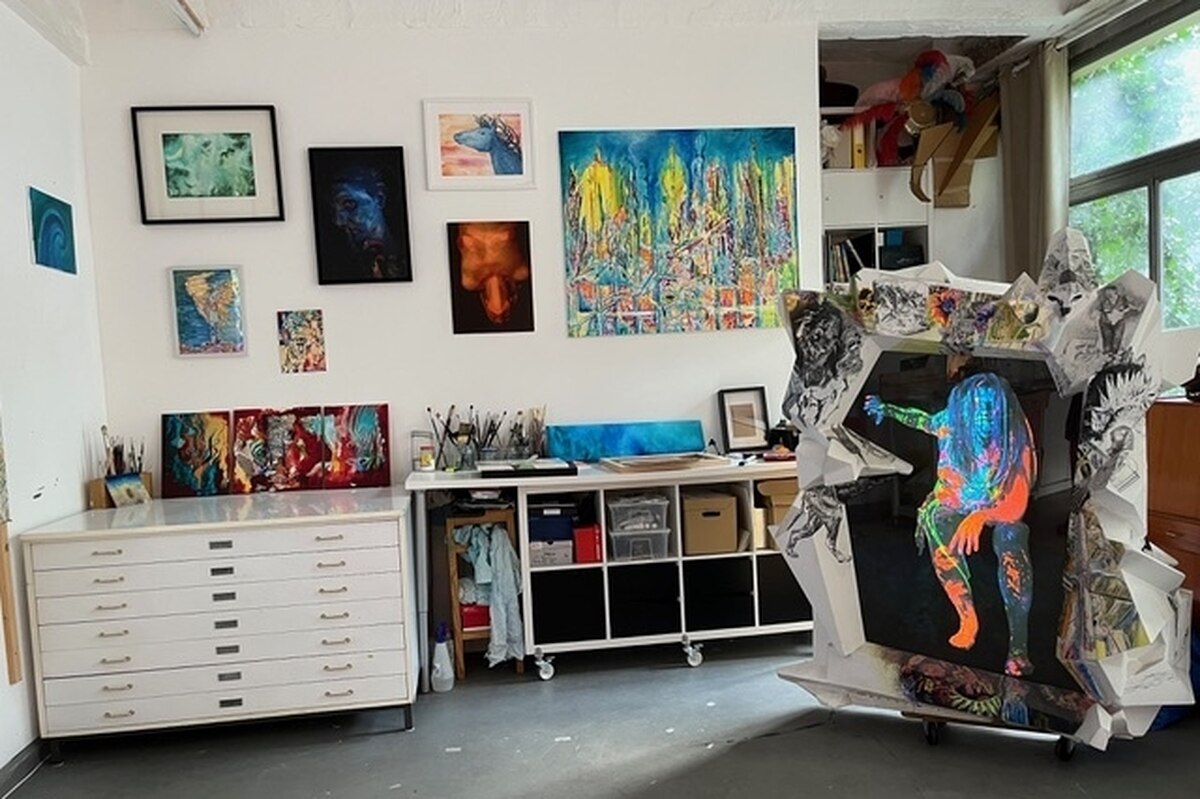
Even the first look at them new platform of the studio office alarm bells are ringing in the Professional Association of Visual Artists in Berlin (bbk). Red dots glow on the digital city map like small, fresh wounds: around a third of the 1,027 studios in more than 60 buildings are considered to be under acute threat. Red here does not mean temporarily unsafe, but rather: in danger of disappearing.
The readjustment of Berlin’s austerity policy in terms of culture at the end of last year did not change this, the speakers unanimously emphasized at the press breakfast in the printing workshop of the bbk’s cultural work in Bethanien on Mariannenplatz. The mood on Monday morning is businesslike but tense. The numbers speak for themselves.
What the studio office in Berlin achieves is considered internationally enviable. The principle is as simple as it is effective: While rents for studios on Berlin’s free market now average 20 euros per square meter, artists pay between 4.90 and 6.50 euros for the 1,027 supported studios – depending on their income. The state of Berlin will cover the difference. An instrument that has proven itself for over 30 years.
But exactly this Instrument is now radically bled dry. Funds for inventory protection will be reduced by around 20 percent. The most drastic cut is in the expansion of new workspaces: instead of over 20 million euros, only a little more than 3 million will be available in the future, which is a reduction of 85 percent. In practice this means: hardly any new studios, increasing uncertainty for existing locations, standstill in an area that actually needs expansion, and at least at the same pace as rent prices.
Wake-up call for the whole world
This morning a sentence was uttered again that has already become a ritual in this context: the cuts are a “wake-up call for the whole world,” said Birgit Cauer, spokeswoman for bbk Berlin. A pathetic sentence – and yet an accurate one. Because he gets to the heart of a major contradiction between cultural-political rhetoric and real financial management.
Berlin continues to present itself as a cultural metropolis, a sexy magnet for creative people, a city of freedom and unlimited possibilities. The cultural budget, however, is around two meager percent of the overall budget – and is now being cut again. For comparison: Hamburg spends almost twice as much.
It has long been proven that culture is not a subsidy business. Cauer points out what various studies show: that every euro invested in culture flows back into the city many times over – through gastronomy, hotels and retail. “Detour profitability” is the unwieldy term for this. Culture not only creates identity in times of meltdown of democracy and the drifting apart of society, but also a source of economic income. For many of those present, the fact that savings are being made here seems like political will.
Julia Brodauf and Lennart Siebert, the bbk studio representativesrecall that their program was once created as an answer to a specific question: How can an art metropolis prevent its producers from being displaced? According to Siebert, the austerity measures have effectively “cancelled the expansion”. And even securing the inventory is uncertain because Berlin’s cultural administration accepts that costs will rise and the target groups will shift. When his office announced that the rents for the studios would essentially have to be even lower, he was met with incomprehension in the administration.
Below the poverty line
According to the two of them, Berlin has the highest density of artists in the world after New York. Various estimates put the number of people trying to make a living from their art in this city between 10,000 and 20,000.
This means that many of them live at or below the poverty line. Their incomes have not increased in the last five years, quite the opposite. Added to this are rising rents and a massive loss of purchasing power. In recent months we have seen more and more artists giving up their studios – and often their profession.
At the end of the press breakfast, he reports Britta Adler to speak. She is one of the artists who works in one of the threatened studio houses. Her description is unspectacular and that is precisely why it sticks. She has been fighting with colleagues for the studio house on Schönstedtstrasse for a year and a half. In order to finance her artistic work, she has to work additionally, and she is also a single mother of two children.
The sentence that follows is bitter: Most artists in Berlin currently wouldn’t even earn enough money if they stopped sleeping.