

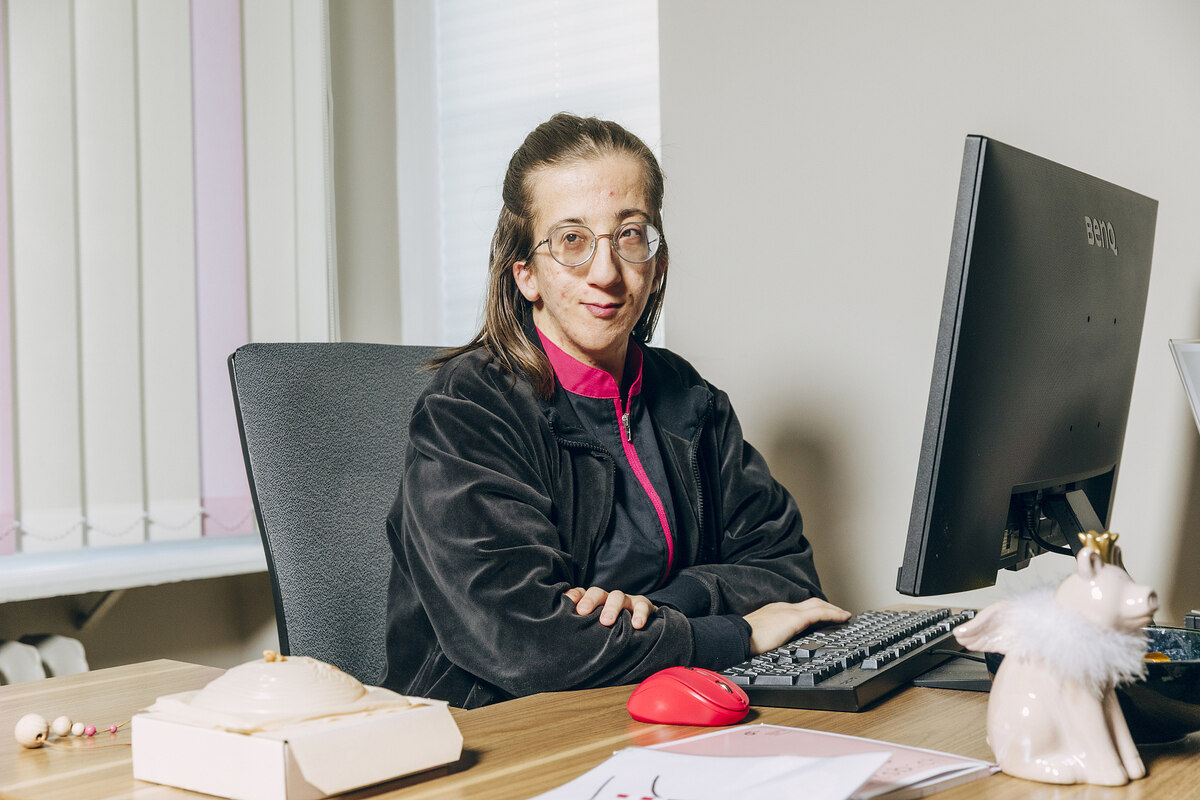
The white winter light shines out from behind pink slats. Soft classical music comes from a pink JBL box. Lisa-Marie Schmidt repeats Laura S.’s zip code and asks: “Have you had any complaints recently?” Laura S. sits slightly tilted forward. “Yes,” she says, “I’ve been feeling a recurring twinge in my left breast for a few months now.” – “Is the area red?” asks Schmidt. “No.”
Lisa-Marie Schmidt nods. It is comfortable in the treatment room in Berlin-Friedenau. Glued butterfly figures protrude slightly from the wall, and there is a crocheted lemon on the desk. In one corner there is a cane with a stuffed turtle dangling from it. The practice of Social enterprise discovering hands is located in a bright old building, with orange ornamental windows in the double doors and stucco on the ceiling.
As a visually impaired woman, Lisa-Marie Schmidt is one of five employed blind and visually impaired women who work as medical-tactile examiners (MTU). There are only 50 women in all of Germany who have mastered this demanding profession. They systematically scan breasts for abnormalities – millimeter by millimeter. They compare layers of tissue and sense compactions and shifts.
MTUs work in gynecological practices or specialized discovering hands centers, for example in Berlin or Hamburg. Since the practice in Berlin-Friedenau is not barrier-free, the MTUs also visit social organizations and institutions for women in other Berlin districts.
More reliable than going to the doctor

Lisa-Marie Schmidt starts at the neck, her fingers feel along the lymph nodes above and below the collarbone
Photo:
Marlene Gawrisch
“May I cheekily touch you now?” Lisa-Marie Schmidt stands in front of Laura S., who sits on the treatment table and laughs. “Yeah, sure.” Humor and directness help against uncertainty. Schmidt has that dry Berlin sense of humor, but unlike the rudeness he is said to have, Schmidt’s approach is sensitive and empathetic. As an MTU, you don’t just need sensitive fingers. It is a caring activity with many facets. People are insecure when they come here. “Did you find anything?” is the most common question Schmidt gets. If she feels something, she lets her patients feel it for themselves.
Around 70,000 women develop breast cancer in Germany every year, and around 2,000 in Berlin. If the cancer is discovered early, it is easily treatable and has a very good chance of survival. Nevertheless, regular mammography screening only begins for women aged 50 and over, although around 20 percent of new cases affect women who are younger.

“We want to feel changes as early as possible. The smaller, the better the chances of recovery,” says Schmidt. A study at the University Breast Center Franconia shows that medical-tactile examiners can increase diagnostic accuracy in patients without previous surgery: they recognized suspicious findings more reliably than the treating doctors.
I feel like breast cancer is more common in younger people. In the past it was more likely between 30 and 90, now also in 20 year olds
Lisa-Marie Schmidt, medical-tactile examiner
Take up to an hour for an examination
Schmidt starts at the neck. Your fingers feel along the lymph nodes above and below the collarbone. “The lymph nodes show whether something is happening in the body – inflammation, infection, even after vaccinations.” She strokes her chest with the back of her hand and checks the temperature. “Inflammation gives off heat, a carcinoma can do that too – but it doesn’t have to.”
Schmidt treats up to 7 people a day. She has up to an hour to complete an examination. In comparison, gynecologists in Berlin can only spend an average of 7.6 minutes for the preliminary consultation, examination and palpation. Schmidt calls these fleeting procedures “playing the piano on the chest.” “Of course we can be happy that they are doing it at all,” she says. However, many patients are not really relieved afterwards.
Laura S. is now lying on her back. Schmidt takes her tools out of a cupboard: 5 documentation strips with red and white fields. They serve as a coordinate system for the findings, which are later passed on to the treating gynecologists. “The red surface is smooth, the white is dotted,” explains Schmidt. “I will now stick them on and scan them horizontally, field by field.”
As she feels, she describes the differences in the tissue. “Normal tissue is knobby and soft, like a marshmallow.” Cysts are hard, round or oval, sometimes almond-shaped, and can be moved. “Their surface can be compared to grapes.” Tumors, on the other hand, are “very hard, rough and cannot be moved. They are stuck – like little arms that claw into the tissue.”

A model for tactile exercises: Lisa-Marie Schmidt can sense diameters of 5 to 8 millimeters
Photo:
Marlene Gawrisch
Tactile exercises on models
The training to become a medical-tactile examiner lasts 9 to 10 months, has been recognized since 2006 and is completed at discovering hands. Schmidt originally wanted to become a physiotherapist, but was unable to pursue the profession for health reasons. “Then a family member brought home an article about working at MTU,” she says. She started training 7 years ago.
The assessment includes tactile exercises on models. A chain with elevations of different sizes shows how fine differences are perceived: Schmidt can reliably feel 5 to 8 millimeters in diameter, gynecologists can feel around 10 millimeters and larger. In addition, knowledge about the structure, function and diseases of the female breast is imparted, as well as basic knowledge of diagnostic and therapeutic methods. “In the second half we learn basic medical knowledge and how to communicate well when we feel something abnormal.”
Since medical tactile examiners (MTU) independently take anamnesis and document findings in everyday practice, “medical writing” and specialist terminology are also part of the teaching content. Schmidt has learned a lot since she started working in the profession. Bodies are different and many things cannot be predicted. Just as many 50-year-olds do not have breast cancer, there are also 30-year-olds who are already in menopause.
Has anything changed since you started your career? “I have the feeling that breast cancer is more common in younger people,” says Schmidt. “It used to be between 30 and 90, but now it’s also 20-year-olds.”
Cancer is detected earlier today
Data supports this: A French registry study shows an annual increase in invasive breast cancer of around 2.1 percent among women under 40 between 1990 and 2018. Schmidt suspects that cancer is being discovered earlier today, partly because there are more and better diagnostic procedures.
If the MTUs detect abnormalities, an ultrasound follows and a referral to a gynecologist who makes the diagnosis. Schmidt is happy about the exchange with her colleagues at the center in Friedenau. Palpating any abnormal findings doesn’t go unnoticed. Prevention is better than aftercare. “You’re never just healthy. There are patients who say: I don’t want to do anything. But how can you know if something is wrong?”
At the end of the examination, Schmidt compares Laura S.’s painful area with the other breast. Nothing unusual can be felt. The stinging may be related to previous shingles or may be muscular. To be absolutely sure, Schmidt recommends speaking to a gynecologist and having an ultrasound.