

The mail order companies Memo and Sykell are now allowed to use the Blue Angel environmental label. On Monday, the Federal Ministry for the Environment, Climate Protection, Nature Conservation and Nuclear Safety (BMUKN) awarded the seal for sustainable reusable systems of the two companies. The Blue Angel has been awarded by the federal government for almost 50 years and is considered one of the most renowned seals of quality for environmental protection in Europe.
The BMUKN awards the eco-label if the products examined contain little to no harmful substances or are produced in as environmentally friendly a manner as possible. Companies can have their products tested independently for the requirements. Ultimately, a jury decides on the award. The jurors are made up of environmental associations, representatives of the Chamber of Commerce and Industry, trade unions and the city council.
The two companies receive the seal because they save packaging waste for their reusable products in the catering and mail order sectors.
The online mail order company Memo relies on this when shipping so-called memo boxa reusable alternative to cardboard boxes. The company, whose core brand says it has always been committed to “responsible consumption” with ecological and socially acceptable products, sells office and school supplies as well as household goods.
Guidance for consumers
Bicycle receives the Blue Angel for its reusable containers for the catering industry. They are intended to offer an alternative to plastic-coated paper cups or bowls and can be returned to normal deposit machines in supermarkets. According to the website, the company is pursuing the goal of so-called circular consumption, i.e. a cycle in which as much material as possible is reused.
On the one hand, the Blue Angel is good advertising for the award-winning companies. Above all, it should help consumers recognize sustainable products. He shows ecological product alternatives and offers practical guidance when shopping, which should make it easier for consumers to choose and make a purchase decision, it is said.
Basic problem packaging
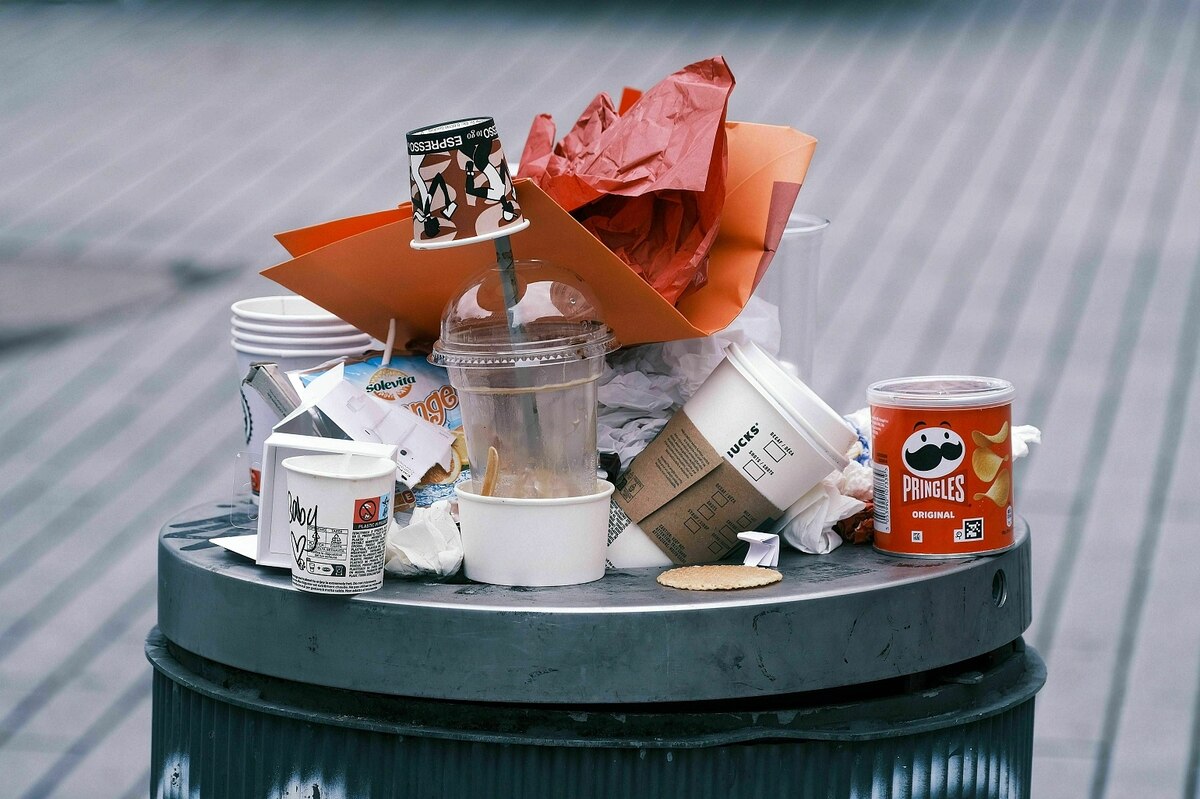
Germany recently produced the most packaging waste in the European Union. This emerges from figures from the Federal Statistical Office (Destatis) for 2021. Germans produce 237 kilograms of packaging waste per capita, according to figures from the EU statistics agency Eurostat – the EU average is just under 189 kilograms. According to the Federal Environment Agency, around two thirds of packaging waste was recycled in 2022.
The principle of reusable packaging is not new in this country. Since January 1, 2023, restaurants and supermarkets have been in Germany obliged to offer reusable packaging for take-away food and drinks. Since then, consumers should be given the freedom to choose whether they take their food with them in disposable packaging or in cleanable and refillable reusable containers. Whether they consume more sustainably remains a question of personal responsibility.