

Art can still be saved? This question has arisen at all times; Above all, it is she who drives artists to work. Jack Smith, the big Uunderground filmmakers of the 60s and 70s, shot his film “Kino ’74 – Jack Smith” in the Cologne Zoo and demanded that the museums stay open until five in the morning and finally show something interesting. He then gave the apes advertising brochures for an exhibition with the slogan “Art remains art”. The monkeys examined the flyers with interest and ate them.
This episode comes from the new volume “What’s Underground About Marshmallows?”, which collects texts by and about Jack Smith. There can be no doubt about Smith’s historical significance: he is an emblematic figure of American performance. Andy Warhol called him “the only person I would ever copy,” and Richard Foreman saw Smith as “the secret source for virtually everything relevant in the so-called experimental theater of America.”
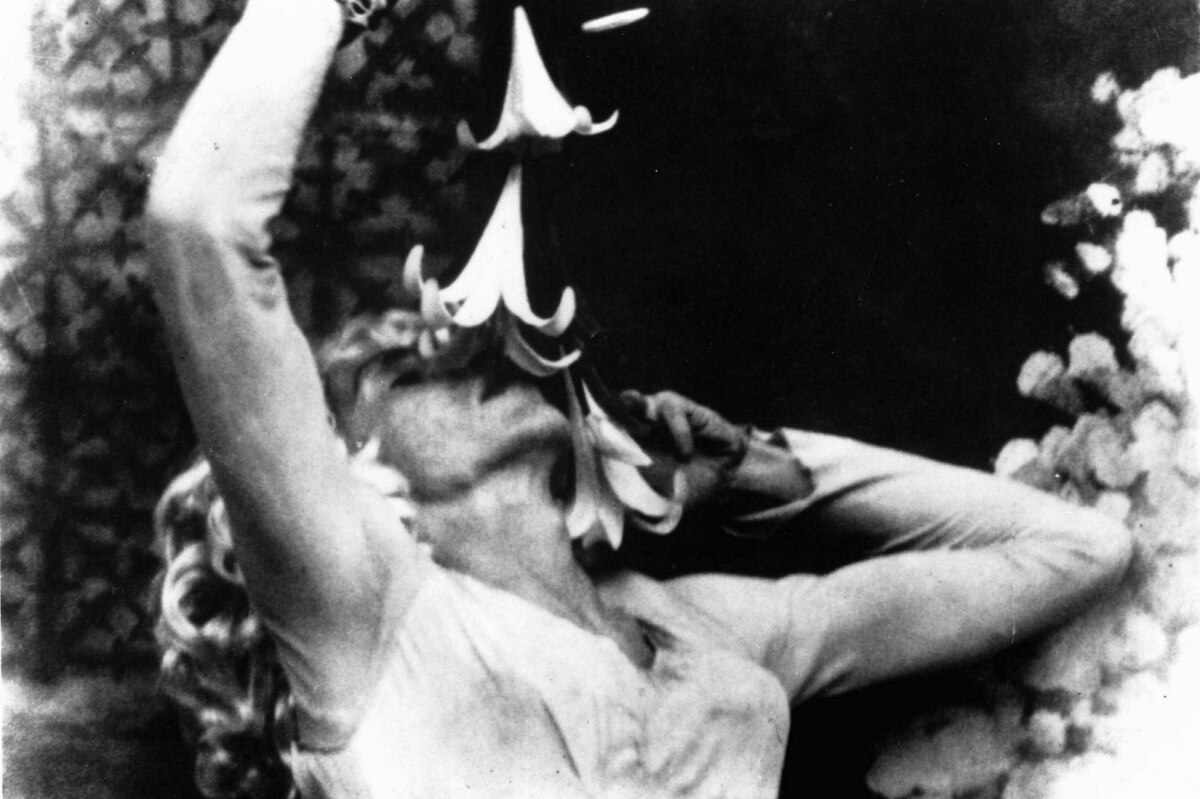
Smith himself would probably have rejected such praise. His 1963 film “Flaming Creatures” would have paved the way for him. The work gained particular fame because of a scene that is perhaps best described as an “asexual orgy”; In fact, this sequence is more of a tumult of body parts, lace dresses, glitter, tulle and soft shapes. Nonetheless, authorities banned the film because of pornography, which gave Smith some notoriety in art circles.
What’s Underground About Marshmallows?
Marc Siegel (ed.), from English by Benjamin Dittmann-Bieber, Gregor Runge, Matthias Haase, Mark W. Rien, Guntram Weber: “What’s Underground About Marshmallows? Texts by and about / Texts by and about Jack Smith”. Alexander Verlag, Berlin 2026, 288 pages, 28 euros
But that was a double misunderstanding: neither worked Jack Smith about shocking the authorities and about the applause of the art world he despised. “Flaming Creatures is a modern work of art of a rare kind: a work of art about joy and innocence,” states Susan Sontag, and that can apply to Smith’s entire oeuvre. Part of this innocence is his complete naivety and indifference to any form of technical refinement: he is not interested in craftsmanship, and certainly not in mastery. It’s about intoxication and love; not an object-related love, but a general love that belongs to everyone. Smith helped found the camp here.
There’s an immediacy to his lyrics, an endearing stubbornness
He dealt with the threat of fame for false reasons as consistently as he did radically. From then on he never finished a single film. Instead, he performed individual scenes in sessions, which he accompanied with music and dialogue: he called it LIVE FILM. Sometimes the actors didn’t show up for a screening, then he used people from the audience as actors.
The mold
“Moldiness”, the mold or mustiness that appears in the form of patina, plays a special role in his art. But it is not a concept that he declines through, but rather one that he associates around; for example in his praise of María Montez, a cinema star of the 1940s. She has the wonderful quote: “When I see myself on the screen, how beautiful I am, I scream with joy!”
Montez was often accused of her limited acting abilities: but for Jack Smith that was precisely her quality. It was precisely the unaffected nature of her, which did not conflict with a certain diva-ness, that attracted Smith. At the same time, however, he makes no effort to convince readers that and how Montez is important: there is an immediacy in his texts, an endearing stubbornness that lies beyond all traditional mediation techniques.
Jack Smith-Buch
Marc Siegel (ed.), Jack Smith: “What’s Underground About Marshmallows?” Texts by and about/Texts by and about Jack Smith. Translated from American English by Benjamin Dittmann-Bieber, Gregor Runge, Matthias Haase, Mark W. Rien and Guntram Weber. Alexander Verlag, Berlin 2026, 288 pages, 35 euros
Not only was Smith a pioneer of camp, but also an advocate of drag. Both components make it still relevant today. The unconditional love and playful devotion that emerge from Smith’s work are points of departure in a technologically advanced world full of AI and transphobia. His understanding of art can be summarized in his words: “What do we expect from a film? / Contact with something we are not, don’t know / don’t think, don’t feel, don’t understand, / thus: an expansion.”