

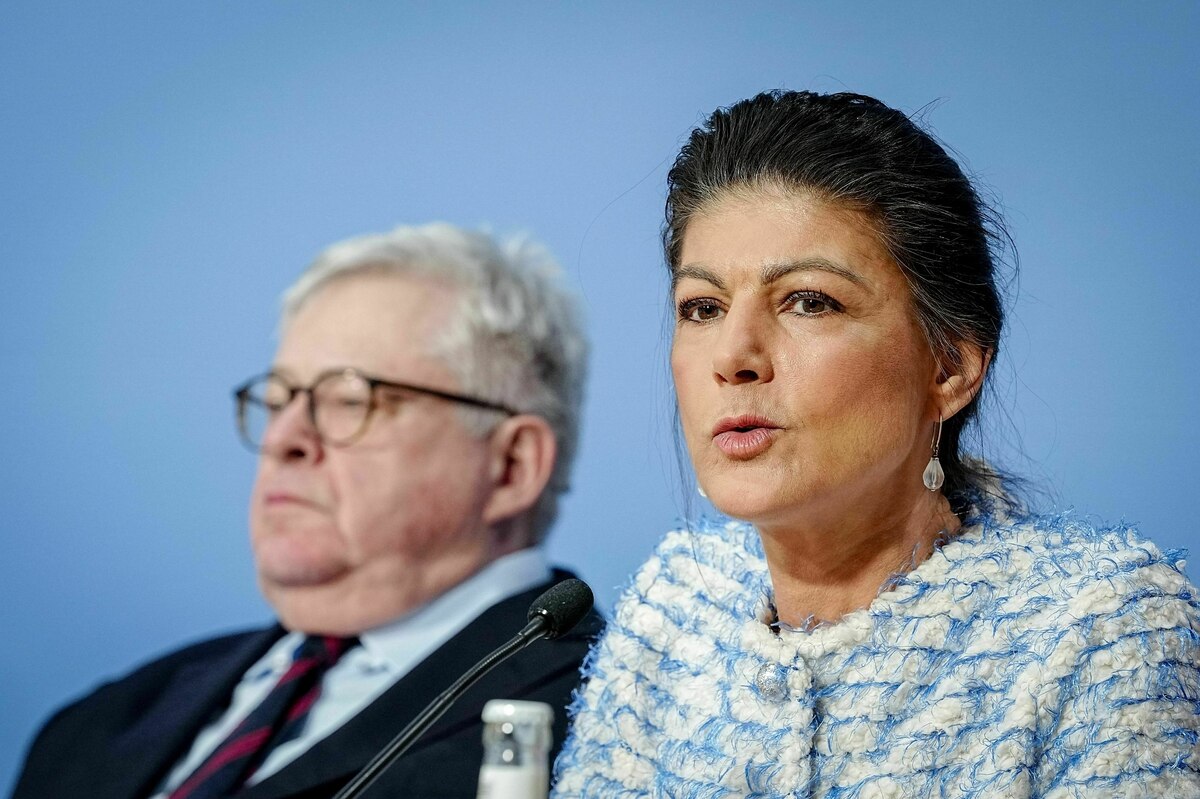
The Sahra Wagenknecht alliance wants to appeal to the Federal Constitutional Court shortly before the deadline on February 18th sue against the validity of the last federal election. Party leaders Amira Mohamed Ali and Fabio De Masi announced this to journalists in Berlin this Monday.
In the federal election in February 2025, the BSW received 4.981 percent of the votes and thus narrowly failed to pass the five percent threshold. Ultimately, only 9,529 votes were missing for entry into the Bundestag. The consequences were significant for federal politics: just because the BSW did not enter the Bundestag, the CDU/CSU and SPD together have a majority in parliament were able to form a government.
Since then, however, the BSW has been calling for a recount of the federal election. First, the party had to lodge an objection against the election to the Bundestag, but this was rejected in December with the votes of almost all factions (except the AfD). According to the Bundestag, the BSW did not present any specific election errors that had not already been corrected or could be refuted.
Only once the objection procedure at the Bundestag has been completed is the way clear for an election audit complaint to the Federal Constitutional Court. The Heidelberg lawyer Uwe Lipinski and the emeritus law professor Christoph Degenhardt are in charge of the brief, which is still being worked on.
Search for “anomalies”
The BSW wants to continue to rely on its statistical argumentation. Because it is quite possible that individual election workers accidentally assigned crosses to the right-wing “Alliance Germany” for the “Sahra Wagenknecht Alliance” when counting the votes, the BSW looked for corresponding “anomalies” in the results of the voting districts. The search was for voting districts with little to no BSW votes and an unusually high number of votes for small parties such as Alliance Germany. Attorney Lipinski comes up with a “potential” of an additional 4,440 votes.
The BSW also extrapolated a sample of 50 voting districts in which recounts were carried out for various reasons. In these non-representative voting districts, which are mostly in Berlin, the BSW received a total of 15 more votes than in the first count. Extrapolated to all 95,109 voting districts in the federal election, that would be an additional 28,533 votes for the BSW. This would then exceed the five percent threshold.
What are the chances of success of the BSW complaint? It is clear that there is no right to a recount of the election just because the result was close. There is also no precedent in which the Federal Constitutional Court allowed statistical assumptions such as those put forward by the BSW to be sufficient for an election objection. There is also no “benefit of doubt for accuracy” principle. Rather, on the contrary: In principle, the “existence and functionality of Parliament” have great importance for the Federal Constitutional Court.
Not a new election, but a recount
Party founder Sahra Wagenknecht said that the election audit was about “trust in democracy”. The party is not seeking a new election at all, just a recount of the votes. “If five votes are still missing, then that would be it, then there would be no more whispering,” promised Wagenknecht. However, the BSW should overcome the five percent hurdle after a recountthe black-red coalition would have to form a minority government and seek its majorities on a case-by-case basis. Alternatively, Wagenknecht suggested a “competence cabinet” made up of experts.
It will take at least a few months for the Federal Constitutional Court to make a decision.