

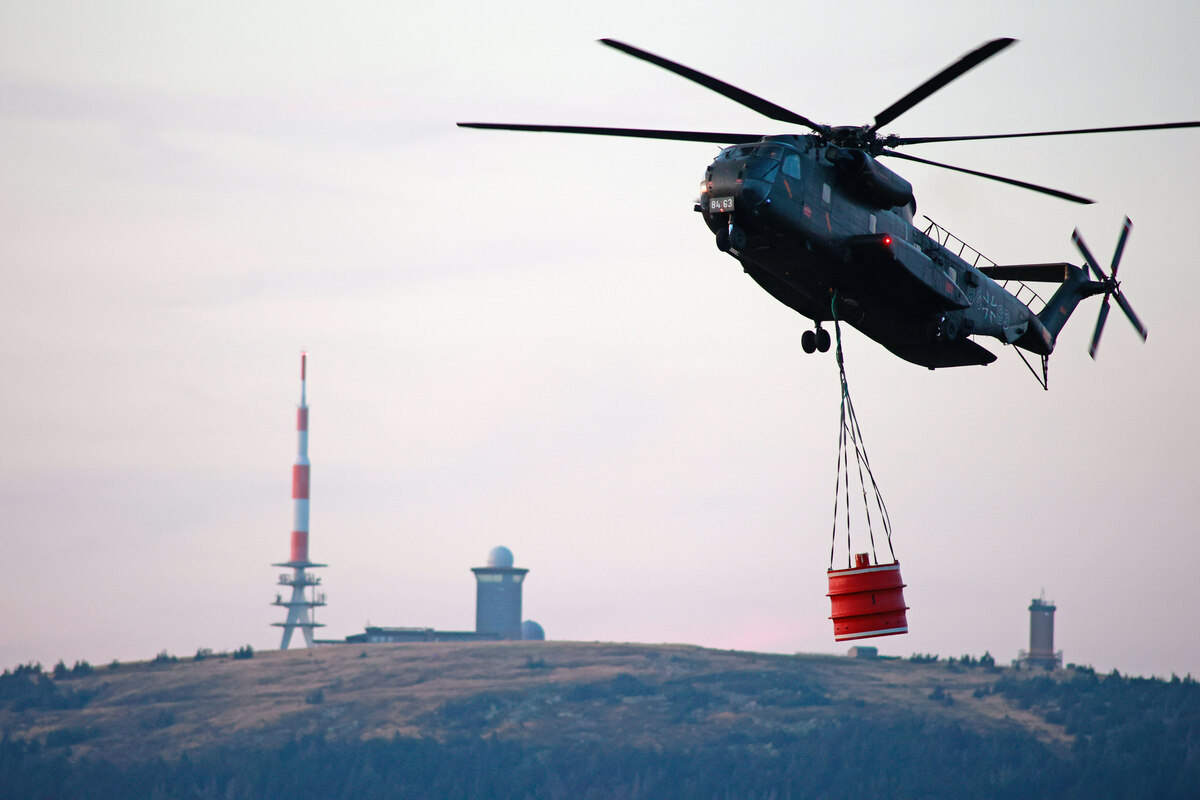
Helicopter always works. When the Bundeswehr and the Harz district presented their plans for a “career camp” for the troops on the Brocken last Thursday, a veritable army helicopter floated in and landed in front of the Brocken Hotel. A local newspaper reported that this caused quite a stir among excursionists.
The Bundeswehr wants to set up camp for two weeks in mid-May on the highest mountain in the Harz at 1,141 meters in order to recruit young talent. Tents and information stands will be set up and tanks and other large vehicles will be presented where hikers would otherwise be on the move. Helicopter landings and low-level flights have also been announced.
According to the Bundeswehr, interested parties should be able to easily talk to soldiers in this “unique advertising format” and find out about military and civilian careers. The aim is to bring the diversity of career opportunities closer to those who might not otherwise attend a traditional career event.
The Harz district is happy about the spectacle. The Brocken, with its numerous visitors, is the ideal place to reach many people, says District Administrator Thomas Balcerowski (CDU): “The Bundeswehr belongs at the center of society.”
With this planned action, the Bundeswehr is crossing a red line, because military vehicles, a camp, overflights of the Brocken and helicopter landings have absolutely no place in the core zone of a national park!
Society for the Promotion of the Harz
He stands against it Harz National Park little of the planned “career camp”. The Brocken lies in the center of the protected area, which extends across the federal states of Lower Saxony and Saxony-Anhalt and, with an area of almost 250 square kilometers, is the largest forest national park in Germany.
The national park administration justifies its rejection of the Bundeswehr event on grounds of nature conservation. The Brockenkuppe is a habitat, resting place and place of reproduction for rare and endangered species, for example the ring ouzel. For them, the mountain is the only breeding area within a radius of several hundred kilometers. Rare migratory bird species also liked to stop off on the Brocken.
Helicopter flights disturbed birds due to the loud noise and visual influences, the national park’s statement continues. Among other things, nests could be abandoned during the breeding season. Strong acoustic disturbances could also cause bats to abandon their roosts.
The Bundeswehr’s PR plans on the Brocken are therefore considered “extremely questionable”. At the same time, the national park expresses “full understanding” for the Bundeswehr’s request. But in order to appeal to young people in particular, there are much more suitable places where “advertising for the Bundeswehr does not inevitably come into conflict with species protection”.
Also that one National Park Support Association is “unreservedly committed to national defense,” said its chairman Friedhart Knolle to the taz. “With this planned action, the Bundeswehr is crossing a red line, because military vehicles, a camp, overflights of the Brocken and helicopter landings have absolutely no place in the core zone of a national park!” The Bundeswehr’s credibility is at stake here, as is its credibility Military training areas are well worth seeing nature conservation operate. “Then why doesn’t she even respect the protective purpose of the national park here and wants to drive breeding birds away from their nests unnecessarily?”
Legally, the “career camp” cannot be prevented
Over the centuries, the Brocken belonged to changing royal families and principalities. In 1937 it was declared a nature reserve and therefore state property. On April 20, 1945, US troops stormed the Brocken summit, where the last Wehrmacht and SS units had entrenched themselves. It was later added to the Soviet occupation zone.
The Brocken became a restricted military area, the Soviet army and the GDR state security service built a fortress with espionage facilities that could listen far into West German territory. After the fall of the Wall, the Brockenkuppe and its technical systems went to Deutsche Telekom. In 2008, a consortium of Harzsparkasse and Norddeutscher Landesbank bought the almost 13,000 square meter site. Last year eThe Harz district acquired the area for 3.5 million euros. “The Brockenkuppe is finally community property again,” says District Administrator Balcerowski. The district can now dispose of it.