

In his theater meeting ennobled “Hamlet” disturbed director Philipp Preuss the audience by putting a perpetual loop at the end. This time it is the old servant Firs who remains in the middle of the stage in the form of Jörg Zirnstein; Even during the applause he doesn’t move from his spot or when we leave the hall. Even with Chekhov, the people simply forget him, leave him behind and run away.
“The Cherry Orchard” is not just the most famous Chekhov playbut also his last. It is a swansong for a time that no one embodies more wonderfully than the exuberant landowner Ranjewskaya. In Darmstadt she flutters in from Paris and makes a ragged impression right from the start.
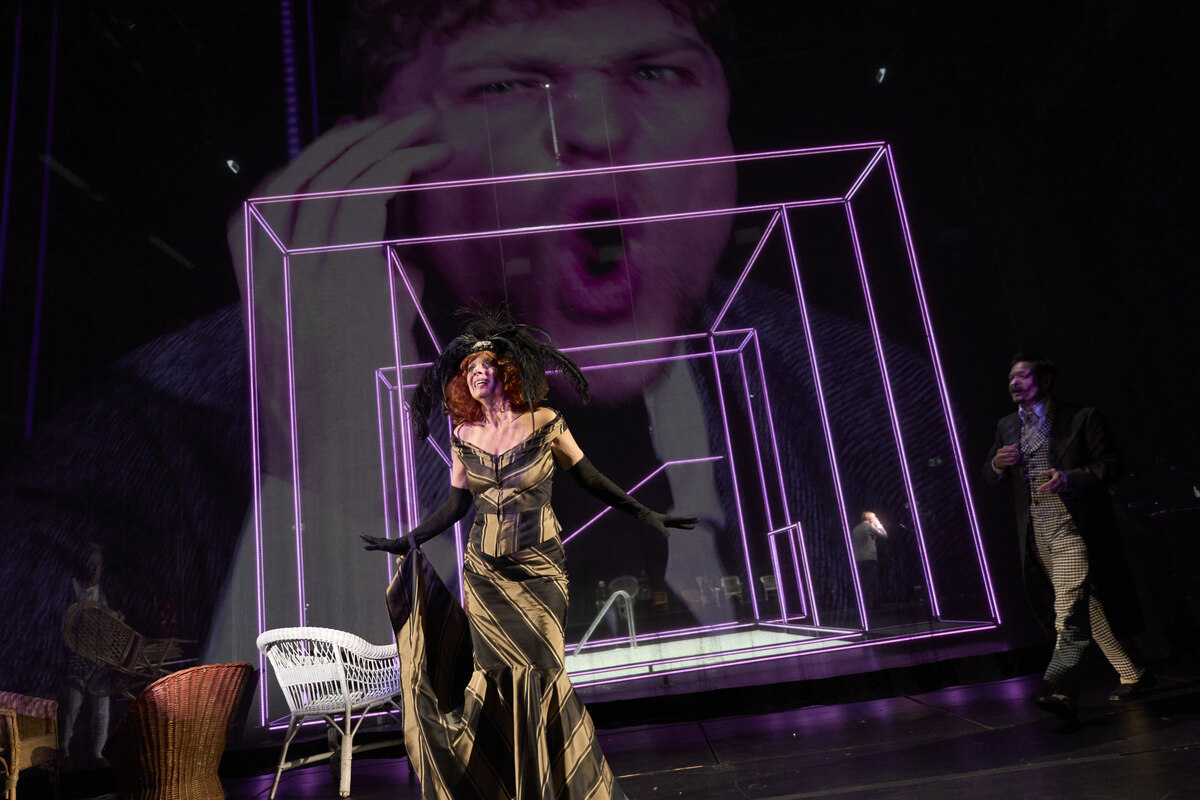
Karin Klein plays her like a pissed-off Hollywood star (costumes: Eva Karobath); she stands primarily on the ramp (middle!) with her hands reaching up to the sky and addresses the audience, panting. A diva without a fortune, her cherry orchard is about to be sold and, of all people, the farmer’s son and boy Lopakhin is going to buy it. Sebastian Schulze plays him as a cool calculator and avenger, who in the end comes into his own like a young dog let off the leash.
At the beginning he is part of the understated joker trio together with Emily Klinge’s stunningly present maid, who later also appears as a governess, and the musician Kornelius Heidebrecht. The three of them give the arriving gentlemen a welcome, pink balloons burst like the illusions of the ruling class, make pretty squeaking noises and a happy hello suddenly turns into hell.
A pool replaces the lake
A parade of wicker chairs are lined up along the rear firewall, looking as if they were left over from old Chekhov productions. The remaining players take their seats there. A box made of fluorescent tubes, more scaffolding than house, is the central element on Sara Aubrecht’s stage. At the bottom of the box there is a covered pool, which replaces the lake in which Ranyevskaya’s son drowned.
The production later celebrates its visual climax above the pool as a big party in the third act. The partygoers go to a white surface, which mutates into the canvas of their decadence. In addition to the mother, her daughters Anja (Aleksandra Kienitz) and Varja (Samia Dauenhauer) as well as the eternal student Trofimov (Niklas Herzberg) are also present. They happily fill the white with red stuff that looks like pickled cherries. They pour it over themselves and roll orgiastically on the floor, crawl over each other like predators, swim in their own juice and appear very aloof and crazy. A camera records it from a bird’s eye view, so you can watch the action like a circus act.
The bloody action not only picks up the cherry red of the garden, but also portends future revolutions and wars. The evening does not provide a stronger picture of how it falls into two parts. Before the break, Preuss doesn’t manage to arouse interest in his staff, only the beautiful Supertramp Dreamer mess wakes you up.
People of today, yesterday and tomorrow
He introduces the second act with the note “123 years later”. So it’s no wonder that the servant covers the gentlemen with white cloths like pieces of furniture that need to be protected before a long journey. They then look like ghosts, trapped in lethargy and loneliness. The stage space thus becomes a realm of the dead and the people in it become mere dreamers. In Darmstadt they seem like people of today, yesterday and tomorrow, amazed at how old others have become, don’t want to leave their usual paradise and flounder like zombies in the contradictions of the fun and tired society.
Nothing will change here until money shifts the balance of power. Utopias no longer appear, and the new cherry orchard owner steals his visions from others (location, location, location). At least now everyone has understood that this piece also affects us.
Philipp Preuss stages his cherry orchard version without kitsch or loveliness. Some camera use seems very superfluous, other images show transience and nostalgia. In the end, all that remains of what was once a magnificent cherry orchard is a pitiful remnant in the form of individual tree slices. And of course the shaky gray servant Firs, who may still be standing on the stage waiting for something to happen.