

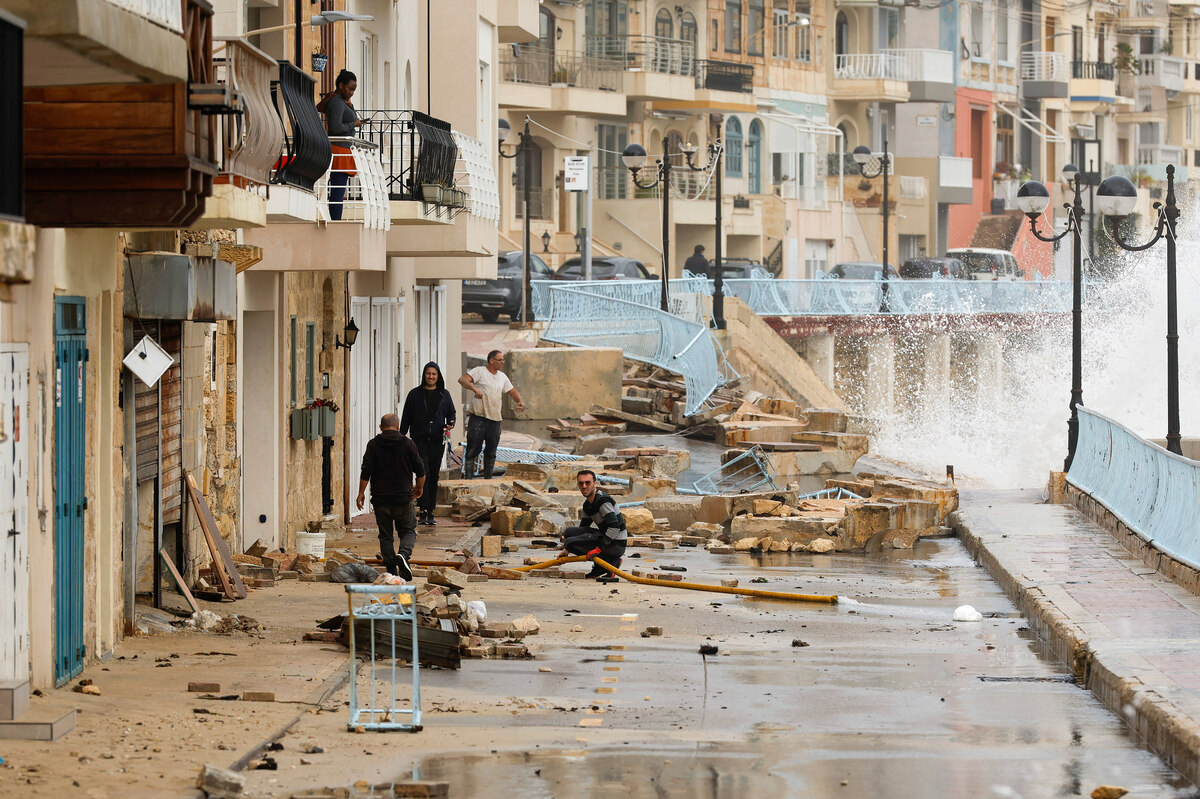
The heaviest rainfall in over 70 years and hurricane-force winds caused severe damage in Algeria, Tunisia and Libya on Monday. Storm “Harry”, which had been announced for days, also brought public life to a standstill in Malta and Sicily. Schools remained closed and authorities instructed citizens to stay at home for the next few days. The masses of water were so immense that several Tunisian coastal towns were flooded by rivers that rose meters high in just a few hours and main streets were flooded with meters of water.
In the coastal cities of Hammamet, Mahdia and Sousse, residents reported sea levels rising dramatically. Waves destroyed harbors, fishing boats and waterfront promenades. Tunisian civil defense helpers recovered 5 dead people in the town of Moknine, and the emergency services are still looking for several cars that were swept away by the spring tide.
230 millimeters of precipitation per square meter was measured on the coast, and many of the reservoirs used to supply drinking water are 100 percent full for the first time since they were built.
The clearing of the rubble is hampered both by further rain and by angry reactions from the population. Since the local authorities between Benghazi and Tunis are apparently completely overwhelmed by the storm, army units were deployed on Tuesday to protect fallen trees and promenades that had been torn into the sea.
We would like to show you external content here. You decide whether you also want to see this element:
Storm “Harry” ends a year-long drought that also led to the water supply being shut off at night in Tunis in the summer. Even many olive farmers in the south of the country were able to produce their harvest can only be saved through the use of pumped groundwater. “North Africa is a climate change hotspot,” says Mohamed Riyahi, a farmer from Sidi Bouzid. The Arab Spring began 15 years ago in the small town in southwest Tunisia – partly because more and more farmers could no longer feed their families. “We actually have very productive soil here, which used to enable everyone to make a good living. But because of the extreme droughts, the destruction of crops by torrential rains and the dilapidated infrastructure, more and more young people are moving to Tunis or further to Europe.”
At least since the flood disaster in the Libyan city of Derna The consequences of climate change are seen by all political camps in the country as one of the biggest challenges of the next few years. Storm “Daniel” caused a dam above the city to overflow in just a few hours in September 2023. The dilapidated dam wall burst, a 13 meter high wave swept a third of the city into the sea, and almost 5,000 people died.
In recent years, local disaster protection units have been set up in Tunisia with the help of the German Federal Agency for Technical Relief (THW). But the multitude of crises is overwhelming the economically struggling countries in the region. In the holiday resort of Hammamet south of Tunis, the beach is disappearing due to rising sea levels, and artificial irrigation of the fields has caused the groundwater level to drop dramatically. As a result, salty seawater seeps miles inland and destroys orange plantations. Tunisian media cite experts warning of sea level rise of 50 centimeters by 2050.
Storm “Harry” won’t change much about the drinking water crisis. Because the rain fell near the coast, most reservoirs in the northwest of the country remain only 33 percent full.