

taz: Raphael Molter, Lara Schauland, you have written a “materialistic football criticism”. What does football have to do with Marx?
Raphael Molter: There are fights in football. It’s about who owns the football and the rooms and within what limits emotionality and protest are allowed to take place. We use the theory of Marxism as a tool for analysis and criticism and look at the fan protests of the last few years. Football is indeed a commodity, but one in which the fans not only consume but also co-produce the whole thing.

Lara Schauland: Football plays a fundamental role in our society. Over 30 million people in Germany claim to be fans, and stadiums are filled with tens of thousands every weekend. There is no other comparable place where so many people come together on a regular basis. It is important to see football as a field in which change is possible and necessary.

taz: And where should this lead?
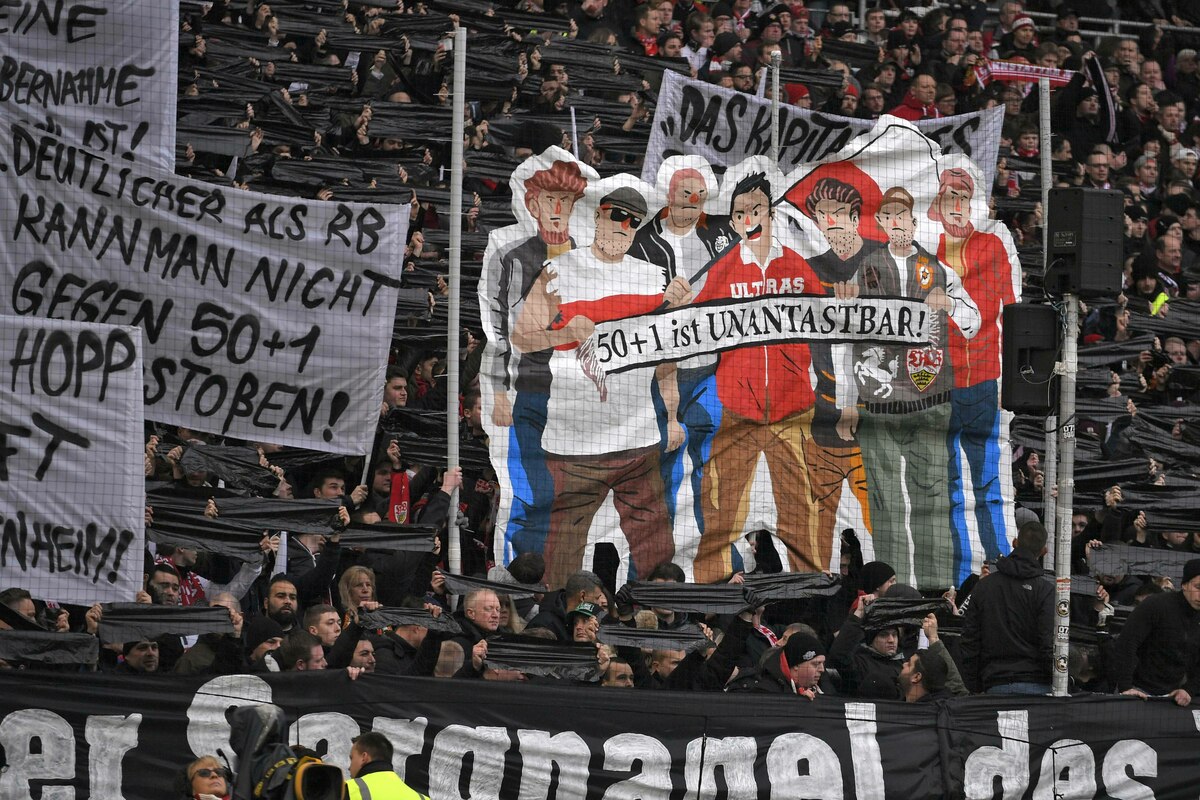
Show country: We don’t want to impose anything on anyone. But many fans feel a need for change. When we talk about commercialization or alienation, most people across the board agree: Football is increasingly oriented towards the market, no longer towards the fans, but rather towards people who sit in China and watch football online, for example. Or that the 50-plus-1 rule is a sanctuary.
taz: So the DFL rule that the majority of voting shares in a spun-off professional department must always be in the hands of the club members.
Molter: Many active, organized fans bring with them a kind of class instinct that is reflected in their values: solidarity, collectivity, identification. Nevertheless, many see themselves as apolitical. Here we see a lack of class consciousness. There is still a long way to go to a nationwide fan movement. There are already grassroots democratic organs in many places, but these are almost always participatory traps.
taz: So the opposite of what you imagine?
Show country: The protests against the DFL investor entry or around the past Interior Ministers Conference (IMK) were defensive protests to prevent something rather than to initiate one’s own ideas. They were described as a successful social movement in Germany, but ultimately it was only about minimal demands. Our idea of change in football is one that moves forward with new ideas.
taz: And what would those be?
Show country: According to our analysis, the question remains as to how much football can actually be changed within the capitalist system. Ultimately, it’s about a different organization of football, with council-democratic structures. Strengthening the associations can be an important nucleus for real democratic processes.
taz: To what extent can it be about more than just football?
Show country: Football and the fan scene do not exist separately from the respective urban society. The willingness to get involved is there. Especially in smaller cities, there is overlap with social movements, campaigns or fundraising events. Ultras have also played a major role in social upheavals, for example in the Gezi protests in Turkey in 2013, which they partly led.
Molter: If freedom of expression is restricted, the stadium can provide a good opportunity to articulate political will. But the natural rivalries between fan groups often make it difficult to make cross-club intentions politically effective. But the seriousness that the Ultras attach to being a fan could still create something that can rise above it. That’s why we talk about ultras as avant-garde. They can create such necessary alliances.
taz: What role could the players themselves take on?
Molter: Example DFL investor search: The protests were also aimed at boosting the exploitation of German professional football even more. The players also suffer from this – except for those with extremely high salaries. With the increased density of games, the risk of injury increases. With alliances you could not only put pressure on from the stands, but also with the key players.
taz: When it comes to IMK, we also have to talk about violence. There’s no denying that she’s performing at the stadium. What is part of football culture and what is not?
Show country: Violence is a relevant part of fan culture. But physical violence in the stadium is actually rare. In the stadium, violence against fans usually comes from the police. Many situations are escalated by the police; significantly more people are injured by irritant gas than by pyrotechnics. When it comes to verbal violence, there are definitely border crossings, such as racist statements. It is also a space that is strongly influenced by masculinity. Something has to change. As a woman who has been playing football for 15 years, I have never felt unsafe.
taz: Do you prefer to ignore the fact that there are also right-wing extremist fan scenes in your book?
Molter: We already know of people who are definitely in organized right-wing circles, but that’s not the point here. You can’t attribute an anti-fascist character to the fan movement, which it doesn’t have.
Show country: We want to convince people with our arguments and thoughts. It’s about strengthening left-wing, progressive structures at the individual locations. Even the fan scenes that we understand as right-wing are often relatively heterogeneous. It is often more a question of power relations.
taz: The goal in stadiums is now often to create a “family-friendly” environment through more expensive tickets. Would that be the end of all football culture?
Show country: It’s about marketing the product better, being more attractive to sponsors and controlling the game. Where violence occurs, there is less control. Ultras played an important part in the protests in Turkey because they knew how to defend themselves through their experience with police violence. Incidentally, the fact that people are excluded due to high ticket prices or that they cannot afford to buy something to drink in the stadium also occurs violently.
taz: A Cooperative concept like St. Pauli Would football also be an alternative?
Molter: St. Pauli is trying to finance the club’s central infrastructure with money from its own fans. The problem is that St. Pauli explicitly does not change the club’s entire organizational model. The gaming operations and the professional department are not part of the cooperative. This is the classic participation trap. If you included that part, you would actually have created a good real utopia in football.
taz: But isn’t football in danger of becoming bad and irrelevant?
Show country: You can also see the football club as a place of community and pursue goals other than sporting success. Maybe the club ends up in the regional league, but you have gained something else: a place where everyone enjoys being, wants to get involved and benefits personally.
Molter: The first football bosses of a club usually have the goal: maximum sporting success. But that should be in relation to successful youth work and deeply anchored club identity. Of course, some alternative models often sound like an end to professionalism. But there are many professional clubs that are run so amateurishly. Then why not try a little socialism in football?
“Matchplan Mutiny – Football Fans Between Commerce and Resistance” was published by Papyrossa Verlag in October 2025.