

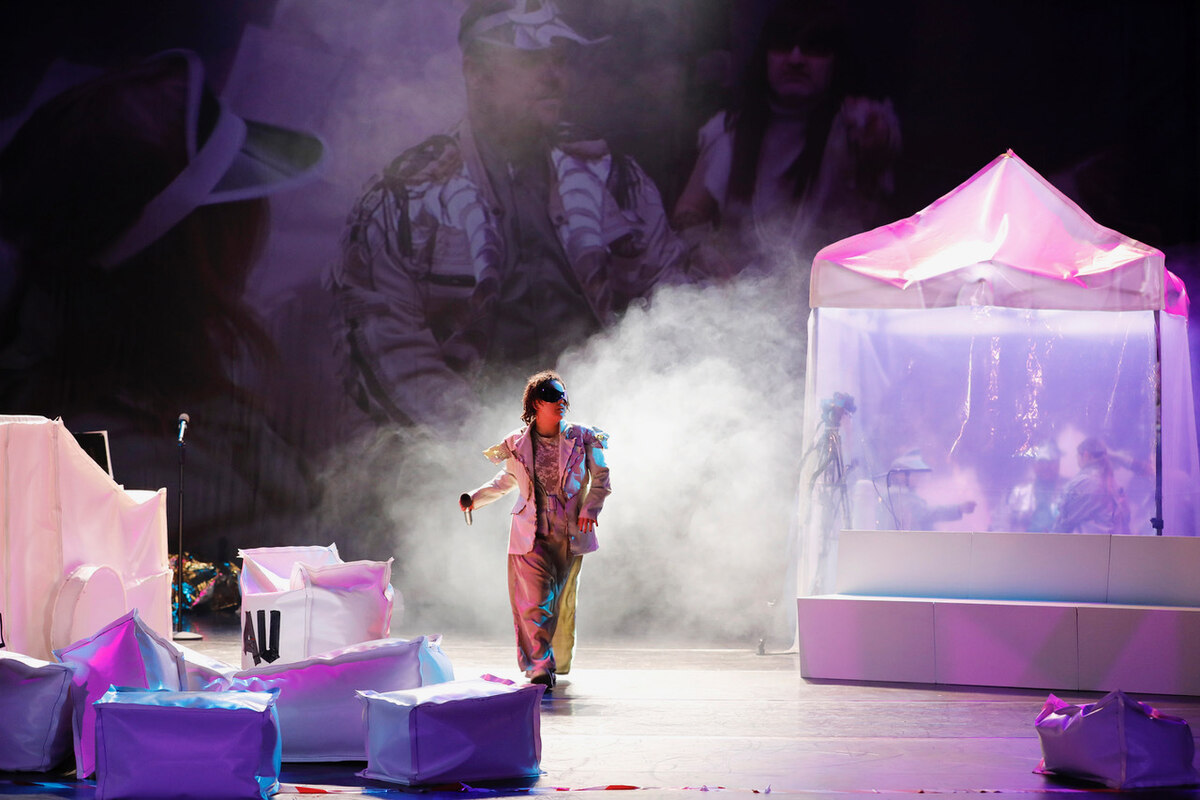
At the beginning it’s more than very playful. The actors create a scene in New York in the early 20th century: Debrecina Arega from Theater Thikwa wears an old-fashioned hat and a feather boa, she plays Emily Dunning Barringer, New York’s first ambulance surgeon, who was instrumental in professionalizing emergency care, better equipment for ambulances and structured training.
Shortly afterwards we suddenly find ourselves on the moon. There is an abandoned moon car belonging to Neil Armstrong – which, to everyone’s amazement, turns out to be a Tesla. Was Neil Armstrong, asks Alexander Karschnia from the artist collective andcompany&Co., really on the moon? Or was he just pretending, playing?
The premiere of “We Crisis Actresses: Lookalike in anger!”, a cooperation between andcompany&Co. and the experimental, inclusive Kreuzberg Theater Thikwa for people with and without disabilities, initially seems like a cheerfully escalating dance of ideas on Friday evening at Hebbel am Ufer.
Crisis actors: This is a term from the area of right-wing conspiracy theories
Sometimes space flight sequences flicker across the screen, sometimes Debrecina Arega dances until the audience claps along, sometimes Max Edgar Freitag plays the guitar. There is laughter, arguments, singing. The actresses, in very strange costumes ranging from surgical green to moonlight silver, occasionally disappear into a rickety medical tent, sit slightly bouncy on rubber balls, drink from an oversized police cup and give highly professional advice on what to do next.
The mangy dog
Only gradually does it become clear what all this is actually about – where the mangy dog is buried, which was initially not missed in the hustle and bustle.
The turning point comes with a longer speech by Alexander Karschnia. He explains how the title of the evening came about: “Crisis actors”. A term from the area of right-wing US conspiracy theories. This refers to alleged actors who are supposed to appear in real disasters or acts of violence in order to fake or manipulate events.
Karschnia reports on the school massacre at Marjory Stoneman Douglas High School in Florida in 2018, in which 17 people were murdered. When survivors remained silent at a memorial event for exactly as long as the massacre lasted, namely a little more than six minutes, it was said in relevant internet bubbles that they were “crisis actors”. As if the massacre never happened. As if the perpetrators were not the perpetrators, but the victims.
At this moment the evening changes – visibly, physically noticeable in the audience. Suddenly it’s clear: This isn’t about harmless role-playing games or ironic doctor scenes. This is about an attempt to counteract the multiple crises of the present with a theatrical hall of mirrors: from nuclear threats to drone warfare, from climate catastrophe to cultural austerity, from abstract systemic crises to very concrete deaths.
Take haters seriously
Or, as Karschnia puts it: What if we took the right-wing haters seriously? What if we rehearsed an emergency and actually trained to become professional crisis actors? Wouldn’t it be useful to be able to re-enact in the courtroom the exact angle from which, for example, the fatal shots were fired at Renée Nicole Good or Alex Jeffrey Pretti?
At this point at the latest, the last laugher’s smile freezes. What is discussed on this strangely tender, yet radical evening is bitterly serious.
How comforting is the final image: around fifty Berlin cultural workers connect to the big screen via cell phone video and sing a big, heartbreaking hymn by Freddie Mercury together. He wrote it when he was already seriously ill with AIDS.
“The Show Must Go On”: A song about carrying on despite pain, fear and approaching death. About the inner struggle between physical decline and the unwavering will to continue living, to continue creating, to continue making art. Standing ovation.
Again on Saturday, 7 p.m.