

When the systematic murder of European Jews is commemorated on January 27th, there will also be a commemoration in Perugia. For two years there has been a place for this in the capital of the Italian region of Umbria: Piazza Biordo Michelotti. In front of the house number 6 lies the first and only stumbling block in Perugia.
The Pietro d’Inciampo, as Stolperstein is called in Italian, is dedicated to Ada Almansi Rimini. She lived here for many years. Her life ended on December 4, 1943. She was 66 years old when she threw herself from the window of her home, the Palazzo Minotti.
Ada Almansi Rimini wanted to avoid the arrest and subsequent deportation that would have befallen her as a Jew. This was what the Verona Manifesto of the Italian Social Republic (RSI or “Republic of Salò”) of November 1943 envisaged. The manifesto was the basic program of fascist Italy under dictator Benito Mussolini, which declared Jewish people to be enemies and marked the beginning of direct involvement in the Shoah.
In 1938 there were almost 50,000 Jews living in Italy, around 8,000 of whom had fled to Italy – mainly from Germany. The Italian and Jewish people lived largely peacefully together. That changed suddenly when anti-Jewish “race laws” were introduced in October 1938 Finally, a manifesto for the elimination of Jewish people cared.
Almost forgotten

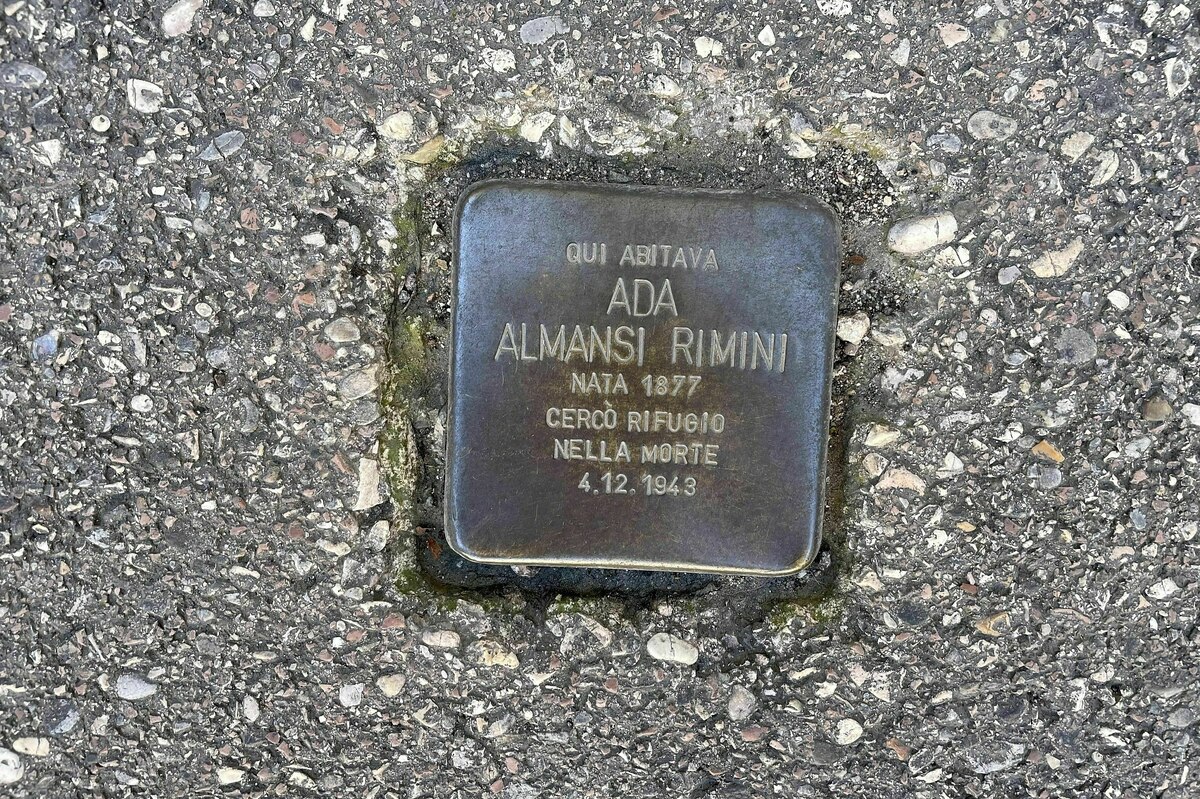
Ada Almansi Rimini lived inconspicuously in Perugia. At that time, the medieval city had around 80,000 inhabitants. Apart from Rimini’s year of birth, 1877, nothing is known about her. What job she did, whether she was married, whether she had children or how long she had lived in Perugia – there is no information about any of this.
She would have almost been forgotten if there hadn’t been an initiative to put a stumbling block in her place two years ago. Perugia’s city administration, the Stolperstein inventor Gunter Demnig and the Federazione Associazioni Italia Israele, an association for Italian-Israeli relations, ensured that the first Stolperstein ever in Umbria was laid in Perugia on January 27, 2024.
The Pietro d’Inciampo for Ada Almansi Rimini is as unremarkable as her life was. In Piazza Biordo Michelotti, a little away from the historic center, it is embedded in the ground, as is usual for stumbling blocks. Most people walk over it carelessly – probably because they don’t even notice the golden stone with the inscription “Qui abitava Ada Almansi Rimini” (Ada Almansi Rimini lived here).
Even those who want to look at the stone have to search for it for a long time. While in Germany the stumbling blocks are placed close to the fronts of houses, the one in Almansi Rimini is further away from the house number 6, on the street between parked cars.
Long Jewish history
Die Stolperstein initiative in Umbria is young. In addition to the one in Perugia, there are only eight other stumbling blocks in Foligno, half an hour’s drive from Perugia. They were lowered into the ground in Perugia a week after they were laid. Nonetheless, Perugia has a long and rich Jewish history that dates back to the Middle Ages.
However, the Jews were expelled in the middle of the 16th century and only resettled at the beginning of the 20th century. In the 1920s and 1930s, many Jews studied and lived not only in Perugia, but also in neighboring Assisi. The birthplace of Saint Francis is now a place of pilgrimage that attracts many tourists.
During the German occupation of Umbria, monks and nuns hid around 300 Jewish people in the cellars under the basilica tower. At night, when the gates of the fortress closed, they came out and did gymnastics exercises to move and feel life. This was extremely dangerous, because the God’s compound was occupied by both Italian and German fascists strictly guarded.
As flourishing as Jewish life in Perugia once was, it seems lost today. There are currently only a few Jews living in the city and the Jewish cemetery was only recently restored. If you want to go to a synagogue, you have to go to larger cities like Rome, Naples, Bologna, Genoa.