

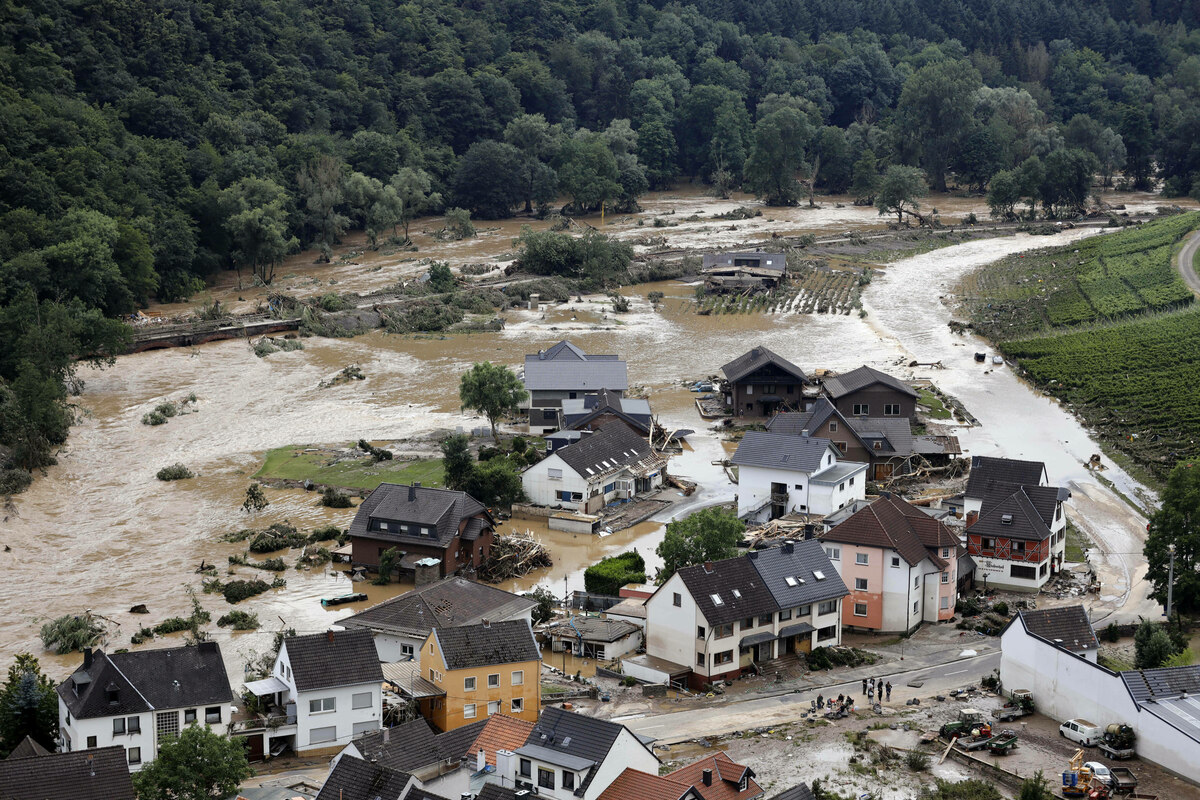
The General Association of the German Insurance Industry (GDV) expects that a legislative process for compulsory insurance for natural damage such as floods will begin this year. GDV President Norbert Rollinger said this to journalists on Wednesday.
“Extreme weather conditions are increasing. Heavy rain, floods and other natural hazards cause more frequent and, on average, more expensive damage,” he said. In high-risk areas, insurance premiums would rise so much that many households would hardly be able to afford them. “If we do nothing, we risk losing comprehensive insurability,” warned Rollinger.
Given the accelerating global warmingthe floods, storm surges and landslides more often and more violent Federal states and consumer advocates have been calling for mandatory insurance against natural disasters such as floods for years.
They fear that the state will otherwise have to step in more and more often and with ever larger sums of money if those affected are not to be left with the costs of climate change. Under the traffic light government However, the project failed due to FDP Justice Minister Marco Buschmann.
In its coalition agreement, the black-red federal government has decided to introduce compulsory insurance against natural hazards. The Federal Ministry of Justice is working on the implementation, as the taz informed upon request. However, the ministry cannot yet provide a specific schedule.
GDV wants to throw endangered buildings into its own pot
In 2025, the proportion of residential buildings insured against natural hazards rose by 3 percentage points to 57 percent. “We are on the right track, even without an obligation,” said Rollinger.
The GDV already had one last December Suggestion what a higher density of insurance against natural hazards could look like. Insurance for buildings in high-risk locations should therefore be bundled into a separate pot called “Elementar Re”. The costs for insuring these houses – the GDV assumes around 400,000 across Germany – are limited and the gap to the “actually risk-adjusted” premium is distributed to all other insured people.
The state should only step in if a natural disaster causes damage of more than 30 billion euros. The GDV also proposes an exit clause: While residential building insurance currently only covers fire and storms, floods should also be covered as standard in the future. If you don’t want this, you can decide against it, but you won’t receive any government support in an emergency.
Association of Insured Persons criticizes exit clause
Criticism of the proposal comes from the Association of Insured People (BdV), which sees itself as a consumer protection organization but also offers group insurance for members. “The contractual freedom praised by the lobby association currently lies primarily in the freedom of insurers,” said Stephen Rehmke from the BdV. “They determine what is actually insured.” Storm surges and sea floods at river mouths are excluded, as is rain that seeps into the cellars.
The BdV is also critical of the exit clause and the associated waiver of state aid. “You cannot exempt the state from liability or release it from its obligation to provide services of general interest and adapt to climate impacts,” said Rehmke.
The GDV also demands that the state must invest in adapting to the consequences of global warming. “A duty alone does not prevent a single harm,” said Rollinger. “Anyone who only talks about obligations but doesn’t change anything about development, spatial planning and protective measures is building a system on sand.” At the same time, it is necessary to protect the climate. “The insurance industry’s business model will be at risk if global warming approaches 3 degrees.”
For the GDV, the reforms of private pension provision will be even more important in the coming months than the debate about elementary insurance. “A fresh start is important here,” said Asmussen. “That will be positive for us.” Among other things, the association demands that insurers not be disadvantaged compared to banks, neo-brokers and fund companies by suspending the legal obligation to provide advice. In principle, the GDV believes it is necessary to organize retirement provision more strongly via stock markets and to promote it accordingly.