

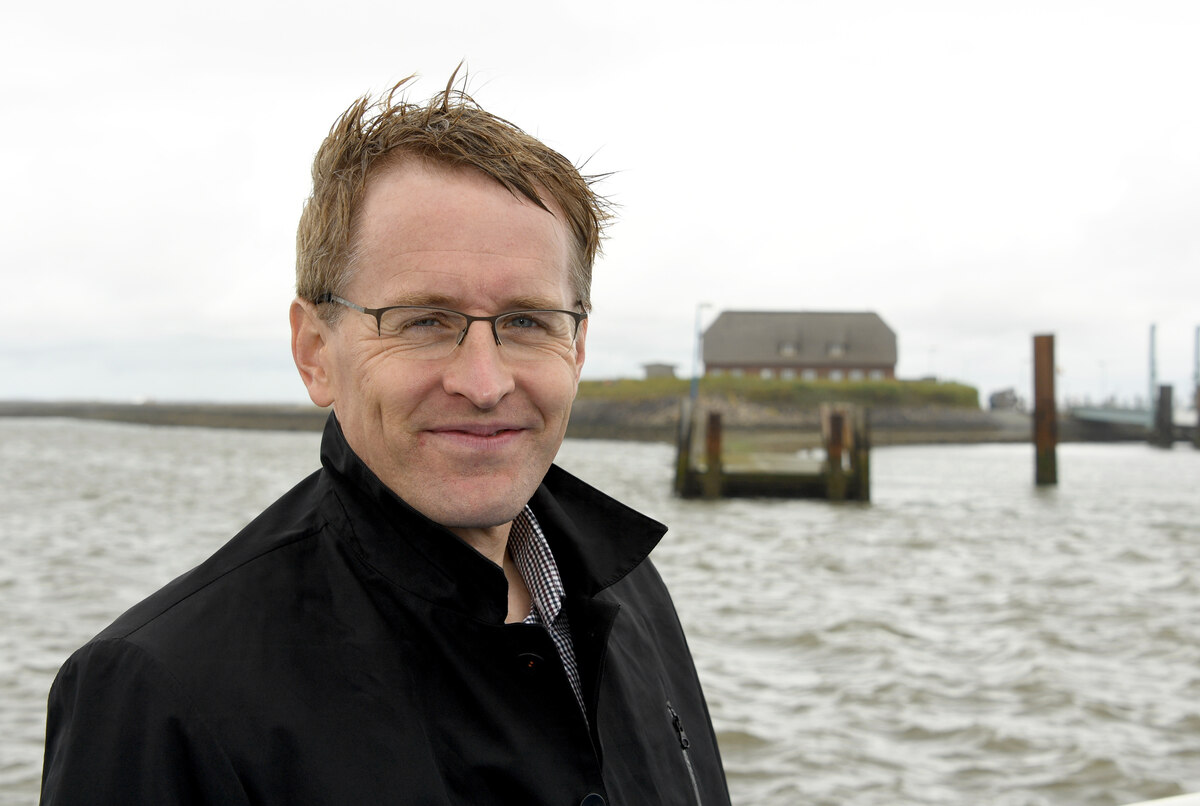
D he winter storm “Elli” has passed, and a mild breeze is blowing around Schleswig-Holstein’s state parliament and the state chancellery on the Kiel Fjord. However, the shitstorm that erupted through Prime Minister Daniel Günther (CDU) does not subside so quickly. First the excitement wind machine Internet switched to turbo, then CSU boss Markus Söder from Bavaria blew hot air into the north, and in Berlin Wolfgang Kubicki puffed out his cheeks. His Kiel FDP party friends are preparing an official request to clarify whether the state government wants to “regulate, censor or ban certain media.” Oops, the nice Daniel Günther is wielding the censorship club?
The following happened: In a discussion with Markus Lanz Günther advocates facing the “enemies of democracy” openly. He is in favor of banning the AfD and criticizes the large tech companies that influence the debate culture in the country via platforms such as X and Tiktok. Günther mentions Schleswig-Holstein’s move to only use German and European software in all authorities instead of US products such as Microsoft or Palantir. And he can imagine a “tech levy” to promote journalism.
He praises the protection of young people from cyberbullying and violence Australia’s advanceto ban social media for under 16s. Günther complains that too many people, even members of his own party, rely on unverified and often false information from the Internet and spread it further. As examples, he mentions the lawyer Frauke Brosius-Gersdorf, who withdrew her candidacy for the Federal Constitutional Court after a bottomless campaign against her, and portals such as the right-wing channel nests, whose reporting he calls “fact-free”.
At the end, Lanz summarizes: “You want to regulate, censor, and ban this?” Without explaining what he means by “that”. “Yes,” says Günther, without specifying on his part. And the network explodes. At nests speaks of a “declaration of war on the free press”, even the German Association of Journalists (DJV) is “shocked by the demand for censorship measures”.
Not a supporter of censorship
It is clear that Günther’s “yes” was not the optimal answer to such a pointed question. However, from the overall context and with knowledge of Daniel Günther’s positions, it can be said that he is not someone who supports censorship. And even if he nests Criticized as lacking quality – unlike his party colleague Julia Klöckner, who equated the right-wing portal with the taz last year – he did not say that he wanted to ban it.
He himself explained the following day that his yes referred to a ban on social media for younger people. Such bans and measures against hate and incitement are for the US government and tech entrepreneurs like Elon Musk certainly censorshipbut fit with German and European ideas about the protection of minors and privacy.
The funny thing about the scandal is that it contains exactly the elements that Daniel Günther criticized: a statement is taken out of context, scandalized and chased through all channels until in the end a huge scare spreads through the internet and the actual issue is forgotten.
That’s sad in this case, because Günther said quite sensible things. Incidentally, his criticism was also aimed at those who immediately jump on every campaign bandwagon. Even if the formulation was not optimal in all respects: its positioning is a breath of fresh air from the Kiel Fjord that we can really use.