

It’s not very loud, not even particularly annoying, but it feels like it can be heard everywhere in the exhibition: a siren wail repeated on a continuous loop, which settles through the ear canal in the brain as a sign of constant alarm. The source of this permanent acoustic penetration can be found right at the entrance to the David Lynch exhibition “Up in Flames” in Prague. Installed here is “Six Men Getting Sick,” Lynch’s first film experiment, made in 1967.
Back when the artist was a young man studying at the Pennsylvania Academy of the Fine Arts, he developed an urgent need to make images move; and so “Six Men Getting Sick” is, strictly speaking, an animated painting. Human organs and faces can be seen in various states of devastation and painful distortion.
In addition to the basic impulse to move art, this installation also centrally contains another core element of Lynch’s work: the human body/organism, its fragility and destructibility – and also the contradictory, not to say perverse, pleasure in the disgust that can be triggered by processes of decay.
“Up in Flames” includes more than four hundred exhibits and fills the exhibition spaces on the ground floor of DOX, the large contemporary art museum that opened in 2008 in the Holešovice district of Prague. From David Lynch’s early work to his final decades, the show covers all phases of his work, with a clear focus in terms of content: “We had planned from the beginning to concentrate on works on paper,” explains curator Otto M. Urban.
„David Lynch: Up in Flames“, DOX Centre for Contemporary Art, Prag, bis 8. Februar.
“David Lynch.” Pace Gallery, Berlin, from January 29th to March 23rd.
Brother Kafka
“Watercolours, drawings, lithographs, photographs. The short films that we are showing in the exhibition are almost all based on drawings.” This concept ultimately succeeded in convincing David Lynch of the exhibition project. The deciding factor was that Lynch was very impressed by the catalog for the exhibition “Kafkaesque” about Franz Kafka’s influence on the visual arts, which was organized by the DOX in 2024. A few Lynch lithographs were also shown there.

David Lynch: „Billy (and His Friends) Did Find Sally in the Tree“, 2018
Photo:
The David Lynch Estate; Courtesy Pace Gallery
For him, Kafka was “the one artist I feel could be my brother,” Lynch once explained in an interview, thereby naturally placing himself alongside the writer as an equal. 2024, one hundred years after Franz Kafka’s deathDavid Lynch was already very ill – he died on January 16, 2025, a few days before his 79th birthday. Nevertheless, everything was suddenly possible for the Prague team after, as Otto M. Urban explains, it had previously taken years to establish contact with the artist.
But then he was able to visit Lynch in his studio in Los Angeles in September 2024 and speak to him personally about details of the planned exhibition. “He gave us complete freedom. But there was one thing that was important to him and that he definitely didn’t want: that we show excerpts from his major films in the exhibition.” They never intended to do that anyway.
In fact, in one respect it is hardly conceivable that there could be a greater contrast between the visual worlds that have emerged from Lynch’s feature films and the works presented in the DOX: as expressive and even striking as he used color in many of his films, he could be just as radical in consciously foregoing color. In his small works on paper, black is almost exclusively predominant.
The different depths of blackness
How consciously he explored the graphic possibilities and different depths of blackness early on can be seen in the drawing “Crucifixion” from 1973, in which a huge amount of ink was used to create differently structured black surfaces.
Next to it, a wall in the exhibition hall is taken up by small-format, black-and-white watercolors, which show seemingly abstract shapes, but which are unmistakably reminiscent of wounds on human skin, of cracks, scratches, crude tattoos. Often the paper image carrier is actually wounded and has visible incisions.
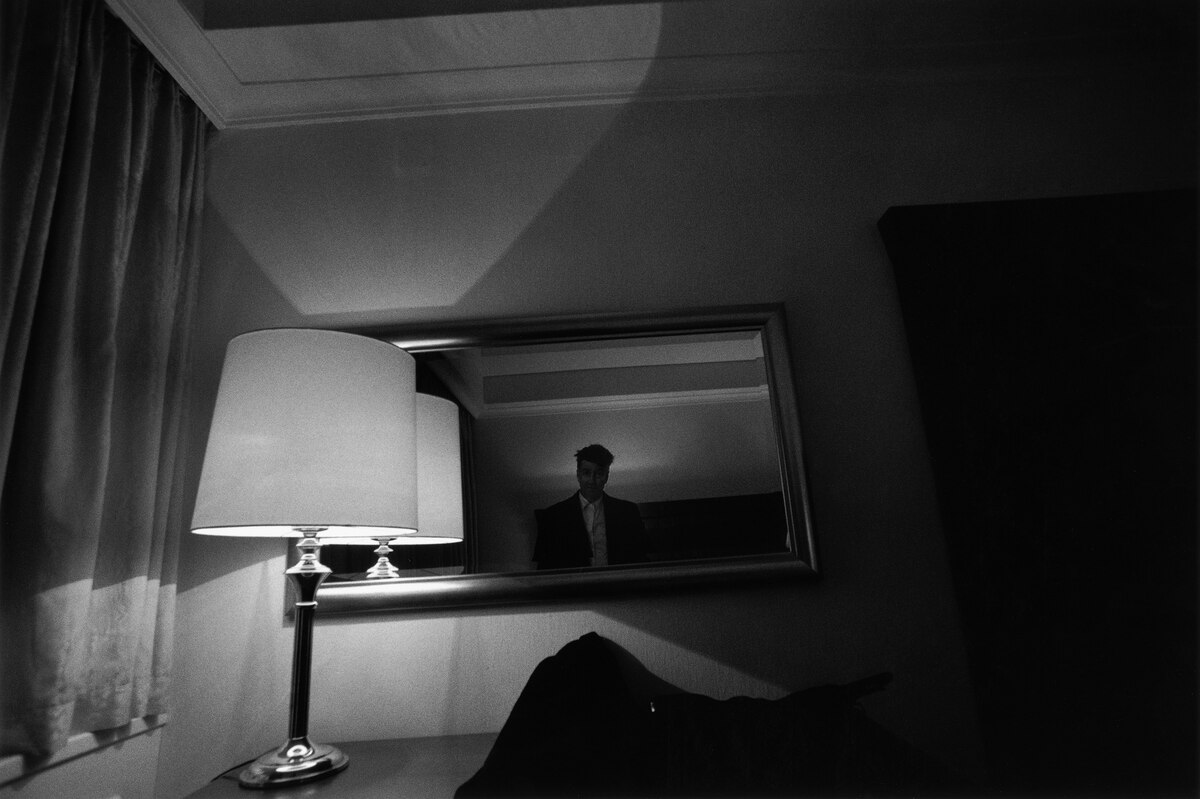
The whole thing is of a very peculiar beauty. The human body in its individual parts is a basic theme running through Lynch’s art. Heads appear in ever new variations; never complete or intact, but radically reduced here, half-decayed there, and often only recognizable through vague external outlines. The disgust-pleasure highlight in this context is the film installation “Ant Head”, in which ants, acoustically accompanied by an energetic drum solo, scurry busily through a severely deformed head sculpture that bears all the signs of advanced decomposition.

Surrealist, printed in Paris: David Lynch’s “Small Stories” from 2014 from the exhibition “Up in Flames” at DOX Prague
Photo:
The David Lynch Estate; Courtesy Item éditions, Paris
He alienates the beautiful
Lynch also often takes the opposite approach, especially in photographic works, not aestheticizing the damaged, but alienating the beautiful or desirable into the uncanny. He does not depict female bodies as complete nudes, but rather breaks them down into highly artificially lit body snippets, displayed in intimidatingly large-format images.
In one interior, a zeppelin seems to float through the room – perhaps it is the same one that, in the short film “The Bug Crawls”, makes its way indifferently over the horizon in the distance, while a gigantic beetle crawls over a house that is burning. Brother Kafka is often not far away.
David Lynch may have died, but his art still seems very much alive – and, it seems, is now even more on the international stage. In recent decades, Lynch has repeatedly worked with lithographs, relying entirely on the expertise of the Parisian studio Idem Éditions, which still uses machines from the 19th century (he also made a short one). Documentary about it, which is available on YouTube). Many Lynch lithographs were created in Paris; Several series from it are now exhibited in Prague.
And there will probably be more art by David Lynch on display. The New York Pace Gallery, which represents his artistic work, is currently preparing two exhibitions: Sculptures and pictures by the multi-artist will soon be on display in Pace’s Berlin branch, including some Berlin photographs. The gallery is also preparing a major exhibition in Lynch’s hometown of Los Angeles this fall.
Popular with international collectors
Artworks by David Lynch are in great demand among international collectors, says Pace. However, the blue-chip gallery, which is one of the larger players on the art market, did not want to disclose the price at which its oil paintings, lithographs or watercolors were sold when asked by taz.
In Prague’s DOX, the surreal exhibition experience can be concluded in style with a visit to the real-life in-house zeppelin: a wooden, filigree-looking solitaire that the Czech architect Martin Rajniš had built in 2016 as an additional event location above the DOX and which now sits high up there, seemingly floating crookedly above the house, visually providing a poetic counterpoint to the modernist concrete objectivity of the main building.
The door of this “Gulliver Airship” is always open, the interior is accessible but guarded. A young man sits at a lofty height next to the entrance and seems to be happy about every person who pokes their head in. The interior of the airship is divided into terraces into several flat surfaces on which you can sit or move – although the latter is best done carefully, as it seems as if you are falling forward a little when you stand on the wooden floor planks. Does this slight feeling of dizziness come from an overdose of Lynchian imagery? But no, the young man explains reassuringly, it’s not an illusion. The floor actually slopes down a bit.