

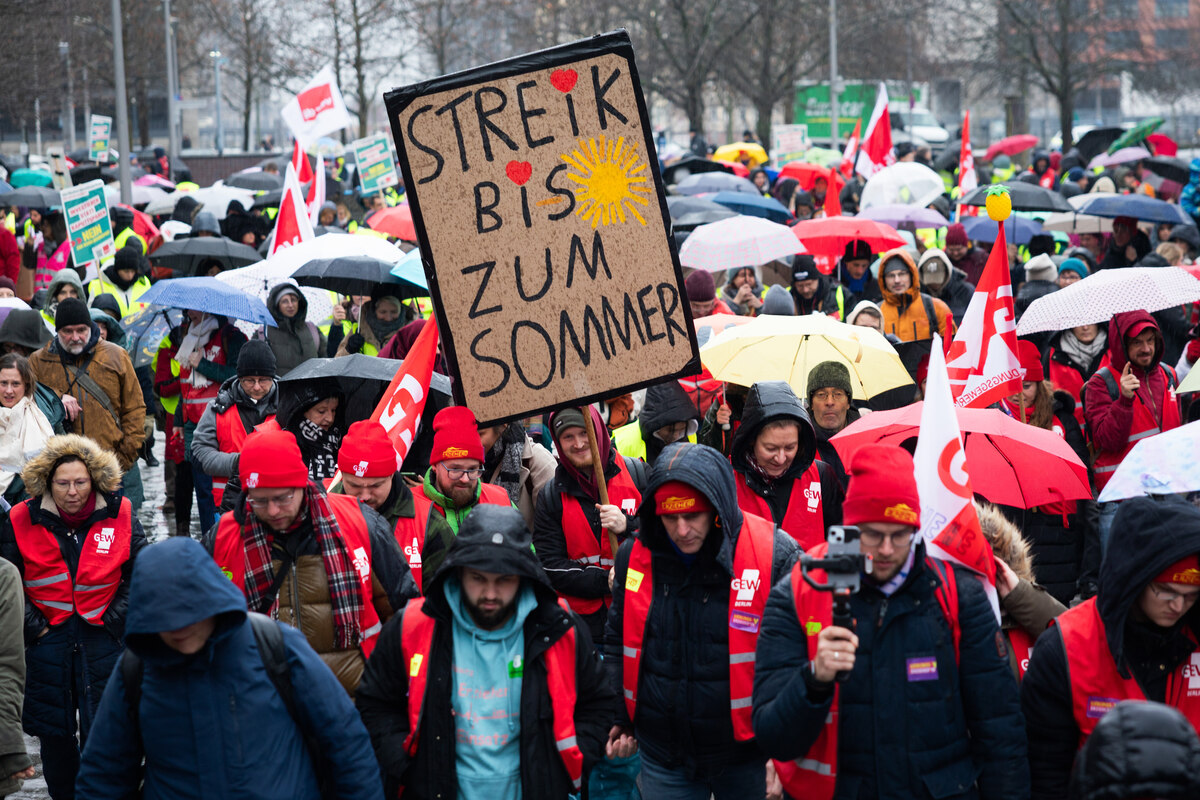
Ulla Wichmann is exhausted. “I don’t feel like going to daycare anymore,” says the teacher. Because of the overload, she feels bad towards the children and parents and constantly has the feeling that she cannot do her job properly. “I hardly have any energy left for my own children,” reports the mother of two. She works part-time.
To express her frustration, Wichmann, wrapped in a thick winter jacket, walked to the Red City Hall on Tuesday morning with around a thousand colleagues. The goal: to present a petition to Education Senator Kathrin Günther-Wünsch (CDU). In it, 3,200 employees and parents are calling on the Senate to significantly improve the skilled worker-child ratio in Berlin daycare centers. They also criticize that the recently passed daycare funding law does not bring any improvements to the often dramatic working conditions at Berlin daycare centers.
The official reason for the one-day warning strike is dThe ongoing collective bargaining in the public sector of the federal states (TV-L). Like administrative staff, teachers, cultural workers, police and fire departments, daycare teachers are among the professional groups that are paid according to the collective agreement and are fighting for higher wages nationwide. The service union Verdi is demanding a wage increase of 7 percent, but at least 300 euros. The employers have not yet submitted an offer in the second round of negotiations on January 16th. A nationwide warning strike in the education sector will therefore take place on Thursday.
Daycare crisis continues
But the employees also use the lifting of the peace obligation to take advantage of it In their view, catastrophic working conditions in the Berlin daycare centers. According to a Verdi survey in July, 89 percent of those surveyed said they were at least “highly” stressed. Only 2 percent stated that they were able to fulfill “their own job requirements”. The sickness rates among Berlin’s educators are the highest in the country with 36 sick days.
Verdi’s previous attempts to ensure better working conditions in the state’s own daycare centers with a collective agreement “for educational quality and relief” failed. Shortly after a clear majority of Verdi members decided to go on an indefinite strike in September 2024, the labor court banned the strike.
Günther-Wünsch did not accept the petition himself on Tuesday. Instead, the education senator criticized the warning strike: “Anyone who uses collective bargaining to enforce political demands that have long been decided and financed is endangering the stability of our daycare centers,” said the senator in a press release. The Senate is investing millions in quality and reliability.
Günther-Wünsch promised to significantly improve working conditions at all Berlin daycare centers – especially through the amendment to the daycare funding law that came into force at the beginning of this year. The new regulation increases the care ratio for those under three years old from five to four children per educator.
Deceptive Kita Funding Act
Verdi press spokesman Kalle Kunkel, however, describes the amendment as a “sham package”. Since the U3 area is the first, in which the declining number of children becomes noticeableonly educators would be kept in the daycare system; the Senate would not incur any new costs. Kunkel criticizes that the Senate has not changed the care ratio in the much larger Ü3 range. “We have a lousy status quo. Berlin’s personnel ratios are some of the worst in a national comparison.”
The educators at the strike demonstration also feel little relief from the decline in birth rates in their facilities. “The fact that we have fewer children only puts more pressure on the management,” reports Melanie, who doesn’t want to read her last name in the newspaper, to the taz. If there are too few children in your facility, educators are simply transferred. “The care key remains the same.”
The falling number of children would offer the opportunity to actually employ significantly more specialists per child in the daycare centers. “During the 2024 strike, the argument was always that there were not enough skilled workers to implement a better personnel ratio,” says Kunkel.
But instead of getting better working conditions, the skilled workers now have to worry about their future. “There is a lot of uncertainty among colleagues. Some smaller facilities have already had to close.”
Reductions in surcharges
The planned amendment is also viewed in a differentiated manner by independent providers. Lars Békési, managing director of the Association of Small and Medium-sized Daycare Providers (VKMK), assesses the project cautiously: “The new daycare funding law in its current form is not a major breakthrough. In particular, the new regulation of staff bonuses leads to a weakening of the funding structure in practice.”
The core point of the criticism lies in the change in the funding logic. In the future, supplements for additional staff will only be granted if at least 20 percent of the children have a Berlin Pass (education and participation package, BuT). Until now, the allocation was based on a high proportion of children with a non-German language of origin and the location in a socially disadvantaged area.
“The exclusive link to the BuT quota ignores the reality in the facilities,” explains Békési. Since many eligible families do not access the benefits of the Berlin Pass (BuT) due to bureaucratic hurdles or embarrassment, many daycare centers and their children fall out of the funding grid. “This means that exactly those support resources that are essential for the integration and language development of children are left behind. “With the current solution, 40,000 to 60,000 children are disadvantaged,” estimates Békési. This new regulation is problematic for many institutions because they now receive less money. “As a result of this cut, positions for language training will inevitably be eliminated,” says Békési.
Verdi spokesman Kalle Kunkel also shares these concerns, describing the reform as “cuts through the back door”. When asked by taz, the Education Senate administration stated that the new regulation of the surcharges would not result in any new costs nor would there be any savings: “The planned financial volume largely corresponds to the previous budget,” says press spokeswoman Susanne Gonswa.
Better working conditions and an end to the daycare crisis are not in sight for employees at the moment, even if the current collective bargaining round brings a good conclusion. She would much rather go on strike again for better working conditions, says educator Ulla Wichmann. But before the daycare movement takes off again, Verdi has to do it first be successful once in the main proceedings in order to lift the strike ban from 2024. However, the decision on this is still pending.