

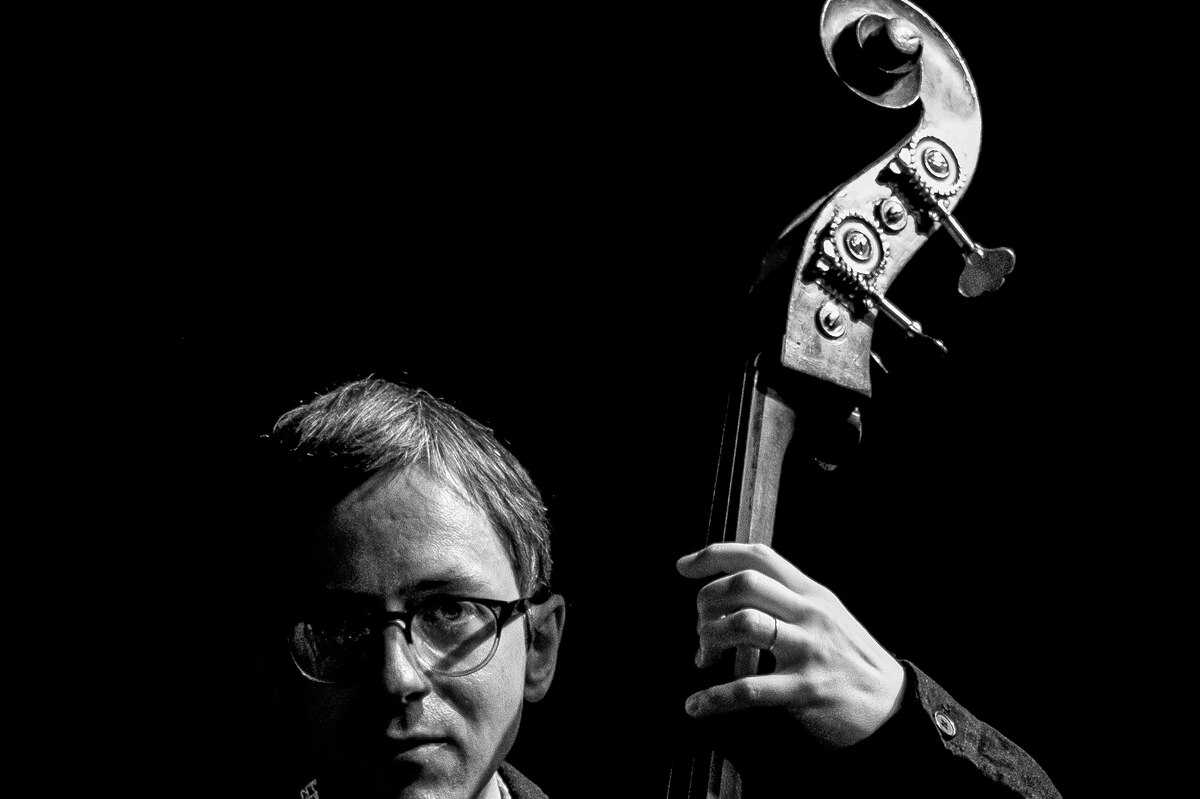
Sound algorithms move amidst branches, moss and shadowy darkness. Below, melodic lines from a flute, a guitar and a stuffed trumpet emerge – they themselves seem like a network of roots, like a hyphae made of the finest underground fungal threads that connects everything together. Analogue music meets computer codes, created from duets with “Woods”, a virtual string instrument.
“Woods” was developed by New York jazz bassist Thomas Morgan, who has been a sought-after sideman for 25 years. His bass is on works by Bill Frisell, Ambrose Akinmusire and Henry Threadgill. On his debut album “Around You Is A Forest” they each act as duo partners of “Woods”. In an interview with taz, the New York artist explains how his fascination with coding has accompanied him since childhood.
“I started playing the cello at the age of seven. A short time later, my father, a computer scientist, taught me the first programming languages,” explains Morgan, who was born in 1981 in Hayward, California, not far from Silicon Valley. “So I’m a digital native and I thought in these languages, like the ‘Closure’ language I used. And although I play primarily as a jazz bassist, I always dreamed of combining the analogue and digital worlds. And soon I was working on computer music in parallel.”
Since 2016, Morgan has been developing his virtual string instrument “Woods” with a Karplus Strong algorithm that simulates plucking and striking a string. The idea came to him while he was on the New York subway read a poem by beat poet Gary Snyderit was depicted there on a billboard for the “Poetry in Motion” series. It touched him and he started researching.
Improvisations by artist friends
He found a voice recording of Snyder on YouTube and contacted the now 95-year-old US poet whether he could use it for his album. Now Snyder’s voice can be heard on Thomas Morgan. The poet reads his poem “Here,” in which a planet shines through the trees in the darkness, coupled with the question: “Why are we here?”
Morgan composed and recorded all of the tracks on the album for “Woods.” At that point, he hadn’t yet thought about inviting colleagues to improvise on his pieces. That was a suggestion from his producer David Breskin. “I immediately liked the idea,” says Morgan. “I then discussed the selection with him and chose who would best suit which of the tracks.” He then sent them to one of his artist friends, who improvised on the recordings.
Morgan himself can be heard on acoustic bass on the title track, which also opens. After a slowly picked, gently melodic solo opening, “Woods” begins with intertwining sound lines. For the longest track, the 11-minute “Rising From The West,” Bill Frisell plays his guitar linearly along Morgan’s virtual composition, creating a polyphonic work of sound art.
On “In The Dark,” flautist and clarinetist Henry Threadgill builds a carefully evolving framework of intervalically blown fragments around the digital sounds. The trumpeter Ambrose Akinmusire, with whom Thomas Morgan played together in high school, can be heard on “Assembly of all Beings”. Spacious, with long-held tones that meet the digital, lace-like string sound of “Woods”.
An extension
When Morgan first encountered jazz in high school, it was a “life-changing moment,” as he says. He is particularly fascinated the bassist Ray Brown (1926–2002). “He was pretty much the first artist whose music I was really obsessed with,” Morgan explains in retrospect. “What made him so special is his sound, which sounds very powerful and concise, but never aggressive.”
Morgan persuaded Brown to take a lesson that took place spontaneously after a Brown concert in the dressing room of the Blue Note jazz club in New York. “It was incredible to hear him up close in that small room.”
Of his debut solo album, Morgan says: “I don’t see it as anything different from my work as a bassist. It’s an extension of what I do. My music simply requires a different way of listening, shaping and interacting with sounds.” What he hasn’t been able to show yet is making music with the computer. “I wanted to share that with other people. That’s why it felt urgent.”