

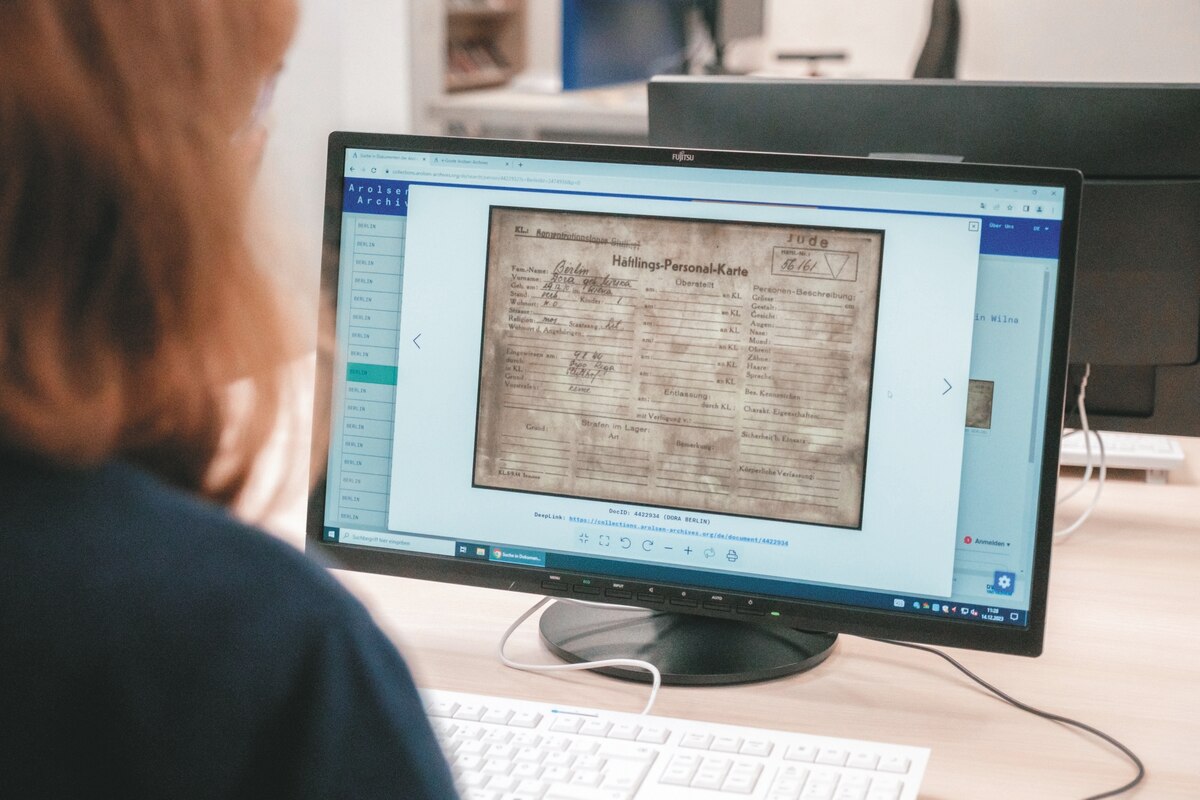
On Holocaust Remembrance Day, the Arolsen Archives are once again launching the #everynamecounts campaign. Everyone can help make files of Nazi victims accessible.
On Holocaust Remembrance Day on January 27th, the Arolsen Archives are once again starting a week of action in which everyone can help digitize Nazi victim files. Using the hashtag #everynamecounts (“Every name counts”), people will ask to enter names and data from victim files into a form so that they can be searched and found in databases.
The Arolsen Archives are the world’s largest archive of the victims and survivors of National Socialism. The collection with information on around 17.5 million people is part of the UNESCO World Documentary Heritage. It contains documents on the various victim groups of the Nazi regime and is an important source of knowledge for today’s society. Many of these files have been scanned but not yet transferred to digital databases.
The campaign week is supposed to change that. It starts on Monday morning, one day before January 27th, when the liberation of the Auschwitz concentration camp in 1945 is commemorated annually.
You can take part via computer or smartphone. On the Website of the Arolsen Archives You can get good instructions for use under #everynamecounts – and then the first index card from the archive. There you have to transfer the names, places and days of birth as well as other entries, sometimes handwritten and sometimes with a typewriter, piece by piece into a form. If something is illegible, you can leave fields blank. And if mistakes happen? No problem either, every card is checked several times.
This week we are talking about 58,000 documents from the Archives Service for War Victims from the Belgian State Archives. The file contains valuable information about the Nazi victims, many of whom the SS deported to Auschwitz via the Mechelen assembly camp in Belgium or various camps in France such as Drancy. The maps were created between 1941 and 1944 by the Security Service of the German Security Police (Sipo-SD). The file from Brussels also contains cards on people who were able to go into hiding or escape and thus escape deportation.
Almost 60,000 index cards? That sounds like a lot, but it is definitely doable. A year ago we had each other at a similar action week organized by the Arolsen Archives a similar number of people involved. And you can definitely do more than one index card if you take a few minutes.
At another week of action in the fall 13,000 memories of Ukrainian forced laborers recorded on postcards be digitized. According to the Arolsen Archives, the largest digital memorial to the victims and survivors of the Nazi era is gradually being created. Anyone who works on this is taking a stand against forgetting.
Together for a free press
As a cooperative, we belong to our readers. And our journalism is not only 100% non-corporate, but also accessible free of charge. We make all articles freely available, without a paywall. Especially in these times, classifications and information must be accessible to everyone. Our readers don’t have to pay anything, but they know that critical, independent journalism doesn’t emerge from nothing. We are very grateful for that. So that we can continue to do our journalism tomorrow, we need more support. Our next goal: 50,000 – and with your participation we can do it. Set an example for the taz and for the future of our journalism. With just 5 euros you are there!
Support now