

Whether on Deutschlandfunk, at the demo or in the taz, her ominous figure has been invoked for some time. Her name is often just whispered. However, she is also loudly accused by those who are particularly courageous. The form changes, the message remains the same: Anyone who doesn’t follow it has to fear consequences, its agents lurk everywhere.
On the other hand, anyone who calls it what it supposedly is – a perfidious tool of state suppression of dissenting opinions about the struggle between two national movements on a narrow strip of land – can feel like a rebel. Attention, here comes the reason of state! One could leave it at that and make fun of the rebellious murmurs. Right-wingers have their chemtrails, left-wing authoritarians have their reasons of state. Some people agree that we should all supposedly be forced into “opinion corridors”..
But now the murmur is too widespread to ignore, if it hasn’t already reached the mainstream. While some German bureaucrats seem to think that they can steer social debates in the “right” direction through language regulations, BDS activists attack left-wing, subcultural spaces.
Alleged memory world champions
Reason enough, then, to take a critical look at the concept of raison d’état. The Haus der Wannsee Conference memorial and educational center invited people to attend on January 20th, the 84th anniversary of the very Wannsee Conference, at which German lawyers and bureaucrats sought to administratively fix the “final solution to the Jewish question” that had already been set in motion. The memorial conference was titled with the question: “Remembering as a reason of state?”
The Nazi state’s reason of state was to eliminate anti-Semitism, said the head of the house, Deborah Hartmann, at the beginning. It seems paradoxical that this reason of state has been replaced by another that was not about remembrance, but rather about “reparation” – “a clarified attitude to one’s own history that has long since calmed down what was disturbing about it.”
Although they believe they are world champions of remembrance, many young Germans today actually believe that there were no perpetrators in their own families, while the work of memorial sites is being attacked not only by the AfD, but also from the left.
Hartmann referred to a recent one New Germany published article in which memorials and places of remembrance were accused of using their authority to make a critical attitude towards Israel impossible. For Hartmann, this is a conspiracy theory narrative that claims “the memory of the Holocaust is being used to silence critical positions.”
The left-wing variant of the right-wing radical “guilt cult” accusation, “Free Palestine from German Guilt,” also follows this line. Hartmann recalled that this slogan could be heard at demonstrations and read on university walls after October 7th – “and recently also increasingly visible in those places that are reminiscent of violent National Socialist crimes.”
Israel policy has always been the politics of interests
The historian Jacob Eder noted that the concept of reason of state was polemically brought into play in the mid-1960s. The political scientist Eleonore Sterling, who fled Germany in 1938, found at the time that the “philo-Semitism” of West Germans had “less to do with the Jews” than “with raison d’être and foreign policy.”
This polemic was not wrong. As is well known, German foreign policy since 1948 has been primarily concerned with good relations with the young Israel, because in this way one could put the past aside and strive for membership in the club of Western democracies. German Israel policy has always been a politics of interests. The fact that German politicians and diplomats continued to speak of “world Jewry” at the time, whose favor one had to court, is not a footnote, but rather indicative of the impact of anti-Semitic influences in post-Nazi Germany.
Eder looked back even further: Since Macchiavelli, the term “reason of state” has referred to the anti-democratic idea “that the interests of the state take precedence over the rights of the individual and the laws”; it has met with little response in the Federal Republic. However, since Merkel’s speech on the 60th anniversary of the founding of the State of Israel, the term was established – and was soon stretched and exploited. Now it overshadows and polarizes almost every debate.
For some, “reason of state” stands positively as the result of a learning process. For many, it has become a mantra to demand unwavering solidarity with Israel, “indeed, Israeli government policy.” Others used the term “derogatory and sometimes vulgar” as a fighting term for everything that allegedly went wrong in dealing with the past. Agitating against “reasons of state” also means being against Israel. Finally, anti-Semites see “reason of state” as proof that Germany is being controlled by dark forces.
Unsurprisingly, Eder came to the conclusion that the fight over symbols and beliefs had little to do with the realities in Israel and Palestine and was hardly helpful in combating anti-Semitism and racism. Eder sees the central problem with the concept of reason of state not in Merkel’s intention, but in the fact that “a politically and legally controversial and never finally defined concept has become a key concept of ‘historical responsibility'”: If something is declared to be a reason of state, there is nothing left to explain, convey or discuss.
The historical responsibility
In contrast, Eder’s historian colleague Anne Rethmann emphasized that “reasons of state” had become an affective code. That’s right, because in fact Merkel’s speech to the Knesset in 2008 is usually not even quoted correctly, and when it is, it is greatly abbreviated. She said: “Every federal government and every chancellor before me have been committed to Germany’s special historical responsibility for the security of Israel. This historical responsibility of Germany is part of my country’s raison d’être.”
This historical responsibility can hardly be dismissed: When Israel was founded, half of the Jews living there were survivors of the Germans’ bureaucratic “Final Solution to the Jewish Question” at Wannsee. It should be added that since 1974 there has not been a German government that has not supported the Palestinian right to self-determination.
Merkel also commented on this in her speech: “Germany is firmly committed to the vision of two states with secure borders and in peace – for the Jewish people in Israel and the Palestinian people in Palestine.” She demanded that her hosts be prepared to make “painful concessions”.
The scandalization of the concept of raison d’état is accompanied by the loss of differentiation, says Rethmann. This can be seen “in the political functionalization of elements of Shoah memory by the current Israeli government.” She also sees “forms of pro-Palestinian mobilization that use Nazi comparisons and ‘never again’ rhetoric” as problematic.
Such analogies exploited the Shoah for their own political or moral purposes. Actors prolonging the war, such as Hamas, fell out of sight: “Questions of concrete responsibility disappear behind one-sided, morally absolute attributions of guilt towards Israel.”
Willy Brandt and Helmut Schmidt
The lawyer and journalist Ronen Steinke considers the constantly repeated assertion of unrestricted, unconditional German solidarity with Israel to be simply silly. He referred to the policies of the Social Democratic Chancellors Willy Brandt and Helmut Schmidt. During the Yom Kippur War in 1973, Brandt wanted to prevent American weapons from being delivered to Israel via Germany. Helmut Schmidt got into a dispute with the right-wing Israeli Prime Minister Menachem Begin because Schmidt wanted to sell tanks to Saudi Arabia and, which Steinke did not mention, advocated for the right of the Palestinians to “organize themselves as a state.”
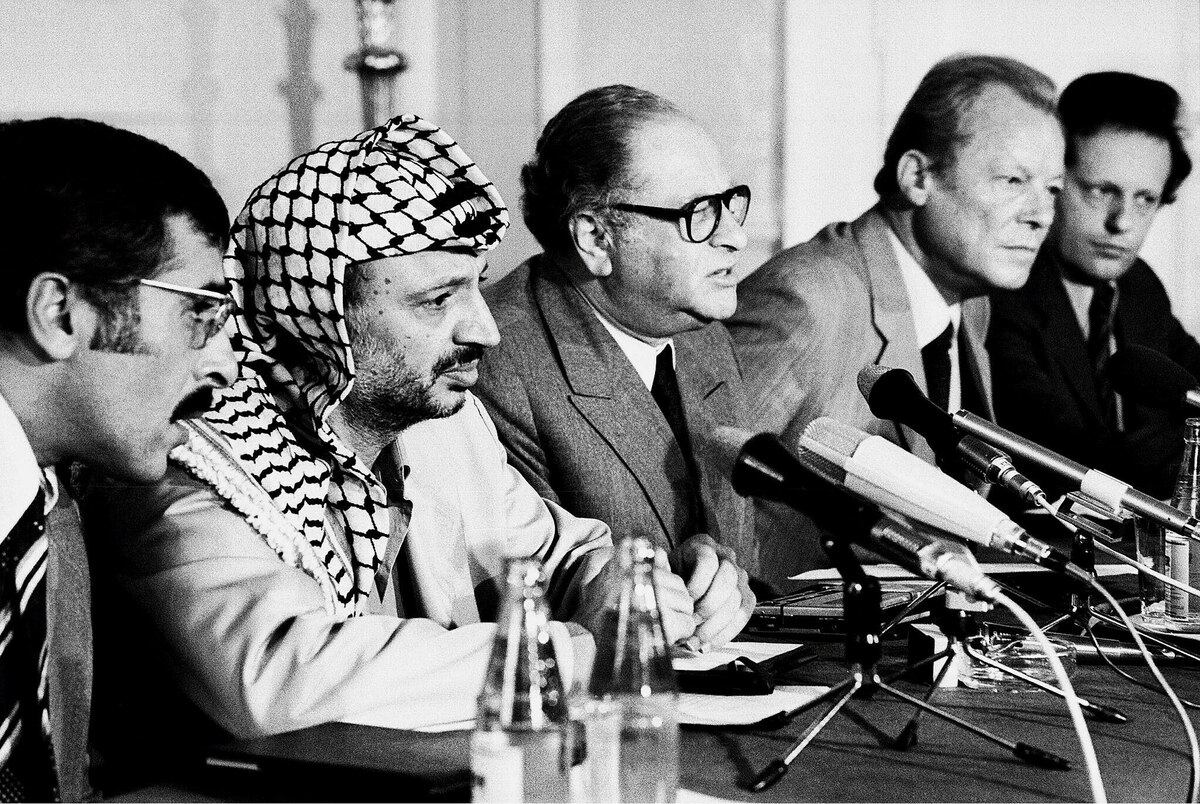
Against the background of the reason of state debate and its often ahistorical premises, it is worth taking a closer look at Willy Brandt’s role: The scandal broke out in 1979 when Brandt, now in his role as chairman of the Socialist International, met with PLO leader Yasser Arafat in Vienna. According to the report, Brandt then announced Mirrors told the Chancellery that Arafat had admitted more clearly than ever before that “that the realization of the right to self-determination for the Palestinians is possible even without the destruction of the State of Israel.”.
Brandt’s diplomatic mission followed the stance he had taken as Chancellor. As early as 1971, the Social Democrat expressed himself not much differently than Merkel did in 2008. His words sound quite current: “Israel is – even the slogans of radical groups do not change this – the grandiose attempt to provide a secure homeland for a people who are largely homeless. It is bitter that the birth of this state demanded the price of new victims and new suffering. Who wanted to keep that quiet? Who wanted to keep quiet about the misery of the Palestinian Arabs?”
Brandt counted the reparations agreement that Adenauer concluded with Ben-Gurion among the achievements “that we consider to be the cornerstones of our state’s self-image.” Grundstein sounds less strict than raison d’état, but the same thing is meant. Either way, one could and can hardly contradict Brandt’s view of things.