

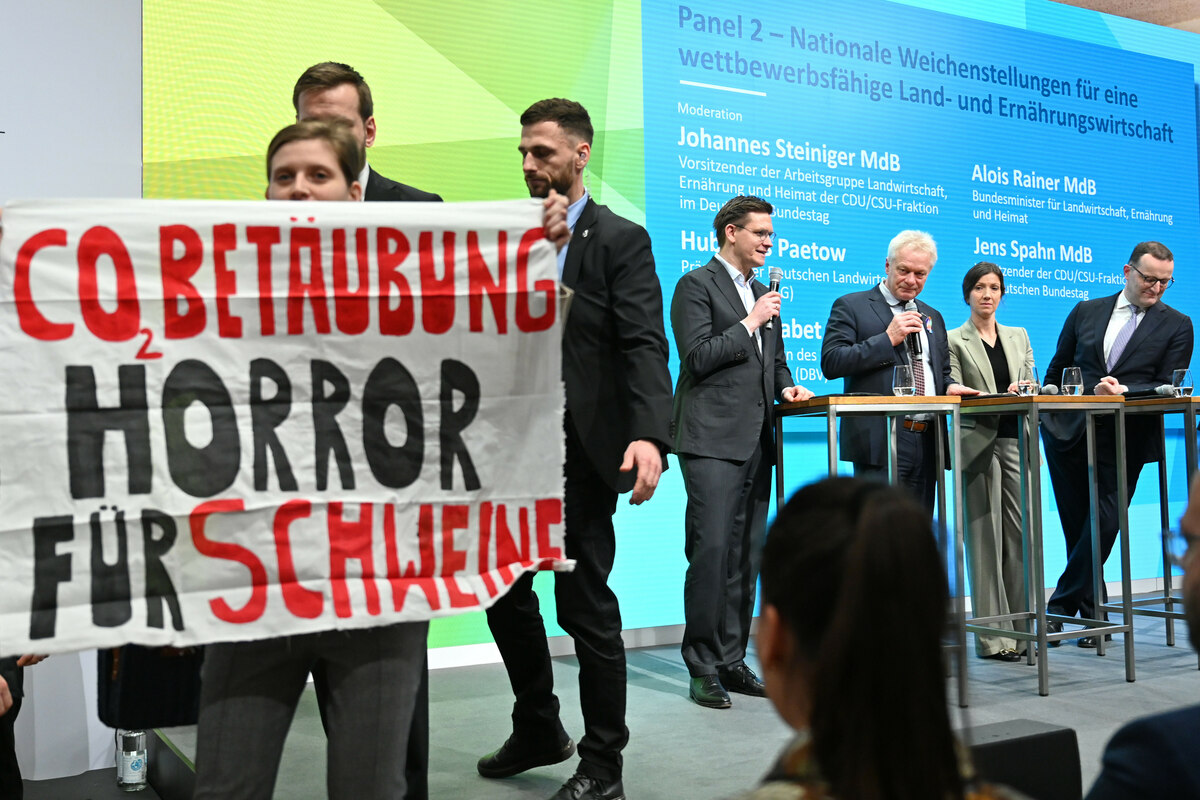
A long, terrible squeak can be heard on the “adventure farm” in Hall 3.2. “Oh, what do we have here?” asks Alois Rainer, Federal Minister for Agriculture, Food and Homeland. On Tuesday afternoon he will be a guest on one of the panel discussions on German and European agricultural policy that will take place at the “Bauernhof”. The CSU politician is likely to know the shrill sounds well as a trained butcher. They come from factory-farmed breeding pigs that fight against the torturous effects of CO₂ stunning.
“CO₂ anesthesia: horror for pigs” is written on the banner that activist Anna Schubert carries onto the stage in the middle of Rainer’s speech. She is currently a defendant in the “slaughterhouse trial” because she installed hidden cameras in the Brand slaughterhouse in Lower Saxony. These documented the behavior of the pigs in the so-called CO₂ stunning gondolas, “undoubtedly the most critical and animal welfare-relevant places in pig slaughterhouses,” as the group writes. The Brand slaughterhouse is considered a pioneer of CO2-Anesthesia in Germany.
The procedure is classified as contrary to animal welfare. As early as 2004 and again in 2020, the European Food Safety Authority (EFSA) called for the phasing out of CO₂ stunning.
But the method is economically attractive: Up to 35 million pigs can be stunned every year before they are killed with a stab in the carotid artery and bled out. However, until the animals are anesthetized, they “spend the last seconds of their lives in fear of death,” writes the animal protection organization Peta.
The CO₂ causes a stabbing pain on the animals’ mucous membranes, they can’t breathe and try to escape in panic. The result: the screams played by the activists and brought from the slaughterhouse to the “experience farm”.
Pure symbolic politics?
The Minister of Agriculture is not disturbed by the disruptive action. In an understanding tone he comments: “I know the discussion, no question at all. We have to talk about the anesthesia. We stand by livestock farming, which is also done with respect. And the respect is due right up to the last minute.” They would definitely take a look at it, assures Rainer, and promises the animal rights activists a conversation after the podium.
But before the dialogue takes place, the agriculture minister disappears from the hall through another exit; the activists are not allowed to follow. “We didn’t get a reason,” notes Schubert.
Rainer recently announced to introduce mandatory video surveillance in large slaughterhouses for animal welfare reasons. Schubert would have liked to ask the Agriculture Minister whether he planned to introduce video surveillance of slaughterhouses in the CO₂ mines as well. If not, “the advance of video surveillance would be purely symbolic politics.”