

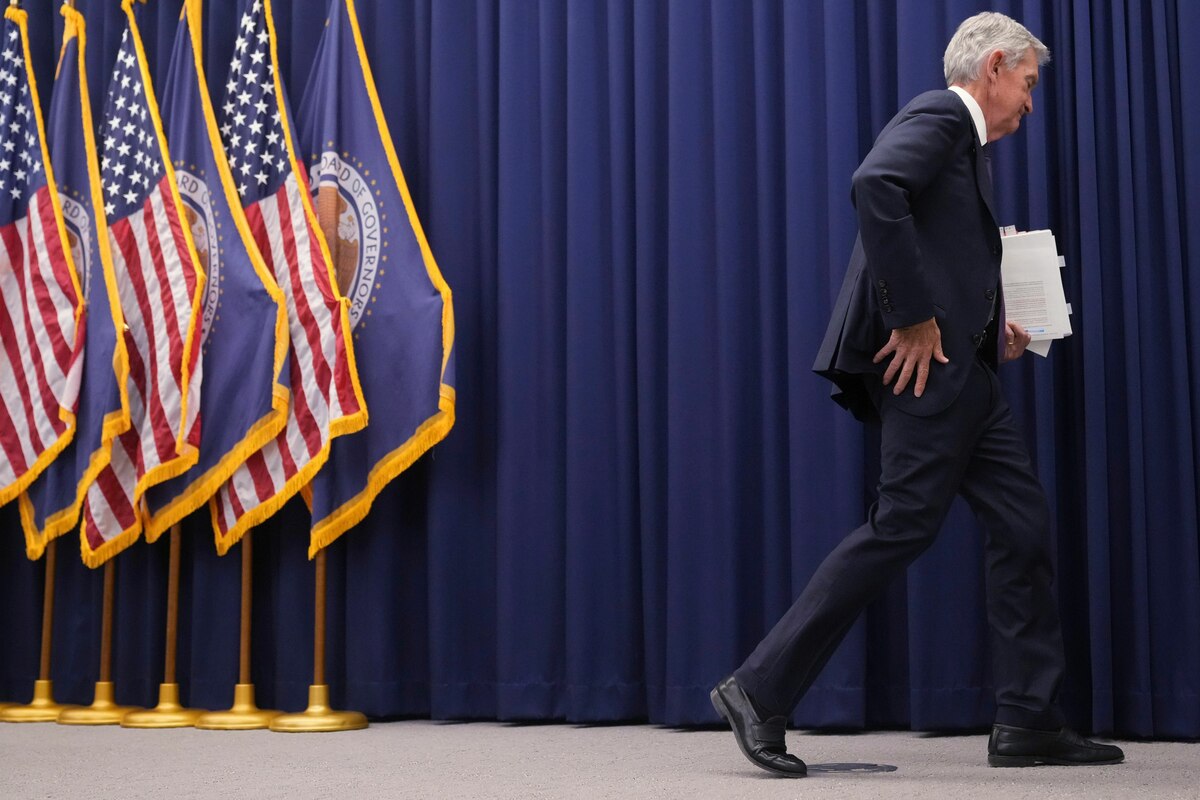
US Federal Reserve does not touch the key interest rate
A stabilization of the labor market and persistently high inflation have led the US Federal Reserve to maintain the key interest rate for the first time in months. The interest rate remains at 3.5 to 3.75 percent. There is currently no reason for a rate cut based on available data, he said Fed-Chef Jerome Powell at a press conference.
The interest rate decision did not have a major impact on the euro-dollar exchange rate. The day before, the euro had already gained significantly against the dollar due to irritating statements from US President Donald Trump. The fact that the euro remained at this level after the announcement of the key interest rate is probably also due to the fact that a majority of economists had expected stable interest rates and the decision had already been priced in.
Germans and citizens of other euro countries who are planning a trip to the USA or who pay in dollars when shopping online are currently getting around 1.19 dollars per euro, which is slightly more in exchange than just a few days ago. German and European companies that export to the United States also benefit from the slightly better exchange ratio.
For the current year, economists expect that the Fed will reduce the key interest rate in two steps – i.e. to 3.0 to 3.25 percent. However, LBBW research analyst Elmar Völker suspects that there will be little change in the current key interest rate by the summer: “We are currently not expecting another key interest rate cut before the Fed meeting in June, the first under the leadership of Jerome Powell’s successor.” (dpa)
Powell advises his successor to distance himself from politics
Amid speculation about his future and a criminal investigation, Federal Reserve Chairman Jerome Powell has offered clear advice to his future successor. “Stay out of partisan politics, don’t get drawn into partisan politics. Don’t do it,” Powell said at a news conference Wednesday. At the same time, he repeatedly dodged questions about a Justice Department investigation and his own plans after his term as chairman ends in May.
The background to the questions was an investigation by the US Department of Justice into cost overruns in the renovation of the central bank’s headquarters, which Powell himself made public in a video message at the beginning of January. At the news conference, however, he declined to provide details or say whether he would remain on the Fed’s board after May. His term as a board member runs for two more years. “I really don’t have anything to say to you about that today,” Powell repeated several times.
Powell’s personality is politically highly explosive. US President Donald Trump, who originally nominated Powell, is currently weighing who he will name as the next Fed chief. Trump has repeatedly criticized Powell and the Federal Reserve for what he sees as too tight a monetary policy and has called for aggressive interest rate cuts, even though inflation remains above the Fed’s 2 percent target. The willingness to cut interest rates is seen as a decisive criterion for Trump’s choice of candidate, which is fueling concerns about the legally anchored independence of the central bank.
The tensions between the government and the Fed were recently shown in a case before the Supreme Court. Powell attended the hearing on Trump’s attempt to remove Federal Reserve Governor Lisa Cook from office. “I would say this case is perhaps the most important legal case in the 113-year history of the Fed,” Powell said. It would have been difficult to explain why he, as Fed chairman, would not have taken part. (rtr)
USA and Mexico want to revise trade agreements
The USA and Mexico want to revise their joint trade agreement (USMCA) and begin formal discussions on possible reforms. The office of US Trade Representative Jamieson Greer announced this on Wednesday after a meeting with Mexican Economy Minister Marcelo Ebrard. Possible reforms include stronger rules of origin for industrial goods and measures against what the US government describes as the relentless dumping of industrial goods in the region.
The discussions are particularly important for the German automotive industry. Corporations such as Volkswagen, BMW and Mercedes-Benz operate large plants in Mexico in order to supply the US market from there duty-free. Tightening the rules of origin could result in their vehicles no longer qualifying for duty-free access. The background is a review clause anchored in the agreement, which applies until July 1st. US President Donald Trump described the agreement as irrelevant. Trade Representative Greer said a simple extension would not be in the U.S. national interest. (rtr)
Shutdown soon in the USA?
There were thousands of flight cancellations, civil servants received no salary, those in need did not receive food stamps – and many US authorities no longer worked: it was only in November, when Democrats and Republicans were able to agree on an interim budget after a long dispute, that the longest partial shutdown of US government business to date ended. The bridging budget expires this Friday – and follow-up financing is far from secured.
This could be the second time in President Donald Trump’s relatively young term in office that a so-called Shutdown come. This also has to do with the fatal shots during an operation by federal officers in Minneapolis US citizen Alex Pretti cost lives and have been stirring up the entire country for a week.
The fatal shooting of two white US citizens by federal officers in Minneapolis sparked protests across the country. A few weeks before the death of the nurse Pretti, an ICE immigration officer shot and killed US citizen Renée Good in her car. The anger and indignation that this sparked in the city in the northern state of Minnesota is also reflected on the political level. The Democrats want to put a stop to Trump’s rigorous deportation policy with raids, especially in democratically governed cities. Through the budget they are trying to force a move away from the brutal deployment methods. (dpa)
Musk is converting Tesla to robots and robotaxis
After the first year with a decline in sales, Elon Musk promises Tesla a future with robots and robotaxis. The older S and X models are being discontinued to free up capacity for robot production. They once established Tesla’s reputation, but have recently barely been delivered. Production of the Cybercab robotaxi vehicle without steering wheel and pedals is scheduled to begin this year. Over time, many more cars will be built of these than all other models combined, the Tesla boss hopes.
In the two new areas, Tesla faces strong rivals and still has to prove that the technology of the electric car pioneer can survive on the market. So far, Tesla has only used a few driverless robotaxis in the Texas city of Austin. They were finally accompanied by guards in the passenger seat. Meanwhile, Google sister company Waymo operates more than 2,500 driverless cars in several US cities and is expanding.
It is also controversial whether Musk’s decision to only use cameras for autonomous driving provides sufficient security. Waymo and other manufacturers also rely on other sensors, especially laser radars, that scan the vehicle’s surroundings. If Musk’s calculations work, Tesla would have an enormous cost advantage.
According to Musk, Tesla is currently testing its robotaxi service with around 500 vehicles in Austin and the state of California. However, California still requires a safety driver to be behind the wheel. Meanwhile, only Chinese developers are significant competition for Tesla’s robot called Optimus, said Musk. However, there are also companies in the USA that have already tested their robots in factories – for example Figure AI in the BMW US factory. Tesla wants to start Optimus production this year – and Musk recently announced that they could be offered for sale “to the public” by the end of 2027.
To make room for robot production, production of the larger Models S and X will be stopped at the Fremont, California headquarters in the coming quarter, Musk said. Owners of the cars will continue to receive technical support over the life of the vehicles, he assured. (dpa)
Facebook founder Mark Zuckerberg wants to use artificial intelligence to tailor his online platforms more closely to individual users. Today, services from the Facebook group Meta are there to stay in touch with friends or discover interesting things, said Zuckerberg. Soon, when you open the meta apps, you will encounter an AI “that understands you”.
This software will be able to identify people’s “unique personal goals,” he promised. With this knowledge, each individual will then be shown “content that will help them improve their lives the way they want,” announced the Meta boss.
Meta also includes Instagram and the chat service WhatsApp. The group earns its money through online advertising on the platforms – and artificial intelligence is expected to play a larger role here too. This will help users find products that interest them, said Zuckerberg.
Huge investments
The contributions in the apps should also become more interactive with the AI change. For example, a user will be able to create their own game using a voice command to the software and share it with others, Zuckerberg said. Today it is mainly videos that can be found on the platforms – but Meta does not assume that this will be the “final format”.
To bring about this AI future, Zuckerberg is prepared to make huge investments. For the current year, Meta announced capital investments of between 115 and 135 billion US dollars. In 2025, the group spent a good $72 billion, primarily on expanding data centers for artificial intelligence. Zuckerberg has big ambitions to surpass rivals such as ChatGPT developer OpenAI and Google and Elon Musk’s AI company xAI in artificial intelligence. He is prepared to spend billions on this – even with the risk of building up too much data center capacity.
The money for AI expansion continues to come primarily from the booming advertising business on platforms such as Facebook and Instagram. In the last quarter, sales jumped 24 percent year-on-year to almost $59.9 billion. That was above analysts’ expectations. The bottom line is that quarterly profit increased by 9 percent to $22.77 billion. (dpa)