

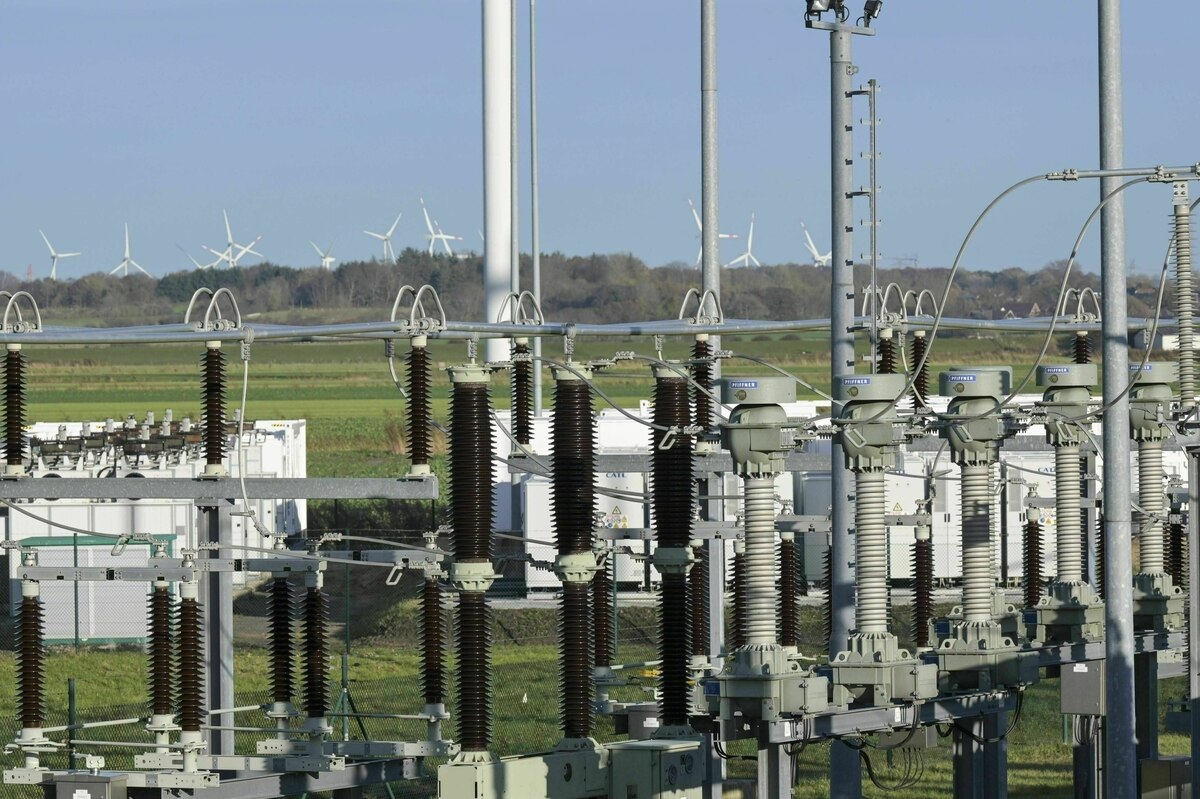
Battery storage capacities have increased fivefold. But for a real energy transition there is no way around hydrogen – and that’s where there’s a problem.
D Germany Energy transition urgently needs electricity storage. In this respect, it is a positive development that battery storage capacities have increased in recent years were significantly expanded. Nevertheless, one should not view this development too euphorically as an indication of a proper energy transition, especially since the number of new buildings has actually stagnated recently.
Because even if the battery lobby tries to give a different impression: an entire economy cannot be converted to renewable energies with battery storage alone. A simple calculation example shows this: Even if the industry’s goals for 2030 were achieved – battery capacities of 100 gigawatt hours – this amount could only cover Germany’s electricity needs for a good hour on a cold winter day.
A lull in the dark, i.e. days and weeks without wind and significant sunshine, cannot be bridged with batteries. Batteries can only be used for short-term compensation – for example by storing midday sun for the evening, or by stabilizing the load in the network in the event of short-term fluctuations.
But if the energy transition is to succeed, it also needs seasonal electricity storage. Those that are filled with solar power in summer and discharged in winter. From today’s perspective, this can only be achieved through the production of storage gases such as hydrogen.

Politicians basically know this and drew up a hydrogen strategy in 2020. But now that this is being implemented through the construction of the first electrolyzers, it seems to have been forgotten why the hydrogen thing is being done in the first place – as I said, to store the surplus electricity from photovoltaics and wind power. However, electrolyzers are currently not being built where there is often an abundance of electricity, but rather where the funding falls – for example in the electricity import area of southern Germany. This is revealed by the expansion of storage resources in Germany a frightening lack of concept.
Together for a free press
As a cooperative, we belong to our readers. And our journalism is not only 100% non-corporate, but also accessible free of charge. We make all articles freely available, without a paywall. Especially in these times, classifications and information must be accessible to everyone. Our readers don’t have to pay anything, but they know that critical, independent journalism doesn’t emerge from nothing. We are very grateful for that. So that we can continue to do our journalism tomorrow, we need more support. Our next goal: 50,000 – and with your participation we can do it. Set an example for the taz and for the future of our journalism. With just 5 euros you are there!
Support now