

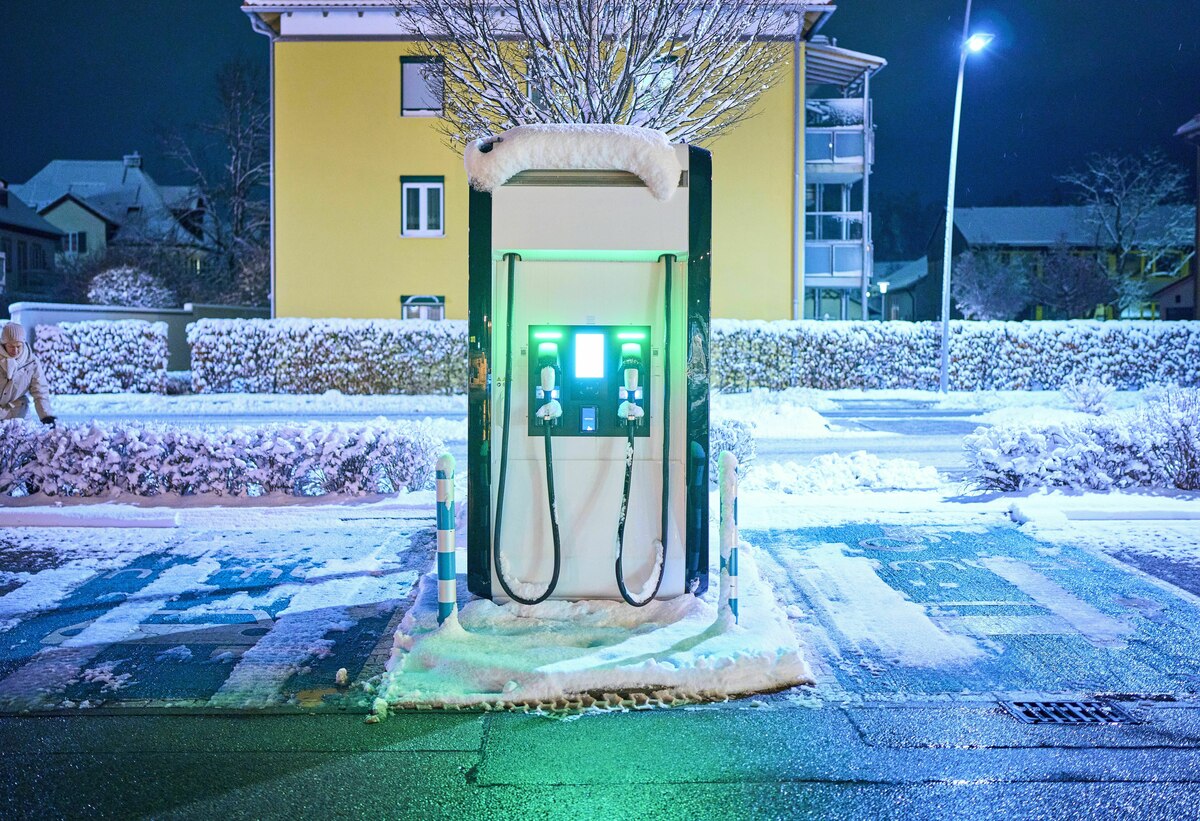
Home, electric car, wallbox as a private charging station – that works quite well in Germany, but is not affordable for everyone. That is why the climate and transport association Transport & Environment (T&E) demands: In order to create socially fair charging options, especially for people in apartment buildings, the federal government must set up a funding program.
This can be implemented with comparatively little money, says T&E. A study The Fraunhofer Institute for Systems and Innovation Research on behalf of the association has shown that up to 3 million parking spaces could be prepared for charging electric cars with a total of 500 million euros.
“Be prepared” means that electrical and data lines are laid to a respective parking space and the electricity measurement technology is pre-installed. They’ll come later Costs for the wallbox – between around 200 and 2,000 euros, depending on the equipment of the device – and for its installation.
The German charging network is becoming denser, but there are still weak points, for example in apartment buildings on highways. In 2025 the Federal Ministry of Transport has an extra one Funding for private charging connections in apartment buildings promised. The ministry told taz what exactly this will look like will be determined by April.
Rules for existing residential buildings
For new buildings, the construction of charging infrastructure is based on the Building Electromobility Infrastructure Act, or GEIG for short. At the European level, the EU Directive on the Energy Performance of Buildings (EPBD) has existed since 2024, which Germany must implement into national law by May 2026. GEIG already covers parts of this.
The federal government is cementing a structural imbalance in electromobility
Susanne Goetz, Transport & Environment
T&E is now criticizing the fact that the federal government wants to adopt the European EPBD one-to-one. The association would like more ambitious regulations. The EPBD does not contain any binding targets for existing residential buildings, unless extensive renovation is required. Even after 2030, 5.6 million existing parking spaces would not yet be prepared for a private charging connection.
“The federal government is thus cementing a structural imbalance in electromobility,” says Susanne Goetz, T&E expert for electromobility. Anyone who lives in a single-family home can charge cheaply – tenants in apartment buildings are left alone. In Germany, electric cars are already being driven two and a half times as often by residents of a single or two-family house as by people in apartment buildings.
Meanwhile, in Europe, electric car sales have reached a “historic milestone,” according to the research institute ICCT announced on Monday. In 2025, one in five newly registered vehicles was fully electric, which corresponds to an increase of 4 percentage points since 2024 – and the highest value ever recorded.
In Germany, electric cars and plug-in hybrids together accounted for almost a third of new registrations, and in northern European countries and the Netherlands even 50 percent. The European car market continues to electrify quickly – despite regulatory and geopolitical uncertainties, says ICCT-Forscherin Sonsoles Díaz. Most car manufacturers are well on their way to meeting EU climate requirements for their new car fleets.
Nevertheless, the EU recently moved away from the previously planned ban on the sale of new combustion engines from 2035.