

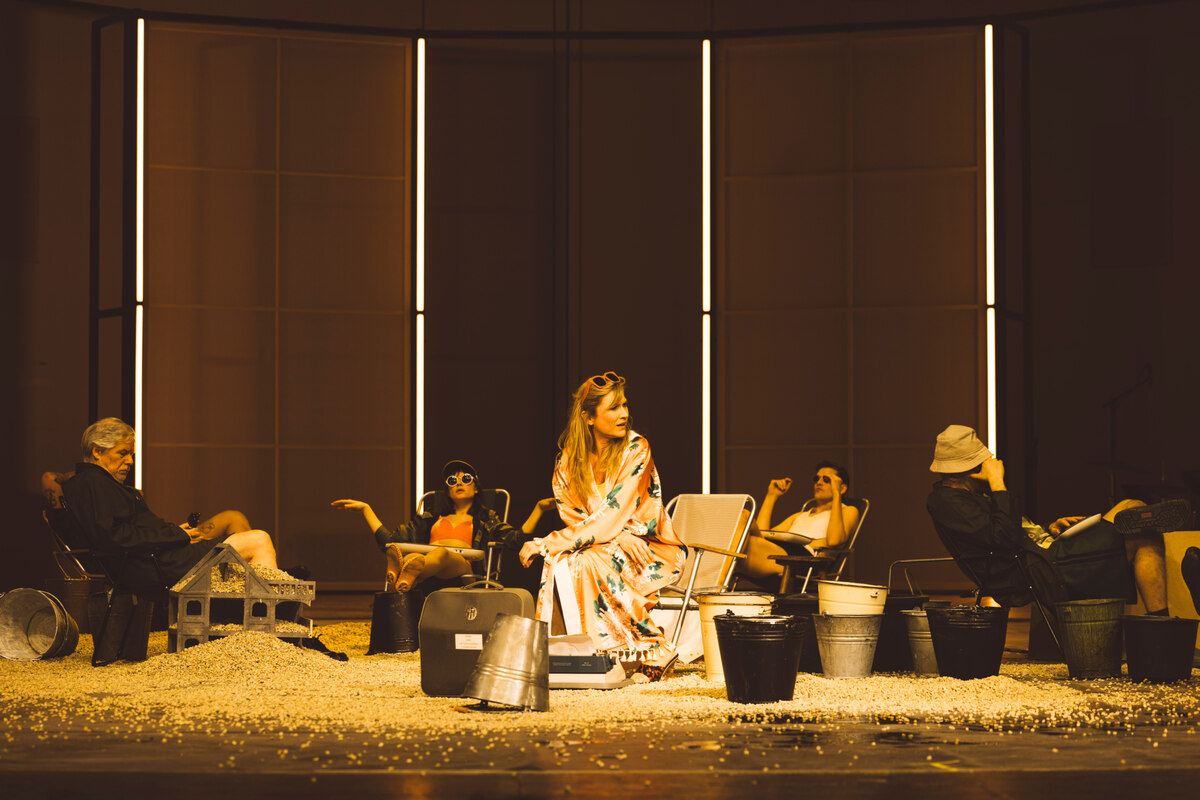
At the beginning she broods quietly on the edge. In a heavy leather coat and cowboy hat, actress Almut Zilcher resembles a ranger from the Wild West – in fact, she plays the gardener in the East who accompanies the house and property on Scharmützelsee for a German century. With fairytale-like emphasis, Zilcher reports how he cultivates the land and follows the movement of the Colorado potato beetle, as if this were the decisive front line of a world that has gone out of control.
In Jenny Erpenbecks In the novel “Visitation” from 2008, the gardener is not only a witness to the changing ownership of land and property but also a link between fragments in which Erpenbeck tells the story from the perspectives of various owners, tenants and heirs. Her own family history plays a role: “The writer” lived in exile in Moscow like her grandmother, the writer Hedda Zinner, and she herself could be the “unauthorized owner” who ends up losing the house. The book is also a work of remembrance based on research, for example on the Jewish girl Doris Kaplan, who was murdered in the Holocaust and who may have been hiding in the neighborhood.
The Guardian chose “Visitation” In 2019 it was among the 100 best books of the 21st century, and in the next three years it will be part of the Abitur material in almost all federal states. It’s immediately on the theater schedule: At the beginning of the season in Hanover, director Adrian Figueroa made the house itself the protagonist of a visually powerful production. Now Alexander Eisenach is putting more focus on figures and language at the Deutsches Theater Berlin.
Daniel Wollenzin placed a metal sculpture in a semicircle made of paper walls. It could be the glacier tongue in front of which Siri Carla Brodowsky initially talks about the creation of the terminal moraine landscape, while the ensemble is shoveling gravel and carrying buckets of water. Later, the structure floats above the stage like a cloud while the lounge chairs are unfolded below. Eisenach’s approach from a medium distance fits this setting: the players retell the novel without illustrating it clumsily; they speak in the third person about characters who they also embody highly emotionally in key moments.
Social and economic pressures
When Julischka Eichel, one of four farmer’s daughters, breathlessly rattles off wedding rules, the social and economic pressure that is causing the family and its property to collapse is reflected. Felix Göser’s architect, who bought and developed part of the property in the 1930s, euphorically represses his complicity: even when he buys the lake property from the neighboring Jewish cloth manufacturer at a bargain price, he still believes that he has enabled the couple to escape. In fact, they were murdered in Kulmhof, reports Peter-René Lüdicke matter-of-factly. In one of the strongest scenes, Anja Schneider as the architect’s wife and Benjamin Lillie’s traumatized Red Army soldier meet in the closet of the house that was occupied in 1945. Face to face, but without touching each other, both talk about a rape – and deliberately blur who is the perpetrator and who is the victim.
But “Visitation” is not only a German, but also an East German novel. Erpenbeck contrasts the privileged family of the socialist writer, who first leases the house from the GDR state and then purchases it, with the less advantaged subtenants who dare to try to escape: the latter, of all people, find Eisenach and his team dispensable. Instead, the production jumps directly from the sophisticated artistic freshness to the post-reunification period. There, granddaughter Svenja Liesau packs her things in holy anger when the demand for repayment is granted by West German heirs. Wounded, she retreats to the glacier sculpture, while a real estate agent tells the impressed clientele that the architect of the house worked for Albert Speer. Does the circle close when Nazis and Wessis rip off innocent Easterners?
Just recently, Claudia Bossard received severe criticism for her “robber” deconstruction of the same house. One person said that school classes should be warned about this, a sentence that DT Marketing has been using aggressively ever since. In the case of the “Visitation,” such alarm is superfluous – all the more reason to argue about the Eastern transfiguration that Eisenach’s version suggests.