In the hour of struggle to preserve the peace order that has existed since the Second World War and the transatlantic relations between Europe and North America, the European Union is relying on its sharpest sword: decisive rhetoric.
It took the heads of state and government of the 27 EU member states a good five hours to discuss their further dealings with US President Donald Trump and his demands for the largely autonomous Greenland, which belongs to Denmark, until early Friday morning. At the end, EU Council President António Costa summarized: “The European Union will continue to stand up for its interests and defend itself against any form of coercion.”
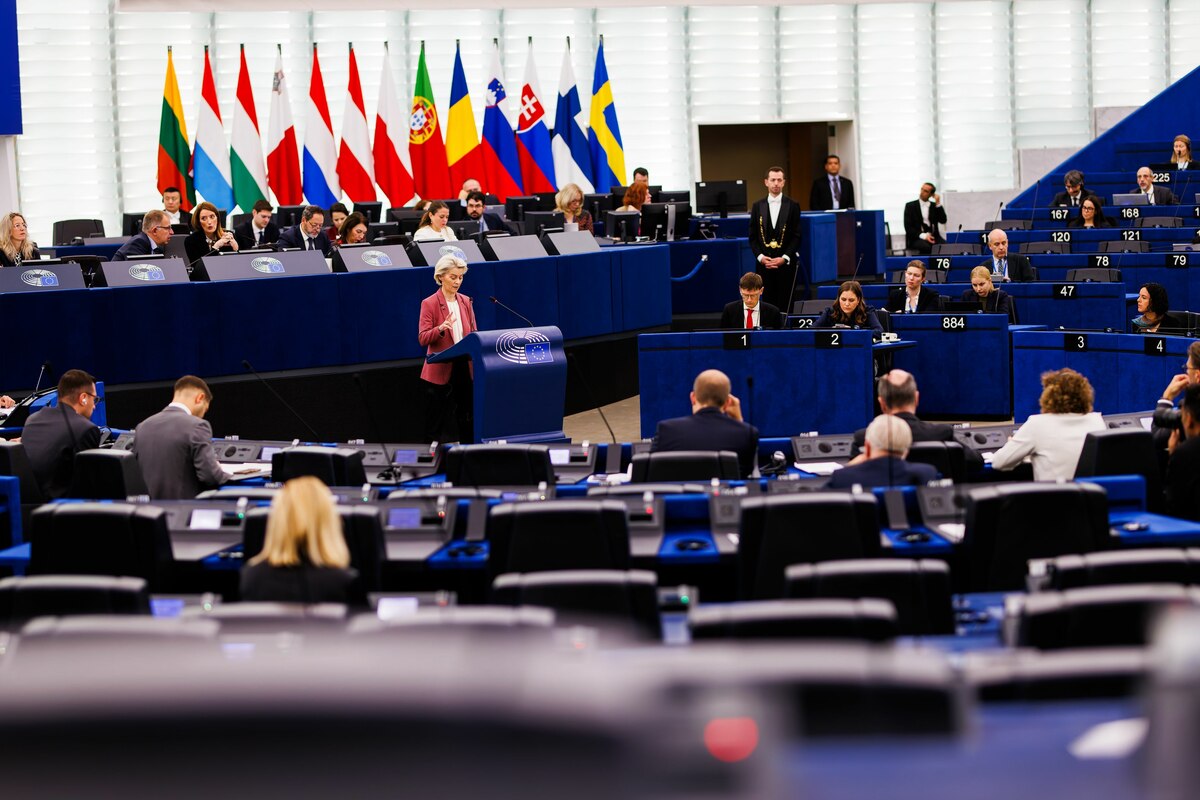
EU Commission President Ursula von der Leyen assisted: “We have learned the lessons from our collective strategy.” On February 12, according to Costa, there will be a “strategic brainstorming session on strengthening the internal market in the new geopolitical environment” in the form of another informal EU summit.
The most concrete was von der Leyen’s admission that the EU had “invested too little in the Arctic and in Arctic security”. That is why the EU Commission made the proposal to “double financial support for Greenland in the next budget” and to use EU funds for “Arctic-capable equipment such as a European icebreaker”. “The EU Commission will soon present a substantial investment package,” said the CDU politician.
Audible helplessness
Ukrainian President Volodymyr Zelenskyj had criticized the EU in his speech at the World Economic Forum in Davos the day before: “Words,” “everything moves faster than Europe,” he said. In fact, there was audible helplessness when it came to further dealings with the erratically acting Trump.
“The European way of life is different than the American way of life,” said Costa. And upon his arrival at the EU Council building, French President Emmanuel Macron responded to a reporter’s question as to whether Trump was still a friend of Europe: “I can’t assess that.”
Chancellor Friedrich Merz said: “We will have to strengthen the resilience of the European Union, which is about defense and competitiveness.” The CDU politician was also cautious when it came to the Western defense alliance: “We should definitely try to preserve NATO,” said Merz, adding: “You don’t just give up on this transatlantic alliance.”
Previously, one of Kremlin chief Vladimir Putin’s chief negotiators had described the punitive tariffs against the EU countries that were actively supporting Greenland, first announced by Trump and then withdrawn on Thursday, as a “sign of the collapse of the North Atlantic Alliance”.
Abusive behavior
And Kirill Dmitriev, the head of the Russian sovereign wealth fund who is negotiating Ukraine with Trump’s Russia negotiator Steve Witkoff, added triumphantly: “The transatlantic alliance is over.” Europe does not want to mess with their “daddy,” as Dmitriyev mockingly called Trump.
After all, Council President Costa voiced audible criticism of the US President’s aggressive behavior: “We have serious doubts about a number of elements regarding the size, its governance and its compatibility with the Charter of the United Nations” about Trump’s “Peace Council” founded in Davos. The “Board of Peace” is intended to settle conflicts under Trump’s lifelong chairmanship and in return for billions in contributions as private competition to the United Nations.
In the conflict over the Mercosur free trade agreement von der Leyen indicated that the EU Commission could enact this unilaterally. Before ratifying the treaty between the EU and South American states, the EU Parliament appealed to the European Court of Justice about the ratification process with a narrow majority.
This could delay entry into force by a year or two. But during the overnight discussions in Brussels there was “a clear interest in ensuring that the benefits of this important agreement can be realized as soon as possible”.
It has not yet been decided whether and when the Commission will temporarily put the Mercosur agreement into force. As in the Trump case, the EU seems to be waiting for the other side to act in this case. According to von der Leyen, when the first Mercosur states ratify the agreement, the following applies: “We are ready when they are ready.”