

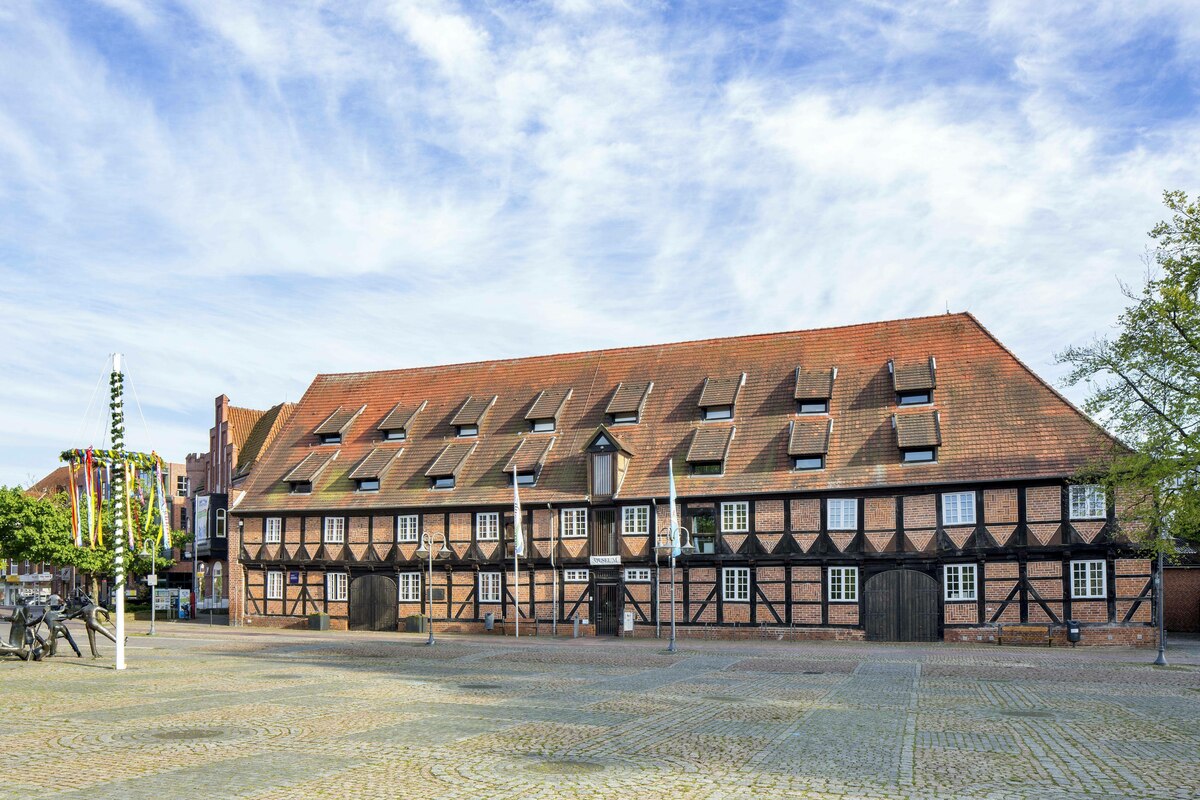
W ies and paths, animals in fields and people doing agricultural work – in the special exhibition “With brush, stone and pen: artists in the Winsen area” There is a lot of nature to see in the museum in the stables in Winsen (Luhe).
However, among the almost 40 artists on display there are at least four who popularized its ideology during National Socialism (NS) and sympathized with the system. This biographical background is hardly an issue in the exhibition.
“This context would have exploded the concept,” the museum’s press spokeswoman explains to taz on the phone. In conversation it becomes clear: those responsible know the at least ambivalent biographies of Arthur Illies, Hugo Friedrich Hartmann, Erich Wessel and Georg Sluytermann van Langeweyde.
However, the historical context of the artists can only be gleaned from the dates of individual works. However, part of their CV is that they were represented at the “Great German Art Exhibition” (GDK) in Munich, where National Socialist art was presented between 1937 and 1944. The opened one day after the opening “Degenerate art” in the Bavarian state capital, with which the verfift modern art should be discredited.
What is the context of the artist and the work? Can or should aesthetics be viewed separately from life?
The artists shown in Winsen were not only present in Munich: Wessel was a member of the Reich Chamber of Fine Arts. In 1939, Hartmann received the “Low German Painter’s Prize”, which was donated by the Gauleiter of East Hanover, Otto Telschow. The district honored Hartmann in 1940/41 with a solo exhibition in the Lüneburg Museum.
In 1942, Hartmann and Illies were represented with numerous works in the Gau exhibition “Lüneburger Land – War Tasks of the Fine Arts” in Berlin, sponsored by Joseph Goebbels. Illies took part in the competition for the redesign of the Lübeck Holsten Gate. The design by the painter, who joined the NSDAP in 1933 and was active in the “Battle League for German Culture”, is today exhibited in the museum in Holstentor. Hitler figures and swastikas adorn the walls and ceiling.
The lack of contextualization in Winsen was due to an employee of the Mobile advice against right-wing extremism noticed. Both the ambivalent biographies of the artists during the Nazi era and the sensitive debate about the transition from popular art to ethnic art are repeatedly the subject of specialist conferences and exhibitions. What is the context of the artist and the work? Can or should aesthetics be viewed separately from life?
“Typical style of blood and soil painting”
However, those responsible for the Winsen special exhibition do not pursue these questions. In the works of Sluytermann van Langeweyde alone there is a brief reference to his Nazi context. “We only explicitly pointed this out in the case of Sluytermann,” explains the press spokeswoman in a written statement, as “the portraits of him on display are in the typical style of blood and soil painting. We did not want to leave this uncommented.”
Also because “in the 1970s, Sluytermann was awarded honorary citizenship of Bendestorf and the culture prize of the Harburg district, despite a simultaneous award and undisguised sympathies from right-wing extremists,” said the press spokeswoman.
The taz’s request triggered investigations. The press spokeswoman writes that the context will soon be examined in a lecture. However, she emphasizes again: “The tenor of the exhibition was fundamentally based on the artistic expression and how the paintings differ from one another and can be classified in terms of the painting style and choice of motifs and not on the biographies of the artists.”
But is such a reduction to the aesthetic appropriate when it comes to National Socialism? The museum is now considering possibly presenting a “critical examination” of the artists.