

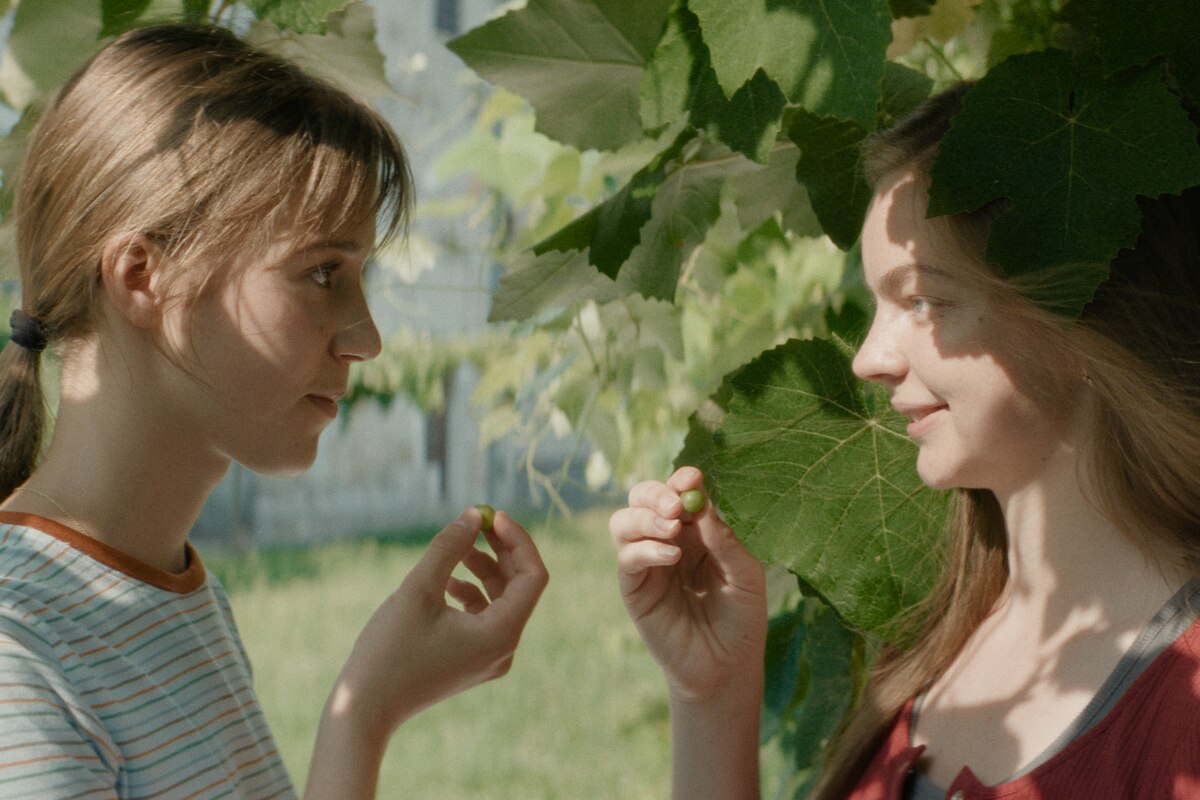
Anyone who remembers youth as a golden age probably hasn’t sat on a school bus in too long. Even before departure, the choice of seat alone can cement hierarchies and give rise to stomach pains. Lucija is spared the latter when she sets off for three days of rehearsals in a northern Italian monastery with the girls’ choir from her Catholic school. The conversations in the clique that the sixteen-year-old recently hooked up with continue to get heated during the journey.
“How long have you had your period?” Ana Maria asks her bluntly. The girl sets the tone in the group because she is the most mature or has the best ability to do so. Lucija, the protagonist in Urška Djukić’s feature film “Little Trouble Girls”, is shyer, more inexperienced and fascinated by Ana Maria. Contrary to what one might expect from the special dynamic on a school bus, she answers honestly: She hasn’t even started her period yet.
Whether she, as a girl with a rather strict upbringing, feels obliged to tell the truth, or doesn’t feel the need to stand up for something school credibility to create a cycle, whether perhaps both are true? Like many things in this strikingly assuredly staged debut, the director leaves this up to interpretation.
„Little Trouble Girls“. Directed by: Urška Djukić. Mit Jara Sofija Ostan, Mina Švajger ua Slowenien/Italien/Croatien/Serbien 2025, 89 Min.
It is clearer what terrain the Slovenian is sending her protagonist into with this journey. Through the bus window, Lucija sees a man standing on the river bank. He is naked, her gaze stops and he looks back. Blank foreshadowing. However, the plot then follows a very unique path to tell the story of this girl’s sexual awakening.
Yes, Djukić abandons a group of schoolgirls far from home and under the eyes of the Virgin Mary in a monastery, where they meet nuns and sweating construction workers. What she makes of it is surprisingly free of nun and construction worker clichés and is less about sex than about sensuality.
More questions than judgments
For Lucija, it will be about no longer perceiving the world and herself through the lens of her upbringing, but rather daring to take a look at it for herself. Sounds easier than it is. If the beliefs you grew up with are Catholic and you also want to make friends, things get a little more complicated. And yet “Little Trouble Girls” seems as if you had been touched by a summer breeze in the grim winter, providing a brief sense of relaxation.
Djukić has cast Lucija with the amateur actress Jara Sofija Ostan, whose slow-paced acting fits well with the reserved girl who has more questions than judgments in her luggage. (Unfortunately, towards the end, this style of acting does less justice to her character’s development.) It’s no coincidence that her ear is the first thing you see of her. As a person who observes everything and only says the bare minimum, she is even more aware of her surroundings.
Even in the opening sequence, the film’s themes and coherent aesthetics skilfully work together: It is the choir rehearsal in which Lucija and Ana Maria meet for the first time, and Lucija’s senses are fully activated. She doesn’t just look at the strange girl, she studies her. Not only hear the Bible text being read, but notice the buzzing of the fly on the chandelier. How strands of hair are wrapped around fingers and text messages are secretly typed.
It happens far too rarely that the sound level in a film receives the same attention as the image. Among the many awards that “Little Trouble Girls” has won so far, at least one was for sound design. You can clearly hear the girls breathing, breathing, and onomatopoeia as they warmly sing. You may not be aware of what this sound reminds you of.
Physical interaction between the girls
The character of Ana Maria is needed to expand the protagonist’s consciousness and advance the plot. That sounds very technical, but it turns out to be far more interesting, as if Lucija had just met the bather from the river bank. The relationship between the girls is complex. It is also not entirely clear whether the attraction between them is only of a friendly nature. Ana Maria explains how you can tell if you are attracted to someone. In an intimate moment she shows her what a real kiss could feel like.
We would like to show you external content here. You decide whether you also want to see this element:

Whether their relationship is queer, as it is about the film that is at the Berlinale 2025 The side series “Perspectives” opened, was called more often, is perhaps not that important. It can also be an expression of the fact that girls are often more physically comfortable than boys of the same age. Getting close is not immediately seen as proof of sexual orientation.
The scenes between the students tell both beautiful and painful things about how complex girls’ friendships can be. Although Ana Maria is an ambivalent character, the relationship between the two is only permanently disrupted by the destructive treatment of the choir director, to whom Lucija confides in her confusion. The cast is also convincing in his role.
The director takes her characters seriously, right down to the nuns. When Lucija asks one of them directly whether celibacy bothers her, the woman answers more freely than the other adults in this story would have managed to respond to the topic. The students are certainly very familiar with social and church expectations. Here Djukić lets them have encounters with spirituality for a change.
Emerging physical desire
What she is less successful in is finding strong images for Lucija’s inner experience. Opening flowers of all kinds are pretty to look at, but seem a little uninspired when it comes to illustrating the burgeoning physical desires of an adolescent. On the other hand: The semi-documentary short film “Granny’s Sexual Life”, with which Urška Djukić became famous, tells of sexual abuse in marriage. Do you want to criticize a few roses that open themselves calmly and without pressure?
We should also briefly recall the defloration comedy “American Pie”, which was a hit in the 1990s, possibly due to the lack of offerings on the subject. The film was primarily told from the perspective of, of course, heterosexual male teenagers who, of course, wanted to sleep with girls or women.
Nevertheless, it was virtually impossible for young viewers to learn anything insightful about female sexuality. If anything, then from the imagined sex lives (uninhibited) of Eastern European exchange students (no matter the country). Women or girls who take care of their desires themselves, as is the case in… „Little Trouble Girls“ sees? This is only slowly becoming common in the cinema, although it is becoming more and more common.
For this contribution to a richer film landscape, one would also like to forgive Djukić for the somewhat confused, rushed ending, which rather clumsily dismisses the protagonist from the plot. The fact that her name is Lucija, the enlightened one, at least gives hope for good things. Perhaps this journey will end for them with the realization that earthly and spiritual joys do not have to be mutually exclusive.