

It should be a special farewell gift. A local specialty that, in the worst case scenario, is the last meal. Sooha (Bella Kim) prepares a fugu, that blowfishwhich is a delicacy not only in Japan but also in South Korea and can be fatal if prepared incorrectly. First she chops off the head, then she cuts the skin on the underside up to the tail fin and pulls it off the fish in one go. The skin and intestines in particular are poisonous. One wrong cut means the difference between life and death.
She cuts the raw, milky-white meat into wafer-thin slices, which she artfully drapes on a plate in the shape of a fan. She serves it with soy sauce and lemon slices. Whether Sooha prepared her fugu correctly remains uncertain. Like so many things in this quiet, complex and unassuming film.
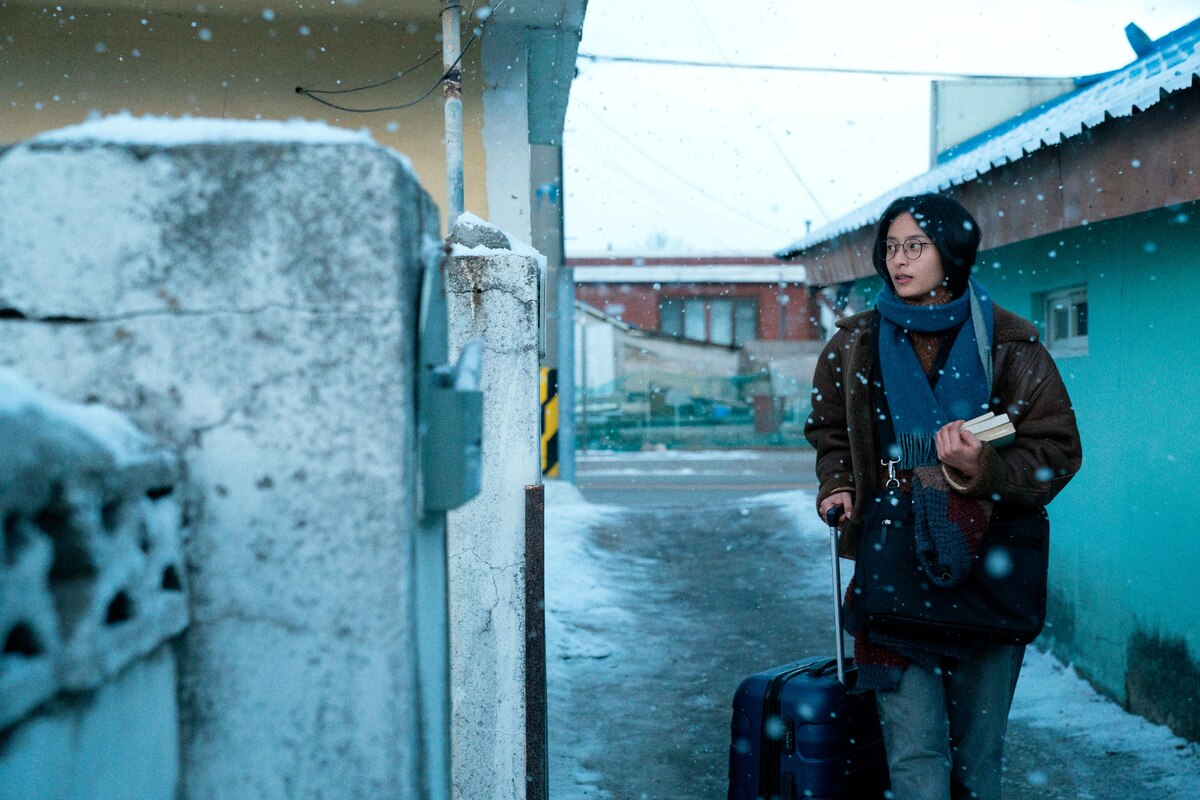
“Winter in Sokcho” is the feature film debut of the French-Japanese director Koya Kamura and is also the film adaptation of the novel of the same name by Elisa Shua Dusapin. Sooha, who is in her early twenties, lives in the eponymous Sokcho, a small coastal town in eastern South Korea. In summer, the city is a popular starting point for hikes in the nearby mountains. During the cold season it seems to hibernate.
“Winter in Sokcho”. Director: Koya Kamura. With Bella Kim, Roschdy Zem and others France 2024, 105 min.
There are hardly any people on the streets, the restaurants seem empty, and only a few guests stay overnight in the guesthouse where Sooha works. In this tranquil town, the young woman leads a quiet and leisurely life, which is one day interrupted by the arrival of Yan Kerrand (Roschdy Zem), a French author and illustrator, is thrown into disarray.
Play with expectations
Koya Kamura makes no secret of why the grumpy guest exerts a great fascination on his protagonist. Sooha has never met her father, a Frenchman. A void in her life. And suddenly this artist, shrouded in mystery, appears and rents the guesthouse for several weeks.
As the film progresses, it could easily follow the topos of a projected surrogate father with all the conflicts that arise. It would have just been an overly maudlin, sentimental and, not least, predictable film. “Winter in Sokcho”, on the other hand, plays with this expectation, only to repeatedly let it come to nothing. His narrative mode is that of omissions and savings.
Sooha’s fascination with Yan is obvious and yet remains mysterious. Is she just expressing a strong desire for a father figure when she secretly watches Yan through the crack of a broken paper window in his room? Is she looking for a way out of the provincial confines in him? Does she even feel sexually attracted to him?
Sooha’s identity, that much is certain, stands on feet of clay. Not just because of the absent father
Sooha’s identity, that much is certain, stands on feet of clay. Not just because of the absent father. There are little moments that Kamura weaves in here and there that point to a self-image that is under attack. The nice street vendor greets Sooha, who is tall by Korean standards, every day “beanpole”. Her mother, a fish seller at the harbor, casually tells her that it’s nice to see how well she eats. But she shouldn’t eat too much either.
Rampant beauty craze
In the traditional bathhouse, which they both go to regularly, Sooha’s gaze repeatedly falls on the older women and their naked, wrinkled bodies marked by the passage of time. And every morning in the guesthouse she serves a grotesque-looking woman who has had her face done and whose head is bandaged all over. The beauty craze that is rampant in South Korea (in the country beauty is seen as a sign of respect) is also omnipresent in the film. Sooha’s boyfriend, an aspiring advertising model with whom she has a rather passionless relationship, suggests that she have an operation. After all, everyone does it.
“Winter in Sokcho” impresses above all with its precise observations and the contemplative and naturalistic narrative style. The abstract animations that are supposed to express Sooha’s inner life just get in the way. Likewise Yan’s figure drawing. He is the cliché of an artistic genius as it appears in the book: aloof, taciturn and cool. A man who doesn’t let anyone look into his (broken) soul.
We would like to show you external content here. You decide whether you also want to see this element:

Sooha’s hospitality (she shows him the city and its surroundings), as one can read from his erratic behavior, is only useful insofar as it serves his new work, which he is working on manically in his little room. On the other hand, he treats her cooking skills (the cooking is excellent in this film) like an ignorant fool.
In the end, Yan is just a guest who comes and goes. Just like winter. Sooha, who stoically defies her feelings, also knows this. Because every darkness is followed by light at some point.