

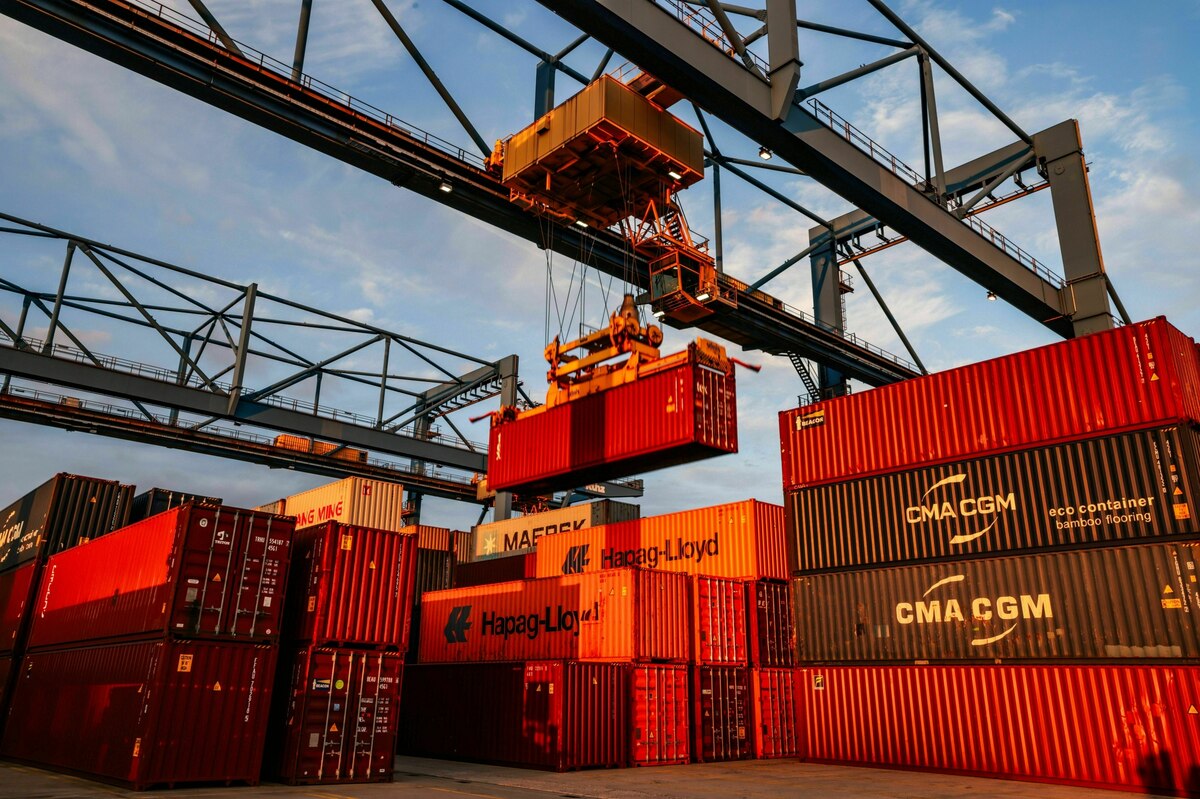
In the fight for better working conditions, the employees of Europe’s largest inland port in Duisburg, together with the Verdi union, are increasing the pressure on their employers – including Duisburger Hafen AG, one third of which belongs to the black-green governed state of North Rhine-Westphalia and one third to the SPD-governed city of Duisburg and is therefore entirely owned by the public sector. They are demanding the conclusion of a collective agreement that will guarantee them better pay and predictable working hours.
But the CEO of Hafen AG, Markus Bangen, has so far rejected outright the conclusion of a collective agreement, which is actually a given in Germany’s social market economy. His company had “not received any feedback from employees that there was interest in union support/representation,” the CEO announced in the local section of the in November West German General Newspaper – and apparently nothing has changed in this position so far.
Even the one from Duisburg had it SPD chairwoman Bärbel Bas responded to a taz request In response, they warned that “collective agreements” are “a core part of our social market economy” that ensures better wages and working conditions. As Federal Minister of Labor and Social Affairs, she is “convincedly committed to strengthening collective bargaining in Germany”.
At two of the companies operating in the port, the Hafen AG subsidiary duisport logistics&port services GmbH (DLPS) and Rhenus Logistics, the employees have therefore elected collective bargaining committees with Verdi support. “Today is the day on which an official request for collective bargaining is made to employers,” said union secretary Sören Brandes late on Monday afternoon at a press conference at the headquarters of the German Trade Union Confederation DGB in Duisburg.
“Our wages are far too low”
How necessary it is to conclude collective agreements in the port of Duisburg was made clear by employees who had the courage to be elected to the collective bargaining committees and to fight for their rights with real names despite feared repression by employers: “Our wages are far too low,” says Jerome Kicka, for example.
In some cases, the employees received net wages of just 1,800 euros per month for a 40-hour week of hard work on the harbor edge, they complain. “We forget that we are outside in snow, hail, rain and heat and keep the logistics running,” says port worker Jörg Duckert. “Port is backbreaking work.”
Today there is a “nose principle” in companies, explained collective bargaining commission member Günay Al. Without a collective agreement, employees are forced to negotiate their wages individually with employers: “Those who can sell themselves well get more money than others.” The Rethmann Group, to which Rhenus belongs and which is privately owned by the family that gives it its name, reported a profit of 713 million euros in 2024 alone, said union secretary Brandes.
In addition, there are constantly changing, unplannable working hours, criticized Christoph Maas, also a member of the collective bargaining committee. A so-called continuous shift system is already planned, in which two days of early shifts are to be followed by two days of late shifts and two days of night work. But he “only finds out on the 28th of the month when I should work from the 29th – and then it is changed 15 times,” says Maas angrily. “I have no planned shifts, no system, no regularity. This is poison for the body – and the families.”
The working conditions that trainee Ayhan Budak describes sound downright early capitalistic: In his second year of training, he worked unaccompanied without an instructor as a crane operator and forklift driver, but also drove large container forklifts called “stackers”. “In the late shift, I’m the last person to lock up the company. I’m completely alone on the premises without a dead man button,” says the 24-year-old, who is training to become a port logistics specialist. The training allowance paid for this is “less than 800 euros net”.
Employers now have until May to negotiate “in peace” with employees, explains union secretary Brandes. But if they don’t move, “an industrial dispute cannot be ruled out.” The union is still trying to avoid strikes, warned his colleague Niels Holger Schmidt, who at Verdi is responsible for the transport company on the Lower Rhine, which includes the Duisburg port. “We are not seeking conflict,” says Schmidt. “But if there is a conflict, there is a conflict.”