

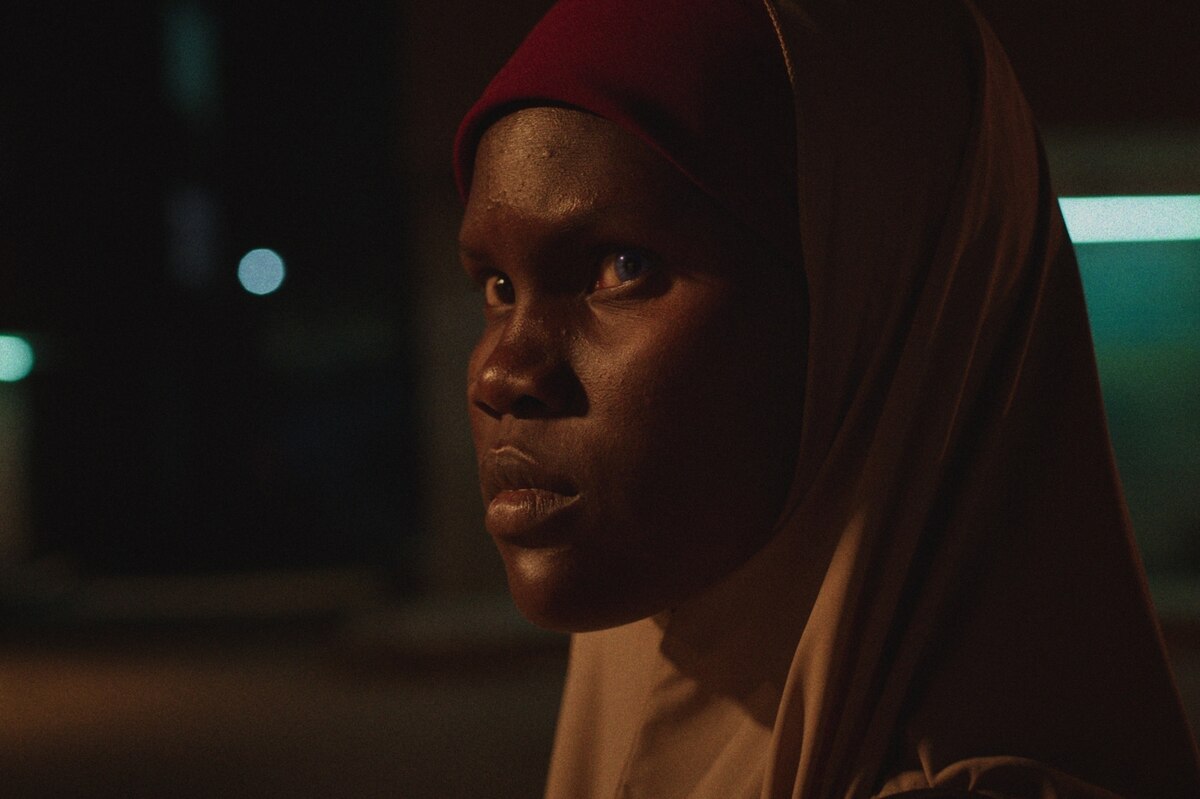
This is not what is called travel, but rather labor migration: The young Sudanese woman Aisha (Buliana Simon) has come to Egypt to work as a caregiver. She sends what she earns to her family, who are suffering from the civil war in Sudan. Accompanied by the constant traffic noise of a busy, dusty district in Cairo, Aisha helps old people in empty apartments, cleaning, feeding, giving injections and lying alone on the bed of her shabby apartment in the evenings.
She accepts the fact that the neighborhood gang led by the manager of this apartment, the small-time gangster Zuka (Ziad Zaza), is dealing drugs outside her window, just as calmly as the unfair treatment that she and her colleagues generally experience. Even meeting the cook Abdoun (Emad Ghoniem), who occasionally prepares food for Aisha, doesn’t seem to change her quiet loneliness.
And it gets even worse: Zuka forces Aisha to give him access to her clients’ apartments in order to break in. Even when Aisha’s employer suspects her, Zuka continues to threaten her. Shortly afterwards, a strange rash spreads across Aisha’s body. But it is only when Aisha’s new client, Mr. Khalil (Mamdouh Saleh), begins to sexually abuse her that Aisha seems to become aware of the downward spiral in which she is trapped.
„Aisha Can’t Fly Away“. Director: Morad Mostafa. With Buliana Simon Arop, Ziad Zaza and others Egypt/France/Germany/Tunisia/Saudi Arabia/Qatar/Sudan 2025, 120 min. (Film release January 15, 2026)
The programmatic title of Morad Mustafa’s debut film “Aisha Can’t Fly Away” conveys the gravity and desperation in which his heroine is: Aisha cannot fly away. It is clear from the start that she is stuck at the bottom of every staircase – as a black, poverty-stricken migrant, as a woman, as a stranger without friends or relatives.
Buliana Simon’s closed face, which is very special due to iris heterochromia, remains almost immobile in the film – the Egyptian director only lets her laugh once when she eats dinner with other Sudanese women and is able to take off the heaviness of everyday life, the circumstances and also the dark hijab for a short time. But this flash of alternatives, of solidarity, friendship, happiness, is immediately wiped away by the violence on the streets and in everyday life, and by Aisha’s enigmatic and threatening general condition.
Observe injustices
Morad Mustafa’s film can be read as a necessary and relevant plea against intersectional exploitation, violence and misogyny. On the other hand, the distance to his protagonist remains too great, her drawing is too one-sided, the problems are too cliche. Also the body horror Her feverish dreams, through which a (flightless) ostrich haunts like an alter ego, do not change Aisha’s actions in the real world.
Perhaps the director intentionally maintains the distance so as not to become offensive to his main character. However, the long, sometimes redundant observation of injustice alone does not create enough empathy: one would like to hear more clearly what Aisha thinks and feels; what she has experienced and hopes to experience.
We would like to show you external content here. You decide whether you also want to see this element:

After all, not letting someone express their desires in the first place has almost the same effect as denying them. The “action” that leads to a – small – change at the end of the long film can only partly be attributed to self-empowerment. Aisha doesn’t really get active.
“Aisha Can’t Fly Away” still manages to create haunting visuals, such as the poster motif: Aisha wears a superhero mask over her hijab while quietly playing hide-and-seek with a client’s child, which seems like a comment on the title. A superhero like that, a Catwoman like that, would definitely extend her claws.