

The majority of birthday shows simply call her Paula. That might sound clumsy confidential, but then again, that’s what we mean Giotto just Giotto and Rembrandt only Rembrandt. And in order to celebrate Paula Modersohn-Becker’s 150th birthday, it is more practical to put the double name aside: “Happy Birthday, Paula,” is what exhibitions in Fischerhude, Bremen, Worpswede and Dresden are currently saying, there are at least seven of them.
“Women don’t have surnames,” says Marie Darrieussecq in her fine portrait essay “Being here is wonderful” about Modersohn-Becker in 2014 with gentle mockery. But Paula had also written herself out of the line of fathers: in a letter to Rainer Maria Rilke during her last stay in Paris in 1906, she told Rainer Maria Rilke that from then on she did not want to be Becker’s superior daughter or Modersohn’s wedded wife. But just herself: “I am me,” she writes, like Rimbaud, only in reverse, and that she hopes to “become more and more like that.”
It’s about independence. It doesn’t matter that the bonds she has to get rid of are made of love. Paula’s parents – railway engineer Carl Woldemar and Mathilde Becker née von Bültzingslöwen – do not understand her, but they support her. Her husband, the established painter Otto Modersohn, is her enthusiastic fan. And even when she briefly leaves him in 1906, he faithfully continues to finance her.
At the same time, probably no woman of her time claimed her right to her own independent existence as an artist more naturally than Paula. It seems strange that the State Art Collections in her native Dresden are giving her Edvard Munch, whom she had zero interest in, for her birthday.
The woman inventor
One might almost suspect that this was an unconscious attempt at art-historical taming by the solitary painter, who called Diane Radycki “the first modern woman artist”. the first modern female artist. The American art historian is serious, and she has not forgotten either Käthe Kollwitz or Berthe Morisot.
She bases her thesis on the basis of the work. She considers the nude pictures that can be seen in the Paula Modersohn-Becker Museum on Böttcherstrasse in Bremen to be crucial: Of course, what is important is the famous “Self-Portrait on the 6th Wedding Anniversary,” which is considered the first female self-nude in art history.
But even more than that, Radycki refers to the monumental, intimate depiction of the lying mother and her baby, far removed from any Mary with the Child convention. And the naked village women. It is precisely in the design of these shamefully exposed girls from the poorhouse that Paula reinvents the female body – in contrast to, for example, Morisot’s sexy shepherdess – new beyond the male gaze regime.
I feel that everyone is frightened by me, and yet I have to move on
Paula Becker, letter to her sister Milly, September 1899
Here it is no longer an object, but an autonomous and tendentiously supra-personal composition of shapes, colors and values. Suggested shades do not create buxom volumes. Nothing about these pictures is lovely, not even the children, especially not the children. That’s exactly what makes her such a force, still.
Bremen was the city of Paula’s youth – and is the city of her later fame. The Paula Becker Modersohn House was opened there in 1927, barely 20 years after her early death. It is the first museum dedicated to a female artist. Together with the Paula Modersohn-Becker Foundation, it has the largest collection of her works.
From this, an exciting retrospective has been arranged, enriched by rarely exhibited loans and clever accents of today’s reception. Under the title “Becoming Paula” it allows you to explore the paths of creation. She does not miss the first steps in art lessons that teenager Paula receives in London and Berlin, nor the surprising academic revivals in her late work.

Large-scale intimacy: A mother lies with her baby on a white cloth, painted by Paula Modersohn-Becker in Paris 1906
Bild:
PMBM
Art is sausage
That makes sense. Because a mass of popular writings and films has made Paula’s work known, but very often invisible. Pressed into the linear developmental logic of a life story like meat into a sausage, the individual paintings serve at best as dramaturgical pieces of bacon in this way of reception. In the Bremen synopsis, however, they appear as protagonists of a unique artistic search movement.
This is not the case in the artist village of Worpswede near Bremen, made famous by Rilke. You have to go there: “This is also where Paula moved,” recalls Beate Arnold, who runs the Heinrich Vogeler Museum Barkenhoff.
And it’s true. Most of her 734 paintings were created in the peat cutting town in Teufelsmoor. Here she married Otto; and yes, she enjoyed living here. She also died here in 1907 at the age of 31, which is why sculptor Bernhard Hoetger immortalized her in the Zionskirch cemetery in 1919 with an ugly gravestone.
“Becoming Paula – London Berlin Worpswede Paris”. Paula Modersohn Becker MuseumBremen. Until September 13th. Catalog (Hirmer): 35 euros
“Paula Modersohn-Becker and Edvard Munch. The big questions of life”. AlbertinumDresden. Until May 31st. Catalog (sandstone culture): 25 euros.
“Paula Becker – Paula Modersohn Becker: The landscapes”. Otto Modersohn MuseumFischerhude. Until May 24th.
“Impuls Paula”. Museums Barkenhof, Haus im Schluh, Great Art Show and Art Gallery, Worpswede. Until November 1st.
And the reception of this painter continues to decline, despite world auction records – for a German modern artist – and Exhibitions in New York, Chicago or Paris back into the regional confines of the northwest German heath and moorland landscape.
You can book the “in Paula’s footsteps” package there, which includes breakfast from the gourmet buffet and entry to the four local museums. You market heterogeneous exhibitions under the title “Impuls Paula”. However, these only bind the celebrant with the help of elaborate curatorial lyrical chains of associations: This makes them seem like desperate attempts to get a piece of birthday cake.
Denying perspective is nice
Of course, a community with fewer than 10,000 inhabitants cannot do without Paula as a tourist attraction if it has to keep four museums running. The only thing missing here is Paula’s works: widower Otto had taken the paintings that had not gone to Bremen or to the collector August von der Heydt in Wuppertal with him to Fischerhude, 20 kilometers south.
After Paula’s death, he made a new start there in the summer of 1908. And there, in the Otto Modersohn Museum near the Wümme, there is the most concentrated anniversary exhibition. In a brittle matter-of-fact way it is called “The Landscapes”, and at least 32 of these works can be seen, according to curator Rainer Noeres, more than ever before in an exhibition.

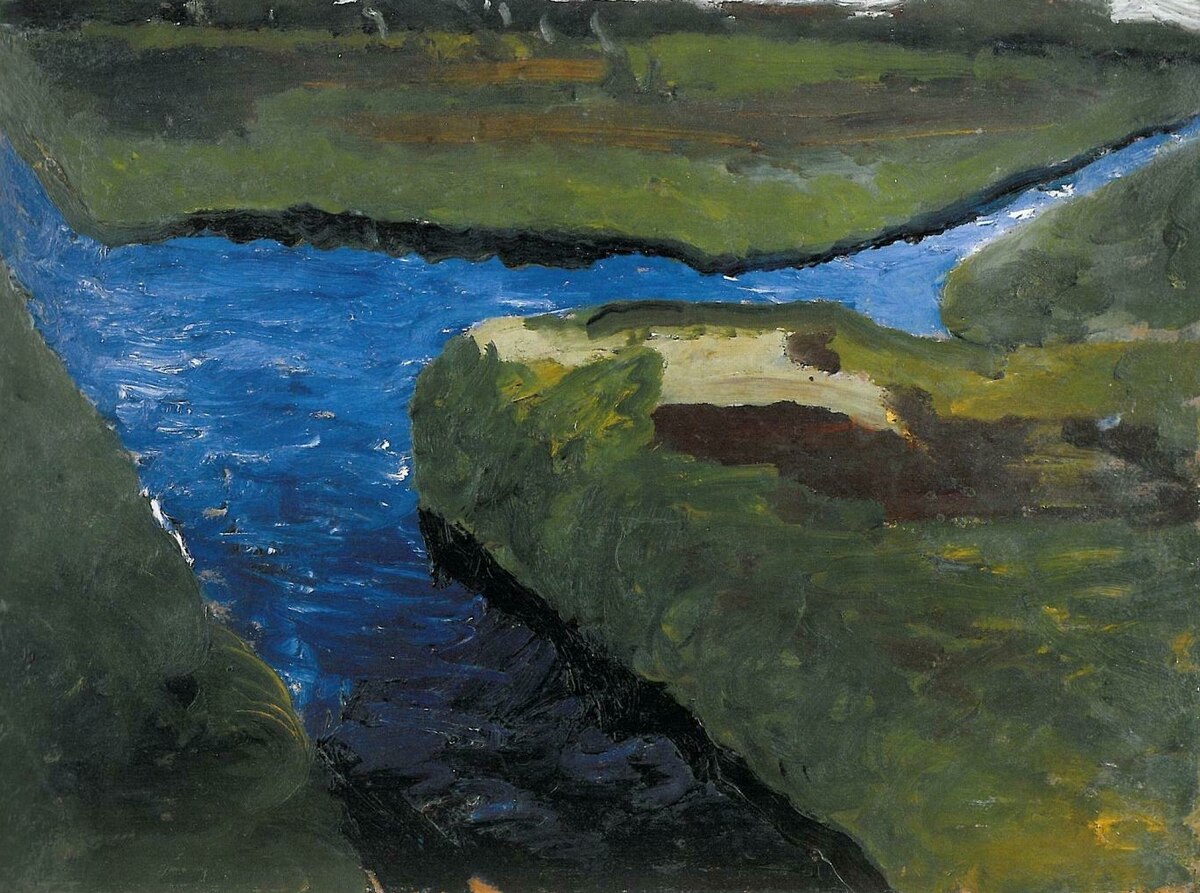
No background, no perspective: Paula Modersohn-Becker’s Moorgraben is an anti-landscape
Photo:
Paula Modersohn-Becker Foundation
They are shown less often. Yet landscape served everywhere where painting pushed into modernity, with Piet Mondrian, Wassily Kandinsky, bei Hilma of Klintand, why not, also with Munch as a crucial field of experimentation.
Paula’s landscapes neither follow the desire to stuff one’s own soul into space, nor do they obey the realism doctrine that prevails in Worpswede.
They often, sometimes even energetically, deny the impression of perspective by cropping the image: instead of the background and foreground, a rich blue-green with black admixtures dominates at the edges of the image, at the bottom right as a projection, at the top across the entire width as a slanted rectangle and at the left as a crooked wedge.
In between there are narrow, irregular surfaces onto which wild brush strokes have splashed pasty blue, plus a few dirty white ripples. The catalog raisonné invites us to see this anti-landscape as a moor, and that must be true: after all, there were no abstract paintings in 1900, and Paula did not pursue this path.
“I feel,” she wrote in 1899 in reference to her goals as a painter, which were alien to her, “that everyone is frightened by me, and yet I have to move on.” This urge is still expressed here. It still touches you today. So there is every reason to celebrate him.