

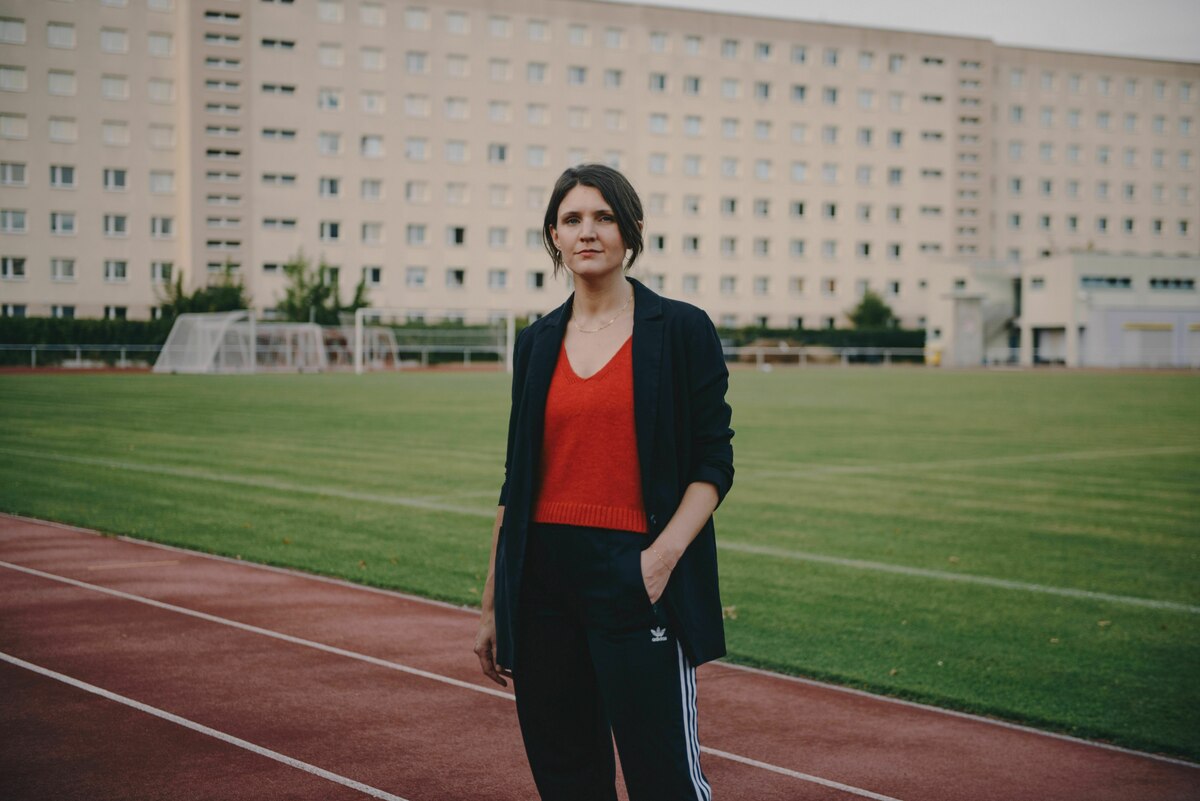
taz: Ms. Keßler, on Friday you will be talking to other writers Literary Colloquium Berlin about the topic of strength training. The heroine of your novel “Gym” initially seems to be just looking for an undemanding job and ends up in the gym, of all places. What interested you literary in this supposedly unpretentious place?
Verena Keßler: Well, first of all, I found it exciting that this didn’t exist before. At least not in that form yet. Until then, I had never heard of a novel that was set almost exclusively in the gym, even though that is an important place in many people’s everyday lives. It also appealed to me to be able to create the text there like a chamber play because it is a closed room with a relatively clear staff. I found the fact that the characters seem to be far removed from the literary world, for example in the way they speak, to be a nice challenge.
taz: At first, your heroine just makes fun of this world. For her, the gym is just a place where she feels like a foreign body. Why?
Kessler: My protagonist comes from a world in which one makes a name for oneself through intellectual achievement, and with her education and intelligence she has come a long way. Suddenly that doesn’t matter in the gym anymore, which I found appealing. It’s also interesting for storytelling when the character has an outside perspective on the world they’re in, because that’s how it describes what’s special about it.
In the interview: Verena Keßler
The book
Verena Keßler’s novel “Gym” was published in 2025 by Hanser Berlin, 192 pages, 23 euros.
The author
Verena Keßler, born in Hamburg in 1988, lives in Leipzig. Her novel “Eva” about four women with very different attitudes to the subject of motherhood was published in 2023. In 2020, her debut novel “The Ghosts of Demmin”, which deals with the mass suicide in the small Pomeranian town in the spring of 1945 when the Red Army took over the place.
The event
On January 16th From 7.30 p.m. at the Berlin Wannsee Literary Colloquium at Sandwerder 1, Verena Keßler will be talking to Selma Kay Matters and Res Sigusch, among others, about their books “Muscles made of Plastic” and “Reasonable Fears”, about fitness as armor, sport as self-optimization and the shift in stereotypical gender stereotypes in the gym. (sm)
taz: The lie that she had just become a mother emerged very early on – out of shame about her own body and the feeling of being too fat for this world. Is this white lie more of a protective mechanism for her or is it the first step towards self-entanglement?
Kessler: So actually she’s not that ashamed of her body. But the moment it’s pointed out to her that she doesn’t fit in well the way she looks, she can’t handle the criticism. She has a problem admitting weaknesses. So it provides a reason against which nothing can be said. She doesn’t think that maintaining this lie could be a problem. She thinks she’s smarter than everyone else and thinks she can handle this little task of convincing people that she has a child on the side.
taz: Motherhood is one of the two great ideals of femininity. Why this alibi of all things?
Kessler: For me it was the most obvious thing. So perhaps the only time when it’s socially acceptable to have a belly is shortly after giving birth, where there’s really no one to criticize it, at least for a short period of time. It came instinctively when I was writing and perhaps it comes instinctively for the character as well. When I came up with it, I wasn’t quite sure what I could do with it.
taz: I don’t even know if I can believe that! Because then everything basically fits together better and better. How she starts training. How she becomes more and more addicted to it. With the bodybuilder Vick, a completely different body ideal finally emerges. Does she represent an opportunity for the narrator to leave stereotypical images of femininity behind – or just a new, equally rigid norm?
Kessler: I thought about it relatively early on that a female bodybuilder would play a role, even if I didn’t know what it was from the start. And it’s not immediately clear in the book; fascination and attraction eventually turn into competition. Vick is a person who doesn’t fit in at all with what is usually expected of women. She is neither a mother nor does she have a body that is considered particularly attractive in the conventional sense. She just created a very unique self. And of course the protagonist finds that attractive because she has never really come to terms with the usual images of femininity.
taz: It is implied that your protagonist was broken in her first career by social differences – by a competitor with scholarships, impeccable education, an international lifestyle. What role does class background play in this failure and then perhaps also in the fascination with the gym?
Kessler: I think it plays a big role in their ambition above all else. That she wants to make something of herself, that she wants to be particularly successful in order to leave her origins behind her. And that she also constantly has this fear of falling back again because she doesn’t naturally belong in these higher circles. She worked for it. And her affiliation always depends on the performance she provides. That’s why she’s so stubborn. The gym, on the other hand, may be a foreign place to her, but the people there are actually much closer to her than she might think.
taz: She actually likes these people too?
Kessler: At least some (laughs). For example, the studio owner’s sister, who she would actually like to be friends with if she had the ability to be friends with anyone at all.
taz: The more the narrator gets into discipline and training, the weirder – and at the same time scarier – the text becomes. Was humor a means for you to make this loss of control visible?
Kessler: The humor only came in when I was writing. This works well in this world, where things are often incredibly serious, as long as the protagonist doesn’t take it all too seriously. But the moment her own attitude changes, it veers into something else, then it becomes less funny and instead a bit gross and horror-like.
taz: In the end, all this tension erupts into a kind of frenzy of violence. Is this more of an escalation or a logical consequence of the excessive self-optimization mania?
Kessler: I think the escalation is the logical consequence because this character has no internal brake. Well, because it won’t stop on its own. Because it is so one-dimensionally fixed.
taz: Today, many young people see the gym very differently than the heroine of your book: not as a place of self-discipline, but as a social place after Corona, perhaps also as a counterspace to social media. For you, does this reading contrast with the world of “Gym” – or does it complement it?
I believe the gym can be both a lonely place for self-optimization or a social meeting place
Kessler: I believe the gym can be both a lonely place for self-optimization or a social meeting place. From my personal observation, many people tend to train for themselves and that is certainly what makes this sport so popular. You can just go when it suits you and you don’t have to conform to anyone else, which is of course much easier to integrate into your everyday life than, for example, team sports. But I also see people meeting there, giving each other help with exercises or having a drink together afterwards. So, I think people go to the gym for very different reasons. Somehow everything is there.
taz: Has it perhaps become a place that has become more cross-class?
Kessler: Might be. But you also have to say that there are very different studios and price ranges (laughs).
taz: That’s true, of course. Nevertheless, I notice that young people do sport with less pressure to perform and more as self-care, where you can stop if it starts to hurt without being laughed at.
Kessler: I think this is very individual. But I don’t have the impression that pressure to perform and the desire for self-optimization don’t play a role for young people, on the contrary. The entire gym world takes place very much on social media, and anyone who is there has a lot of opportunity to compare themselves and chase after ideals and body trends.