

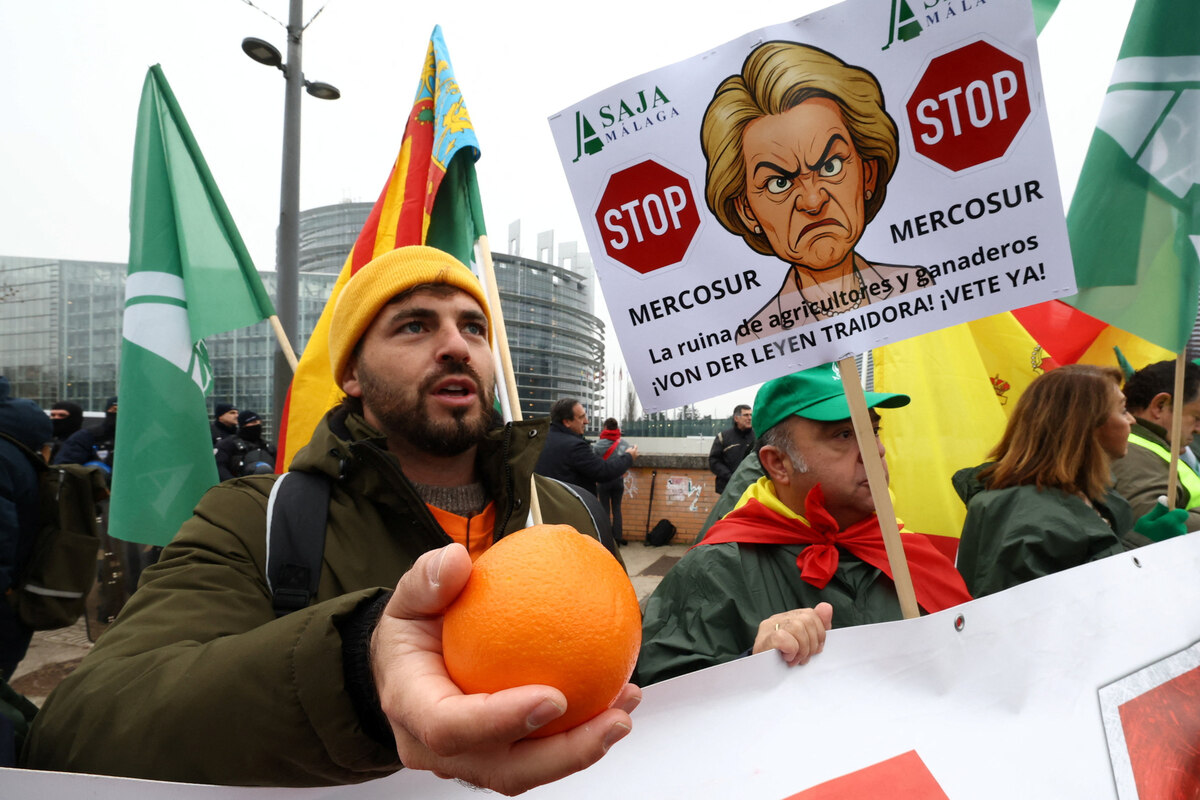
Serious setback for the EU Commission and the European export industry: The European Parliament has questioned the new, “historic” free trade agreement with the South American Mercosur states and slowed down.
Just a few days after the agreement was signed in Paraguay, MEPs appealed to the European Court of Justice (ECJ) to have the deal reviewed for its compatibility with EU law. This is likely to delay ratification by many months.
Chancellor Friedrich Merz (CDU) wants to prevent this. There should be “no more delays,” Merz wrote on
The left-wing faction in parliament submitted the application for review by the EU court – on the grounds that it was about democracy. It was approved with an extremely narrow majority: 334 MPs voted in favor, 324 against, and 11 abstained.
The EU Commission and the Federal Government had until recently sought approval and tried to prevent the matter from being referred to the ECJ. In view of US President Donald Trump’s new tariff threats, Mercosur is indispensable for Europe, it was said.
In contrast, left and green, but also right-wing populist MPs on legal issues and ecological and economic problemsthat duty-free trade with South America could cause. There are critics in all parliamentary groups.
The right-wing Rassemblement National from France has even submitted a vote of no confidence against the EU Commission and its boss Ursula von der Leyen (CDU) because of Mercosur. This is the fourth attempt to overthrow von der Leyen; but he is not given any chances.
The reactions to the renewed delay in the agreement, which the EU has been negotiating with the Mercosur states for more than 20 years, were unusually emotional. MEP Niclas Herbst (CDU) spoke of a “devastating signal”.
The EU’s reliability has suffered “serious damage,” said Herbst. SPD MEP Udo Bullmann was also frustrated. The delay was irresponsible, he said: “I hope the ECJ works quickly and brings Parliament back into the game.”
The co-chair of the Left, Martin Schirdewan, spoke of a “big victory for us and everyone who fights for workers’ rights, consumer protection and environmental protection”. Green MP Anna Cavazzini also welcomed the appeal to the EU court.
The core of the dispute revolves around the question of whether the EU Commission can override the member states and their parliaments. The crucial trade part of the Mercosur deal is considered an “EU-only” agreement. It does not require ratification by the 27 member states.
The entire agreement was adopted by a qualified majority. Germany and Italy were in favor, France, Poland, Ireland and Austria were against it. Nevertheless, the customs barriers are to be removed in all 27 countries; the national parliaments have no say.
This is primarily why the European Parliament has stepped on the brakes. However, a new democratic problem is now emerging: the EU Commission could apply the agreement provisionally – without waiting for the ECJ and ratification by the EU MPs.
The Brussels authority said the decision had not yet been made. The EU Treaty basically allows such a possibility. In fact, several European free trade agreements are being applied without ratification being completed.
The head of the largest parliamentary group, Manfred Weber (CSU), has called on the EU Commission to also provisionally apply Mercosur. The leader of the Liberals, Valérie Hayer, called on the Commission to wait for the EU court’s ruling. Greenpeace warned of a scandalous and anti-democratic decision.
Whatever Brussels decides: the dispute over Mercosur is far from over.